
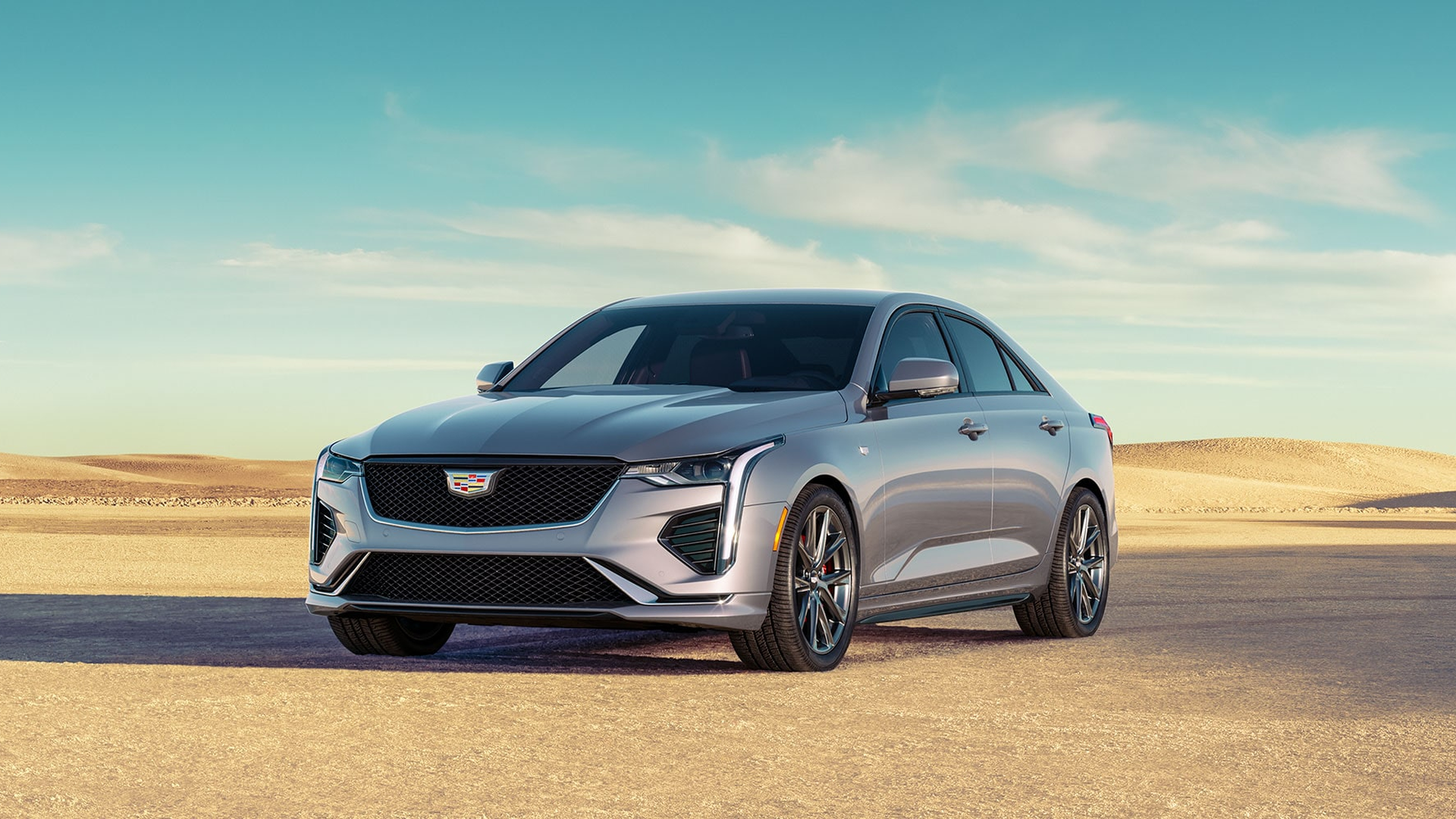
The Alpha Architecture: A Rear-Wheel-Drive Defiance
As the automotive industry entered the 2020s, a disturbing trend emerged within the compact luxury segment: prominent European manufacturers began abandoning traditional longitudinal, rear-wheel-drive architectures in favor of cheaper, transverse, front-wheel-drive platforms for their entry-level sedans. The Cadillac CT4 explicitly rejects this mechanical compromise. Debuting for the 2020 model year as the direct successor to the ATS, the CT4 proudly retains the second generation of General Motors' legendary Alpha platform. This specific engineering decision guarantees that the CT5's smaller sibling retains the pure, uncorrupted driving dynamics demanded by true automotive purists.
To keep the curb weight aggressively low without sacrificing structural rigidity, the Alpha unibody relies heavily on advanced high-strength steel and strategic applications of aerospace-grade aluminum. During assembly, robots apply extensive structural adhesive along the primary weld seams. This aerospace bonding technique creates an immensely stiff chassis. Because the core unibody entirely refuses to flex during heavy lateral cornering, the suspension components can operate with mathematical perfection. This absolute structural integrity allows the steering wheel to transmit immediate, unfiltered feedback directly from the front tire contact patches to the driver's hands.
By stubbornly retaining a true rear-wheel-drive layout in a segment increasingly dominated by front-wheel-drive compromises, the Cadillac CT4 ensures that steering inputs remain completely isolated from the corrupting influence of torque steer, preserving the holy grail of pure sport sedan dynamics.
Suspension Kinematics: The Double-Pivot Strategy
Achieving razor-sharp turn-in response requires highly specialized front axle geometry. The CT4 utilizes a modified MacPherson strut front suspension featuring a double-pivot lower design. Instead of a single lower control arm, two separate links connect the steering knuckle to the subframe. This creates a virtual steering axis that sits closer to the true center of the front wheel. This specific geometry physically reduces the scrub radius, allowing the sedan to initiate sharp directional changes instantaneously while remaining completely stable during heavy, high-speed panic braking.
The rear of the CT4 is anchored by a complex five-link independent suspension. The five physically separate steel links manage vertical wheel travel and lateral toe control independently. When the driver attacks a sweeping off-ramp, the multi-link setup forcibly keeps the rear tires planted flat against the asphalt. This prevents the rear end from stepping out unpredictably over mid-corner bumps, providing the driver with immense confidence to aggressively apply throttle long before reaching the absolute apex of the corner.
Propulsion: The LSY Twin-Scroll Core
The foundational engine for the standard CT4 is the 2.0-liter LSY turbocharged inline-four. Cast completely from lightweight aluminum to minimize critical mass over the front axle, this engine utilizes high-pressure direct fuel injection and dual overhead camshafts. To completely eradicate the sluggish throttle response associated with older turbocharged engines, engineers utilized a twin-scroll turbocharger mounted directly to the cylinder head. The exhaust manifold routing is physically separated, preserving exhaust pulse kinetic energy and spooling the turbine wheel instantly the moment the driver demands acceleration.
The LSY integrates a highly complex tripower valvetrain system. The camshafts physically slide to engage three distinct operating profiles: high valve lift for maximum airflow during heavy acceleration, low valve lift for optimized efficiency during steady-state cruising, and Active Fuel Management. Under extremely light aerodynamic loads, the ECU physically deactivates two of the four cylinders, allowing the CT4 to operate seamlessly as a two-cylinder engine to drastically maximize highway fuel economy.
2.0L LSY Turbocharged Engine Specifications
- Engine Block Architecture
- Inline 4-Cylinder, Aluminum Block and Cylinder Head
- Displacement
- 1998 cm3
- Valvetrain
- Dual Overhead Cam, Tripower variable valve lift, Active Fuel Management
- Peak Horsepower
- 237 hp @ 5,000 RPM
- Peak Torque
- 258 lb-ft @ 1,500 - 4,000 RPM
- Transmission
- Hydra-Matic 8-Speed Automatic
The L3B Dual-Volute Turbo: Massive Mid-Range Punch
For buyers demanding a significantly more aggressive threat level, Cadillac offers the 2.7-liter L3B turbocharged inline-four, standard on the V-Series and available on the Premium Luxury trim. Originally engineered for the Chevrolet Silverado pickup truck to move heavy payloads, this large-displacement four-cylinder generates an absolutely massive wave of low-end torque.
The technological centerpiece of the L3B is its unique dual-volute turbocharger. Unlike a twin-scroll design, the dual-volute architecture physically separates the exhaust gas routing all the way down to the turbine wheel itself. Exhaust gases strike opposite sides of the turbine simultaneously, completely eliminating turbo lag and generating explosive off-the-line thrust. This engine produces 310 horsepower in the Premium Luxury trim, and is aggressively recalibrated to deliver 325 horsepower and a staggering 380 lb-ft of torque in the CT4-V. Both variants of the 2.7L are mated exclusively to the heavy-duty Hydra-Matic 10-speed automatic transmission.
Kinematic Supremacy: Magnetic Ride and eLSD
The CT4-V deploys General Motors' absolute finest suspension hardware: Magnetic Ride Control 4.0. The physical shock absorbers contain a specialized magneto-rheological fluid filled with microscopic iron particles. Sensors read the road surface topography up to 1,000 times per second. An electromagnetic coil surrounding the damper instantly alters the viscosity of the fluid. The system aggressively stiffens the outside shocks during heavy cornering to crush severe body roll, and softens them entirely to absorb harsh bridge expansion joints on the interstate.
Working in perfect synchronization with the magnetic dampers is the Electronic Limited-Slip Differential (eLSD). Mounted on the rear axle, this hydraulically actuated clutch pack provides true, active torque vectoring. When accelerating aggressively out of a tight hairpin corner, the digital computer clamps the differential, transferring up to 100 percent of available rear engine torque directly to the outside wheel with the most physical grip. This action forcibly rotates the compact sedan around the apex, completely neutralizing inside wheel spin and maximizing corner exit speed.
The Digital Cockpit and Acoustic Engineering
The interior architecture balances intense digital telemetry with tightly tailored luxury craftsmanship. The dashboard features an advanced, high-definition digital instrument cluster that communicates critical vehicle data directly to the driver's line of sight. The central infotainment system utilizes an intuitive touchscreen interface running natively on Google Built-in, providing seamless access to Google Maps, Google Assistant for natural voice commands, and flawless wireless Apple CarPlay and Android Auto integration. To preserve ergonomic sanity, Cadillac strictly retained physical, tactile climate control buttons, preventing the driver from navigating complex touch menus at high speeds.
Cadillac acoustic engineers approached the CT4 cabin as a dedicated sound studio. Thick acoustic-laminated front glass and specialized liquid-applied sound deadener injected directly into the floor pan channels create a remarkably silent rolling environment. The premium Bose audio system features advanced Active Noise Cancellation, physically neutralizing the low-frequency rumble of concrete highways by broadcasting precise opposing acoustic frequencies through the cabin speakers.
Super Cruise: Autonomous Highway Mastery
Protecting the occupants requires a massive suite of ADAS hardware. The CT4 acts as a rolling digital sensor net, integrating high-resolution radar, ultrasonic sensors, and external optical cameras. The crown jewel of this technological arsenal is the available Super Cruise system. Operating as the industry's premiere true hands-free driving technology, Super Cruise relies on highly precise LiDAR map data spanning hundreds of thousands of miles of divided interstates.
When engaged, the vehicle autonomously manages rapid acceleration, aggressive braking, and pinpoint lane-centering. It can even actively execute autonomous lane changes to pass slower-moving traffic without any physical input from the pilot. An infrared camera firmly mounted on the steering column constantly monitors the driver's eye movements and head position, ensuring strict human attention remains on the road ahead.
The Blackwing: A Violent Apex Predator
The CT4-V Blackwing entirely transcends the standard compact luxury segment, existing as a terrifyingly fast, highly focused track weapon. Engineers completely discarded the standard four-cylinder engines, physically shoehorning a heavily fortified 3.6-liter twin-turbocharged LF4 V6 into the engine bay. Utilizing titanium connecting rods and specialized low-inertia turbochargers, this engine screams to its redline, generating a brutal 472 horsepower and 445 lb-ft of torque.
Power routes exclusively to the rear wheels through either the 10-speed automatic or a heavily reinforced Tremec 6-speed manual transmission featuring active rev-matching and no-lift shift programming. To shed massive kinetic energy, the Blackwing features colossal Brembo brakes and specialized Michelin Pilot Sport 4S tires specifically engineered for this exact chassis. This mechanical violence launches the compact sedan from zero to 60 mph in a blistering 3.8 seconds, securing its absolute dominance over the European establishment.
The Unapologetic American Sport Sedan
The Cadillac CT4 serves as a highly aggressive defense of traditional driving dynamics. By stubbornly refusing to abandon the highly rigid rear-wheel-drive Alpha architecture in favor of a cheaper front-wheel-drive platform, Cadillac preserved the visceral, communicative driving experience that pure driving enthusiasts demand. From the advanced dual-volute turbocharged engine of the V-Series to the reality-bending track performance of the Blackwing, the CT4 provides a masterclass in modern kinetic propulsion. Paired with the autonomous brilliance of Super Cruise and a tightly tailored digital cockpit, the CT4 secures its position as a highly intelligent, intensely capable machine engineered to conquer tight canyons and open interstates with absolute mechanical grace.