
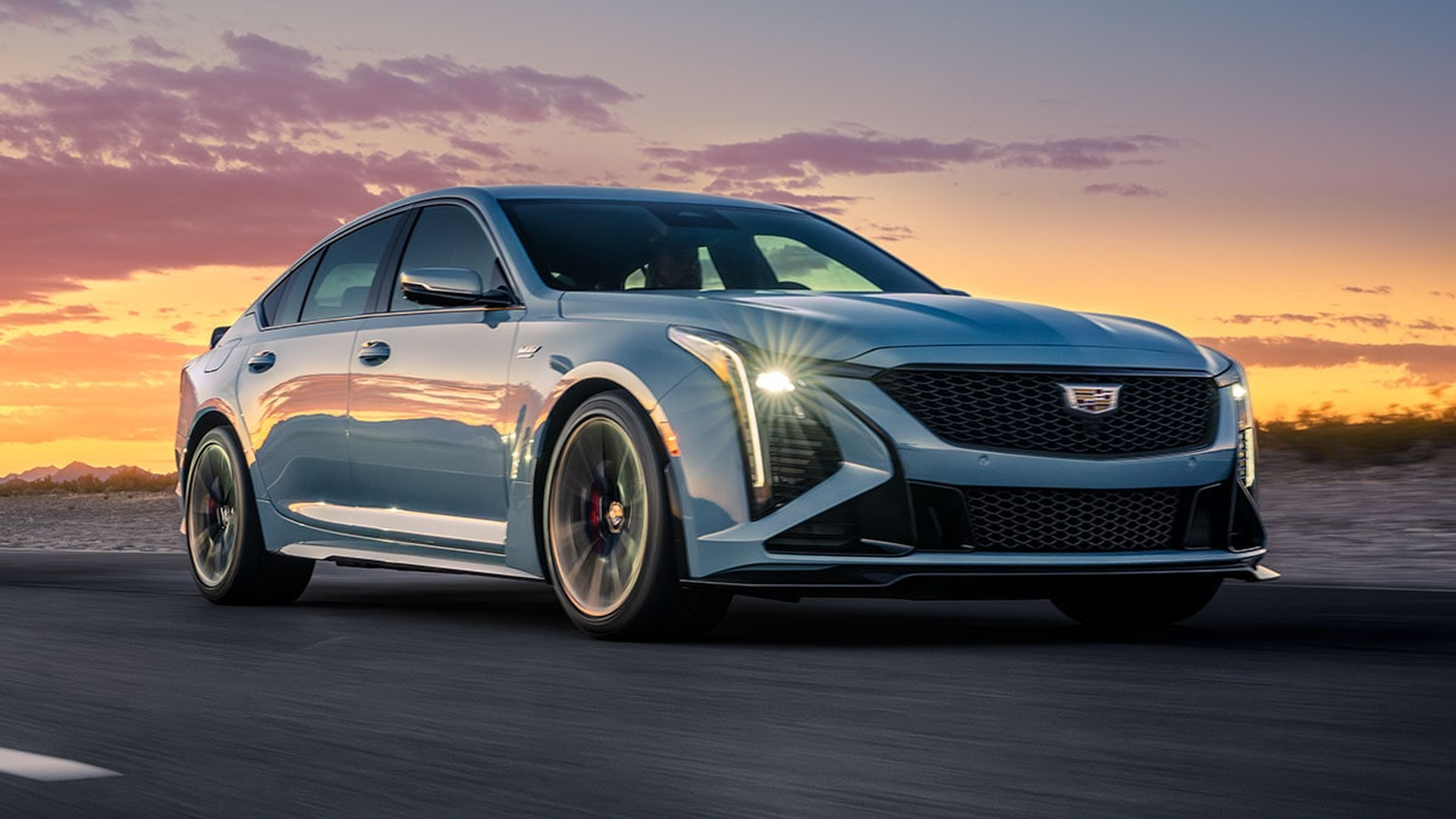
The Alpha 2 Genesis: Recalibrating the Sport Sedan
The Cadillac CT5 arrived for the 2020 model year bearing an immense corporate burden: replacing the critically acclaimed but aging CTS. Rather than simply mimicking the exact dimensions of its German rivals, Cadillac engineers executed a strategic "tweener" sizing strategy. The CT5 occupies a unique physical footprint-priced to compete directly with compact luxury sedans while offering the interior volumetric capacity and stretched wheelbase of mid-size executive cars. This aggressive packaging disruption completely alters the value proposition within the premium segment. Designers discarded the traditional three-box sedan silhouette entirely, utilizing a sweeping fastback roofline that visually pulls the visual weight of the vehicle directly over the rear drive wheels, telegraphing its performance intentions before the ignition is ever fired.
Structural Metallurgy and Chassis Rigidity
The mechanical soul of the CT5 relies entirely on the second generation of the highly lauded Alpha platform, designated internally as Alpha 2. This longitudinal-engine, RWD architecture represents a masterclass in modern metallurgical application and mass optimization. To achieve the unyielding structural rigidity required for high-performance track driving without suffering massive weight penalties, structural engineers deployed a complex matrix of advanced high-strength steel alloys, aerospace-grade aluminum, and ultra-high-strength martensitic steel throughout the passenger safety cage and suspension mounting points.
During the robotic assembly process, the factory supplements traditional spot welds with hundreds of feet of aerospace structural adhesive applied directly along the primary chassis seams. This advanced dual-bonding technique drastically increases the overall torsional stiffness of the unibody shell. A stiffer chassis provides the absolute mechanical foundation for luxury dynamics; because the steel shell completely refuses to flex or twist over broken urban pavement, the independent suspension components can absorb brutal impacts with absolute mathematical precision.
The Alpha architecture was specifically benchmarked against the most rigid European sports cars of its era. Its deployment in the CT5 guarantees that suspension inputs translate into immediate lateral rotation, establishing the sedan as one of the sharpest driving instruments in its class.
Suspension Kinematics: MacPherson and Five-Link Precision
Isolating the passenger cabin from chaotic road surfaces while maintaining razor-sharp steering feedback requires highly sophisticated suspension kinematics. The front axle utilizes a highly modified MacPherson strut design featuring double lower ball joints. This specific dual-pivot geometry creates a virtual steering axis, physically reducing torque steer and scrub radius. This allows the steering wheel to communicate the exact limit of front tire grip directly to the driver's hands without transmitting harsh impact vibrations.
The rear architecture relies on a highly complex five-link independent suspension. The five separate physical steel links allow engineers to tune vertical wheel travel and lateral toe control completely independently. When the driver attacks a sweeping high-speed corner, the multi-link setup keeps the rear tires planted firmly on the asphalt, neutralizing snap-oversteer and ensuring the rear axle follows the exact trajectory dictated by the front wheels.
Propulsion: The 2.0L LSY Twin-Scroll Turbo
The foundational powerplant for the CT5 is the 2.0-liter LSY turbocharged inline-four. Cast entirely from lightweight aluminum to reduce critical mass over the front axle, this engine utilizes high-pressure direct fuel injection and dual overhead camshafts. The technological centerpiece of the LSY is its twin-scroll turbocharger bolted directly to the cylinder head. By physically separating the exhaust gas routing-cylinders one and four feed into one scroll, while two and three feed into the second-the design preserves exhaust pulse kinetic energy. This spins the turbine wheel instantly, entirely eradicating the sluggish throttle response associated with older turbocharged engines.
Engineers integrated a highly complex tripower valvetrain system to maximize thermal efficiency. The camshafts physically slide to engage three distinct operating profiles: high valve lift for maximum power, low valve lift for optimized efficiency, and Active Fuel Management, which completely shuts down two cylinders under light aerodynamic loads to drastically reduce tailpipe CO2 emissions.
2.0L LSY Turbocharged Engine Specifications
- Engine Block Architecture
- Inline 4-Cylinder, Aluminum Block and Cylinder Head
- Displacement
- 1998 cm3
- Valvetrain
- Dual Overhead Cam, Tripower variable valve lift, Active Fuel Management
- Peak Horsepower
- 237 hp @ 5,000 RPM
- Peak Torque
- 258 lb-ft @ 1,500 - 4,000 RPM
The 3.0L LGY Twin-Turbo V6: Escalating the Threat Level
Buyers demanding superior kinetic force upgrade to the 3.0-liter LGY twin-turbocharged V6, available in the Premium Luxury and standard V-Series trims. This compact, power-dense engine features exhaust manifolds cast directly into the aluminum cylinder heads. This specific architecture forces the extremely hot exhaust gases to travel mere inches before striking the twin turbochargers, providing immediate spooling and terrifying off-the-line thrust. To manage the immense thermal load generated by compressing that much oxygen, the engine utilizes a highly advanced water-to-air intercooling system, guaranteeing consistent intake temperatures even during punishing track sessions.
3.0L LGY Twin-Turbo V6 Specifications
- Engine Block Architecture
- 60-degree V6, Cast Aluminum Block and Heads
- Displacement
- 2990 cm3
- Aspiration
- Twin Turbochargers with Water-to-Air Intercooling
- Peak Horsepower (Premium Luxury)
- 335 hp @ 5,400 RPM
- Peak Horsepower (V-Series)
- 360 hp @ 5,400 RPM
- Peak Torque
- 405 lb-ft @ 2,350 - 4,000 RPM
Transmission Technology: The 10-Speed Hydra-Matic
Power from both engines routes through the incredibly robust Hydra-Matic 10L80 10-speed automatic transmission. The massive multitude of planetary gearsets keeps the turbocharged engines locked perfectly within their optimal power bands. A highly aggressive 4.70:1 first gear ratio provides explosive off-the-line acceleration, while three deep overdrive gears drop the engine speed to a near-silent whisper at 80 mph on the interstate. The Performance Algorithm Shifting logic actively monitors steering angle, lateral g-forces, and throttle position. If the digital computer detects aggressive canyon driving, it completely alters the shift map, holding gears through corners and executing perfectly rev-matched downshifts the exact moment the driver applies heavy braking.
All-Wheel Drive and Electronic Torque Vectoring
While the CT5 is inherently a rear-wheel-drive machine, Cadillac offers an advanced AWD system for buyers navigating severe winter climates. This active transfer case continuously monitors wheel slip, steering angle, and vehicle yaw rate. During dry, straight-line highway cruising, the system biases nearly 100 percent of engine torque to the rear wheels to preserve the traditional sports car feel and maximize fuel efficiency. The exact millisecond the digital sensors detect front wheel slip on ice or slick rain, the heavy-duty internal clutch pack engages, instantly routing massive torque to the front axle to physically pull the vehicle out of the skid.
Magnetic Ride Control 4.0 and eLSD
The V-Series variants deploy General Motors' crown jewel of suspension kinematics: Magnetic Ride Control 4.0. The physical shock absorbers contain a specialized magneto-rheological fluid filled with microscopic iron particles. Optical and gyroscopic sensors read the road surface topography up to 1,000 times per second. An electromagnetic coil surrounding the damper instantly alters the viscosity of the fluid, aggressively stiffening the outside shocks during heavy cornering to crush severe body roll, and softening them entirely to absorb harsh bridge expansion joints.
Working in perfect synchronization with the magnetic dampers is the Electronic Limited-Slip Differential (eLSD). Mounted on the rear axle, this hydraulically actuated clutch pack provides infinite torque vectoring. When accelerating aggressively out of a tight apex, the computer actively clamps the differential, transferring up to 100 percent of available rear torque to the outside wheel with the most physical traction, physically rotating the sedan around the corner and entirely neutralizing inside wheel spin.
Braking Dynamics: Electro-Hydraulic eBoost
Shedding kinetic energy safely requires massive thermal capacity. The CT5 V-Series utilizes a high-performance Brembo braking system featuring fixed four-piston front calipers clamping down on massive ventilated rotors. Cadillac discarded the traditional vacuum-assisted brake booster, implementing a highly advanced electro-hydraulic system known as eBoost. An electric motor builds hydraulic pressure instantly, providing a rock-solid, incredibly consistent brake pedal feel regardless of engine RPM or extreme brake fluid temperatures during sustained track abuse.
The Digital Cockpit and Acoustic Serenity
The interior architecture balances intense digital telemetry with meticulous luxury craftsmanship. The 2025 mid-cycle refresh executed a massive overhaul of the digital environment, discarding traditional analog gauges for a staggering 33-inch diagonal curved LED display spanning from the driver's A-pillar to the center console. This continuous sheet of glass renders vehicle data and Google Built-in navigation with absolute cinematic clarity. Despite this digital supremacy, Cadillac smartly retained physical, tactile climate control buttons, recognizing that drivers refuse to navigate complex touch menus simply to adjust cabin temperature at 75 mph.
Cadillac acoustic engineers approached the CT5 cabin as a dedicated sound studio. Thick acoustic-laminated glass and liquid-applied sound deadener create a rolling sensory deprivation chamber. To fill this engineered silence, buyers can equip the AKG Studio Reference audio system, which broadcasts precise opposing acoustic frequencies through the door speakers to physically neutralize harsh engine drone before it ever reaches the human ear.
Super Cruise: The Digital Shield
Protecting the occupants requires a massive suite of ADAS hardware. The absolute crown jewel is the available Super Cruise system. Operating as the industry's premiere true hands-free driving technology, Super Cruise relies on highly precise LiDAR map data. When engaged, the vehicle autonomously manages rapid acceleration, aggressive braking, and pinpoint lane-centering. It actively executes autonomous lane changes to pass slower-moving traffic without physical input. An infrared camera mounted firmly on the steering column constantly monitors the driver's eye movements, ensuring strict human attention remains focused on the road ahead.
The V-Series Blackwing: An Apex Predator
The CT5-V Blackwing entirely transcends the standard luxury segment, existing as a terrifyingly fast, track-focused apex predator. Engineers discarded the V6, physically stuffing a hand-built 6.2-liter LT4 supercharged V8 into the engine bay. Utilizing titanium intake valves, forged aluminum pistons, and a massive 1.7-liter Eaton supercharger spinning at 20,000 RPM, this engine generates a brutal 668 horsepower and 659 lb-ft of torque. Power routes exclusively to the rear wheels through either the 10-speed automatic or a highly fortified Tremec 6-speed manual transmission featuring active rev-matching and no-lift shift programming. This mechanical violence launches the Blackwing from zero to 60 mph in 3.4 seconds, achieving a staggering top speed exceeding 200 mph.
LT4 Supercharged V8 Specifications (Blackwing)
- Engine Architecture
- 90-degree V8, Cast Aluminum Block, Forged Internals
- Displacement
- 6162 cm3
- Aspiration
- 1.7L Roots-Type Supercharger with Liquid-to-Air Intercooling
- Peak Horsepower
- 668 hp @ 6,500 RPM
- Peak Torque
- 659 lb-ft @ 3,600 RPM
The Enduring Mission
The Cadillac CT5 completely shatters the notion that American manufacturers cannot build a world-class luxury sport sedan. By stubbornly refusing to abandon the highly rigid rear-wheel-drive Alpha architecture, Cadillac preserved the visceral driving dynamics that pure driving enthusiasts demand. From the incredibly efficient twin-scroll turbocharged four-cylinder to the reality-bending violence of the Blackwing's supercharged V8, the CT5 provides a masterclass in varied kinetic propulsion. Paired with the absolute digital supremacy of the 33-inch LED cockpit and the autonomous brilliance of Super Cruise, the CT5 secures its position as a highly intelligent, intensely capable machine engineered to dominate the global asphalt.