
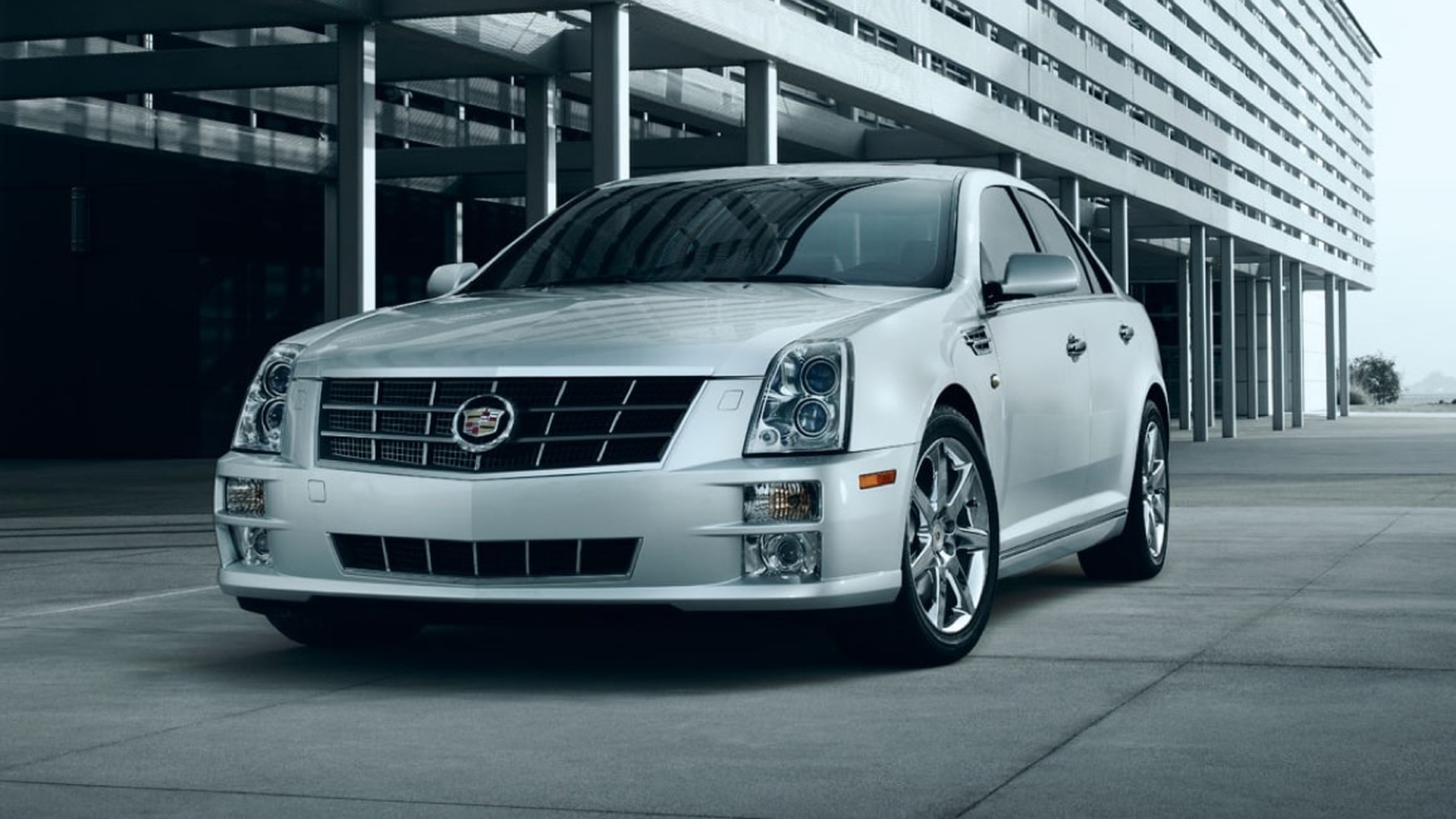
The Sigma Paradigm: Reclaiming the Executive Segment
General Motors executed a violent architectural pivot for the 2005 model year, officially retiring the front-wheel-drive Seville and unleashing the Cadillac STS. Engineers completely discarded decades of transverse-engine packaging, recognizing that competing directly against the BMW 5 Series and Mercedes-Benz E-Class required an authentic, longitudinal RWD sport sedan. The STS emerged as the largest vehicle built upon the highly lauded Sigma platform, stretching the footprint to maximize executive legroom while preserving razor-sharp dynamic handling.
Structural Metallurgy and the Sigma Architecture
Achieving world-class kinetic response requires absolute unibody rigidity. Structural metallurgists deployed massive quantities of advanced high-strength steel across the entire STS floor pan and safety cage. This aerospace-inspired skeletal structure entirely refuses to flex during heavy lateral cornering, allowing the independent suspension components to absorb broken urban pavement with mathematical perfection. By pushing the front wheels to the absolute forward corners of the chassis, designers physically slashed the front overhang, visually anchoring the sedan to the asphalt while drastically improving weight distribution. The heavy battery sits securely under the rear seat cushion, an aggressive packaging strategy specifically utilized to pull critical mass away from the front axle.
Propulsion Dynamics: The High Feature V6
Cadillac offered multiple paths to kinetic supremacy. The foundational engine was the 3.6-liter High Feature V6, designated internally as the LY7. Cast entirely from lightweight aluminum, this motor utilized dual overhead camshafts and continuously variable valve timing on both the intake and exhaust sides, producing a highly respectable 255 horsepower. For the 2008 mid-cycle refresh, engineers heavily fortified this architecture, introducing the LLT variant. By deploying high-pressure direct fuel injection, highly atomized gasoline sprayed directly into the combustion chamber. This rapidly cooled the intake charge, allowing for a significantly higher compression ratio. The direct-injected V6 generated a surging 302 horsepower, nearly matching the output of earlier V8 engines while drastically reducing tailpipe CO2 emissions.
The Northstar V8: Atmospheric Supremacy
Buyers demanding absolute mechanical authority bypassed the V6 entirely, opting for the legendary 4.6-liter Northstar V8. For the STS application, Cadillac utilized the LH2 variant, specifically re-engineered for a longitudinal layout. This naturally aspirated powerplant generated 320 horsepower and delivered a deep, visceral exhaust burble at idle, transforming into a sophisticated howl as it screamed toward its 6,400 RPM redline.
Power routed through a heavy-duty Hydra-Matic automatic transmission, later upgraded to the highly responsive 6L50 6-speed. This gearbox featured highly advanced Performance Algorithm Shifting. The transmission control module constantly analyzed steering angle, lateral g-forces, and throttle position. If the digital computer detected aggressive canyon driving, it completely altered the shift map, holding gears through tight corners and executing perfectly rev-matched downshifts the exact moment the driver applied heavy braking.
4.6L LH2 Northstar V8 Specifications
- Engine Architecture
- 90-degree V8, Cast Aluminum Block and Heads
- Displacement
- 4565 cm3
- Valvetrain
- Dual Overhead Cam, 32 valves, Variable Valve Timing
- Peak Horsepower
- 320 hp @ 6,400 RPM
- Peak Torque
- 315 lb-ft @ 4,400 RPM
Kinematic Mastery: Magnetic Ride Control
Isolating the cabin from infrastructure degradation while maintaining communicative steering feel required massive dynamic intervention. Steering precision relied on a ZF Servotronic II variable-ratio rack-and-pinion setup. At parking lot speeds, the system maximized hydraulic assistance. As velocities climbed on the interstate, the steering heavily weighted up, physically locking the driver into the vehicle's trajectory. Buyers checking the right option boxes received General Motors' absolute finest suspension hardware: Magnetic Ride Control.
The physical dampers contain a specialized magneto-rheological fluid filled with microscopic iron particles. Digital sensors read the road surface topography 1,000 times per second. An electromagnetic coil surrounding the damper instantly alters the viscosity of the fluid. The system aggressively stiffens the outside shocks during tight canyon hairpins to crush severe body roll, then softens them entirely to absorb harsh bridge expansion joints.
The precision of MagneRide was so absolute that elite European manufacturers, including Ferrari, eventually licensed this exact General Motors technology to manage the suspension kinematics of their own high-dollar supercars.
The All-Wheel Drive Offensive
To conquer severe winter climates, Cadillac introduced an advanced AWD system for the STS. Available with both the V6 and V8 powertrains, the BorgWarner active transfer case utilized a heavy-duty planetary gearset. During dry, straight-line highway cruising, the system physically biased 60 percent of engine torque to the rear wheels, preserving the traditional sports car feel uncorrupted by torque steer. The exact millisecond the digital wheel speed sensors detected front or rear slip on black ice, a hydraulic clutch pack instantly locked, routing massive kinetic force to the axle with the most physical traction to pull the heavy sedan out of the skid.
The STS-V: Supercharged Apex Predator
For the 2006 model year, Cadillac entirely transcended the standard executive segment, unleashing the terrifyingly fast STS-V. Built to actively hunt the BMW M5, engineers discarded the standard engines, physically shoehorning the 4.4-liter LC3 supercharged Northstar V8 into the engine bay. A single, dedicated master builder hand-assembled every LC3 engine at the Performance Build Center.
The technological centerpiece was a massive Roots-type supercharger integrated directly into the intake manifold. Four separate Laminova tube intercoolers stripped immense thermal heat away from the compressed atmospheric air before it slammed into the combustion chambers. Shedding the kinetic energy of this 4,300-pound sedan required massive thermal capacity. The front axle utilized four-piston fixed aluminum Brembo calipers clamping down on 14-inch ventilated rotors. Specialized cooling ducts physically routed high-velocity ambient air directly to the inner rotor vanes, aggressively fighting brake fade during punishing track sessions.
4.4L LC3 Supercharged V8 Specifications (STS-V)
- Engine Architecture
- 90-degree V8, Cast Aluminum Block
- Displacement
- 4371 cm3
- Aspiration
- Roots-Type Supercharger with Liquid-to-Air Intercooling
- Peak Horsepower
- 469 hp @ 6,400 RPM
- Peak Torque
- 439 lb-ft @ 3,900 RPM
Digital Telemetry and Acoustic Isolation
The interior architecture balanced intense driving telemetry with meticulous luxury. Cadillac acoustic engineers approached the cabin as a dedicated sound studio. They utilized Quiet Steel-a specialized viscoelastic acoustic polymer sandwiched between two layers of high-strength steel-for the firewall, physically neutralizing harsh engine mechanical noise. The dashboard projected critical vehicle data via an advanced color HUD, reflecting speed and navigation routing directly onto the windshield glass. The STS served as an early pioneer for digital safety, integrating Lane Departure Warning systems that utilized forward-facing optical cameras to monitor road stripes, alongside an adaptive cruise control radar matrix that actively managed throttle and braking to maintain following distances in heavy traffic.
The Chinese Market Expansion: The SLS
Recognizing explosive growth in the Asian luxury sector, Cadillac engineered a specific variant for the Chinese market designated as the SLS (Seville Luxury Sedan). Chinese executive buyers prioritized rear-seat volume because they typically employ private chauffeurs. Engineers physically stretched the Sigma platform by 3.9 inches, adding massive legroom to the rear passenger compartment. The SLS featured heavily upgraded rear seating with active massage bladders, individual climate zones, and integrated rear-seat entertainment monitors, cementing Cadillac's status as a top-tier prestige brand in Shanghai and Beijing.
The Enduring Legacy
The Cadillac STS successfully executed a massive strategic pivot. By stubbornly prioritizing the highly rigid rear-wheel-drive Sigma architecture, Cadillac completely abandoned the compromised front-wheel-drive dynamics of the 1990s. The STS proved American engineers could build a sophisticated, highly capable machine equipped with advanced direct-injection, reality-bending magnetic suspension, and world-class digital telemetry. While production officially ceased in 2011 to make way for the larger XTS and the third-generation CTS, the STS permanently secured its legacy as the vital evolutionary link that transformed Cadillac back into a true, globally respected performance brand.