
Genesis of a Segment: The K5 Blazer Arrives
The late 1960s witnessed a seismic shift in American automotive preferences. The public was moving away from the lumbering station wagons of the previous decade, craving something that offered both utility and a sense of adventure. Ford had kicked open the door with the Bronco, and International Harvester was already in the fray with the Scout. Chevrolet, never one to cede ground, responded in 1969 with the K5 Blazer. It was a masterstroke of engineering efficiency. Rather than developing a standalone platform, Chevy shortened the wheelbase of their robust C/K pickup truck line. The result was a vehicle that offered the ruggedness of a truck with a shorter, more manageable footprint. This was not a crossover in the modern sense. It was a brute. It sat high on a ladder frame, utilized solid axles front and rear, and offered a removable fiberglass top that turned the hardtop into a stylish convertible. This dual-purpose design resonated deeply with the American public. You could take the family to church on Sunday and haul a load of firewood on Monday. The K5 Blazer didn't just compete in the emerging SUV market; it defined the expectations for the full-size segment for decades to come.The First Generation: 1969-1972
The inaugural Blazer set the template. It was available exclusively in four-wheel drive initially, with two-wheel drive models joining the lineup later. The aesthetic was unmistakably Chevrolet-square, honest lines with a broad grille flanked by round headlights. Under the hood, power came from the reliable inline-six as standard, but the optional V8s were the heart and soul of the machine. The 350 cubic-inch small block V8 became the engine of choice for those who demanded serious towing capacity and highway merging power. The interior was a lesson in utilitarian design. Vinyl seats were standard, designed to be hosed down after a muddy excursion. The dashboard was a metal slab populated by simple, legible gauges. There were no touchscreens or complex infotainment systems-just a radio, a heater, and a commanding view of the road. This generation of the Blazer has become a darling of the collector market, specifically the 1969-1972 models, which are prized for their classic styling and lack of federal safety bumper mandates that would later alter the vehicle's profile.The removable hardtop of the first-generation K5 Blazer was a marketing triumph, allowing owners to enjoy open-air cruising without sacrificing the security of a hard shell during inclement weather.
The Square Body Era: 1973-1991
In 1973, Chevrolet introduced the second generation, known affectionately to enthusiasts as the "Square Body." This iteration would become the most iconic and long-lived version of the Blazer. The design was a reflection of the times-sharper angles, larger glass areas for visibility, and a more integrated front fascia. The rounded lines of the previous decade gave way to a more modern, chiseled appearance that looked at home in both the suburbs and the construction site. Mechanically, the Square Body represented a significant leap forward. The K5 adopted coil spring rear suspension, a departure from the leaf springs of the past, which dramatically improved ride quality. The four-wheel-drive system was refined, and the introduction of partial-time cases allowed for driving on dry pavement in 4HI without binding the drivetrain. This generation saw the proliferation of the 350 and 400 cubic-inch V8s, as well as the introduction of the 6.2L Detroit Diesel V8 in the early 1980s, marking the brand's first foray into diesel utility vehicles. Safety regulations in the mid-1970s brought significant changes. Large, protruding bumpers were mandated to withstand low-speed impacts, altering the front and rear aesthetics. However, the core appeal remained untouched. The removable top stayed, offering that unique open-air experience that competitors were starting to abandon. By the late 70s and early 80s, the Blazer had cemented its status as the king of the hill, often outselling the Ford Bronco and completely outclassing the dwindling International Scout.Performance and Powertrains
The engine options for the Square Body were vast. From the reliable 250 inline-six to the thundering 454 big-block V8 (available in earlier years and aftermarket applications), there was a powerplant for every need. However, the 350 V8 remained the sweet spot, offering a balance of torque and relative fuel economy-an important consideration during the fuel crises of the era.- 1985 Chevrolet K5 Blazer Engine Specs (Standard V8)
- Engine: 5.7L (350 cu in) V8
- Horsepower: 165 hp @ 3800 RPM
- Torque: 275 lb-ft @ 2400 RPM
- Transmission: 4-Speed Manual or 3-Speed Automatic
- Transfer Case: NP208 or NP205
The Compact Contender: The S-10 Blazer
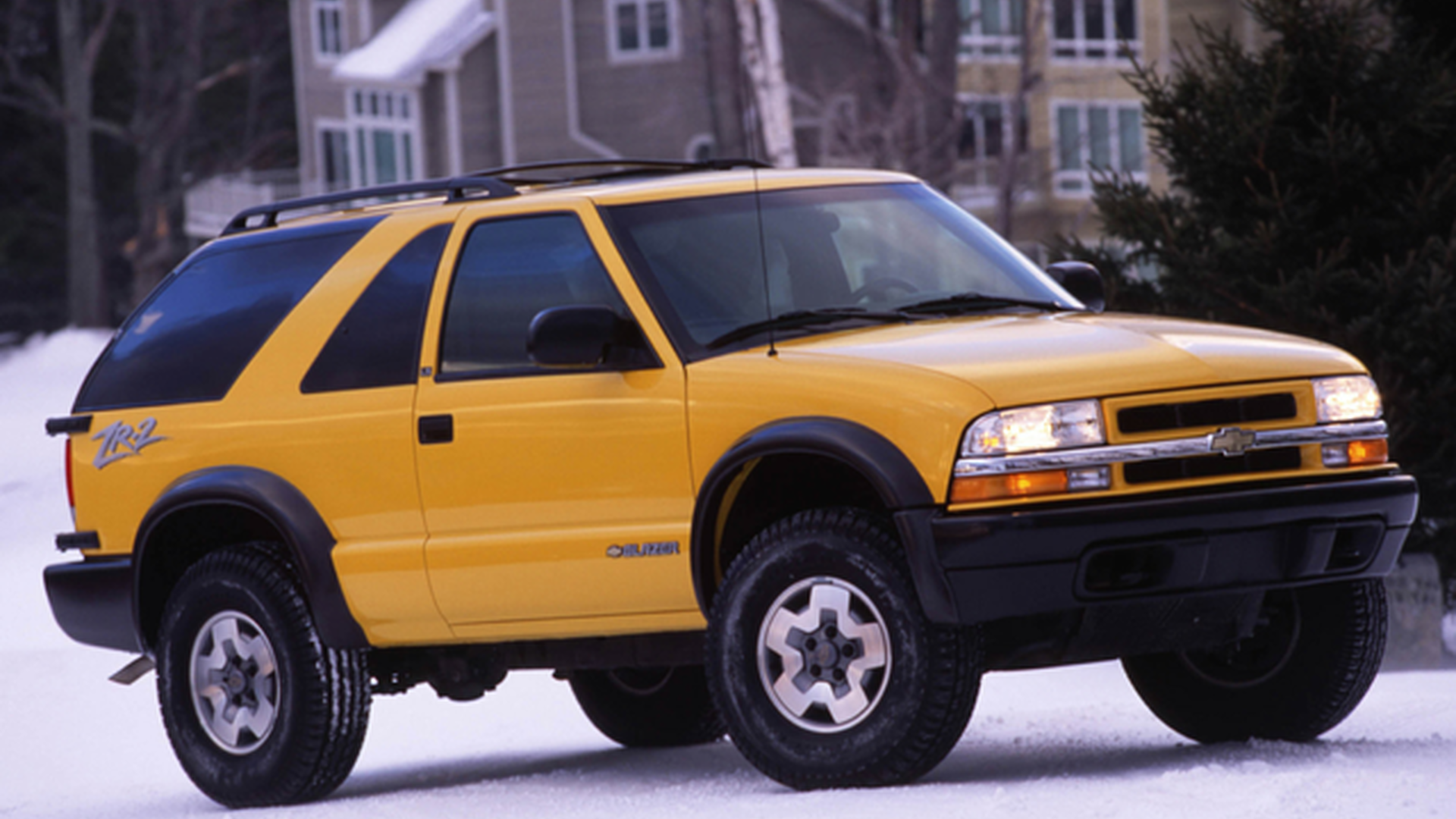
While the K5 ruled the full-size roost, the 1980s brought a demand for smaller, more fuel-efficient vehicles. Chevrolet answered the call with the S-10 Blazer in 1983. Unrelated to its full-size brother, the S-10 Blazer was based on the compact S-10 pickup platform. It competed directly with the Ford Bronco II and the Jeep Cherokee. The S-10 Blazer was a different beast entirely. It was lighter, more maneuverable, and considerably smaller. It became a favorite among urban drivers who needed utility but struggled to park the massive K5. Initially available only as a two-door, a four-door variant arrived in 1991, broadening its appeal significantly. The S-10 Blazer would eventually outlive the full-size K5, evolving through the 1990s with the introduction of the "Old Body Style" (OBS) and eventually the SUV boom of the mid-90s.The GMT400 Revolution: 1992-1994
The final iteration of the full-size, two-door Blazer arrived in 1992, based on the new GMT400 platform. This platform also underpinned the redesigned C/K pickups. This "new body style" Blazer was a thoroughly modern machine. The aerodynamics were drastically improved, the interior was ergonomically designed with safety features like a driver's side airbag, and the TBI (Throttle Body Injection) engines gave way to more efficient Vortec engines. However, the writing was on the wall for the two-door, full-size SUV. The market was shifting rapidly toward four-door family haulers. The removable top was deleted in favor of a fixed roof, a sign of the times that emphasized structural rigidity and safety over open-air novelty. 1994 marked the end of the line for the full-size Blazer nameplate in the US. In 1995, the full-size model was rebranded as the Chevrolet Tahoe, a name that endures to this day, while the S-10 Blazer continued to carry the Blazer torch.The S-10 Blazer's Long Goodbye: 1995-2005
From 1995 onwards, the "Blazer" name in the Chevrolet lineup referred exclusively to the mid-size S-10 model. This generation is perhaps the most common on used lots today. It featured the "Vortec" 4.3L V6 engine, a motor known for its durability and surprising torque output, often referred to as the "baby V8" due to its similar architecture to the small-block Chevy. The S-10 Blazer of this era was a staple of American driveways. It offered optional features that were previously the domain of luxury sedans, such as leather seats, power sunroofs, and premium audio systems. The high-performance "SS" model was introduced in 1996, offering unique cladding, specific colors, and slight performance tweaks, though it never achieved the cult status of the Typhoon (the GMC Syclone's SUV sibling). Despite its popularity, the S-10 Blazer began to show its age against newer, car-based competitors like the Ford Explorer. The body-on-frame construction provided durability but resulted in a choppy ride compared to the unibody designs entering the market. Production of the S-10 Blazer ceased in 2005, replaced by the Chevrolet Equinox and the TrailBlazer (the name eventually given to the GMT360 platform successor).Off-Road Culture and the Blazer
The legacy of the Chevrolet Blazer is inseparable from American off-road culture. The solid front axle on the K5 models makes them prime candidates for rock crawling and desert running. The aftermarket support for these vehicles is staggering. Lift kits, locking differentials, winch bumpers, and custom roll cages are easily sourced, allowing owners to transform a vintage cruiser into a trail-conquering monster. One of the most compelling aspects of Blazer ownership is the community. From classic truck shows to dedicated off-road parks like Moab and The Rubicon Trail, the Blazer is a fixture. The simplicity of the older models means that a home mechanic with a basic set of tools can perform most maintenance tasks, a refreshing contrast to the computer-dependent complexity of modern vehicles.Design Evolution: From Utility to Comfort
Tracing the lineage of the Blazer offers a fascinating look at how consumer priorities have shifted. The 1969 model was a utilitarian tool, designed to get dirty. The interior was sparse, and noise insulation was minimal. By the time the 1990s rolled around, the Blazer had morphed into a comfortable family vehicle. Carpeted floors, plush velour seats, and electronic amenities like push-button four-wheel drive became standard expectations. This evolution reflects the broader trend in the automotive industry. The SUV started as a specialized tool for rural workers and outdoor enthusiasts. The Blazer was instrumental in bringing that concept to the mainstream suburban driveway. It proved that a truck-based vehicle could serve as a daily driver, a school bus, and a vacation transporter all in one.The Modern Interpretation
While this article focuses on the truck-based heritage of the Blazer, it is impossible to ignore the modern context. The Blazer nameplate returned to the Chevrolet lineup in 2019 as a mid-size crossover. However, for purists and historians, the "true" Blazer remains the K5 and its S-10 descendants. The original Blazer offered a mechanical honesty-a connection between the driver, the machine, and the terrain-that is increasingly rare in the modern automotive landscape.- Key Dimensions (1987 K5 Blazer)
- Wheelbase: 106.0 inches
- Overall Length: 186.0 inches
- Curb Weight: Approx. 4,500 lbs
- Ground Clearance: 8.0 inches (Stock)