
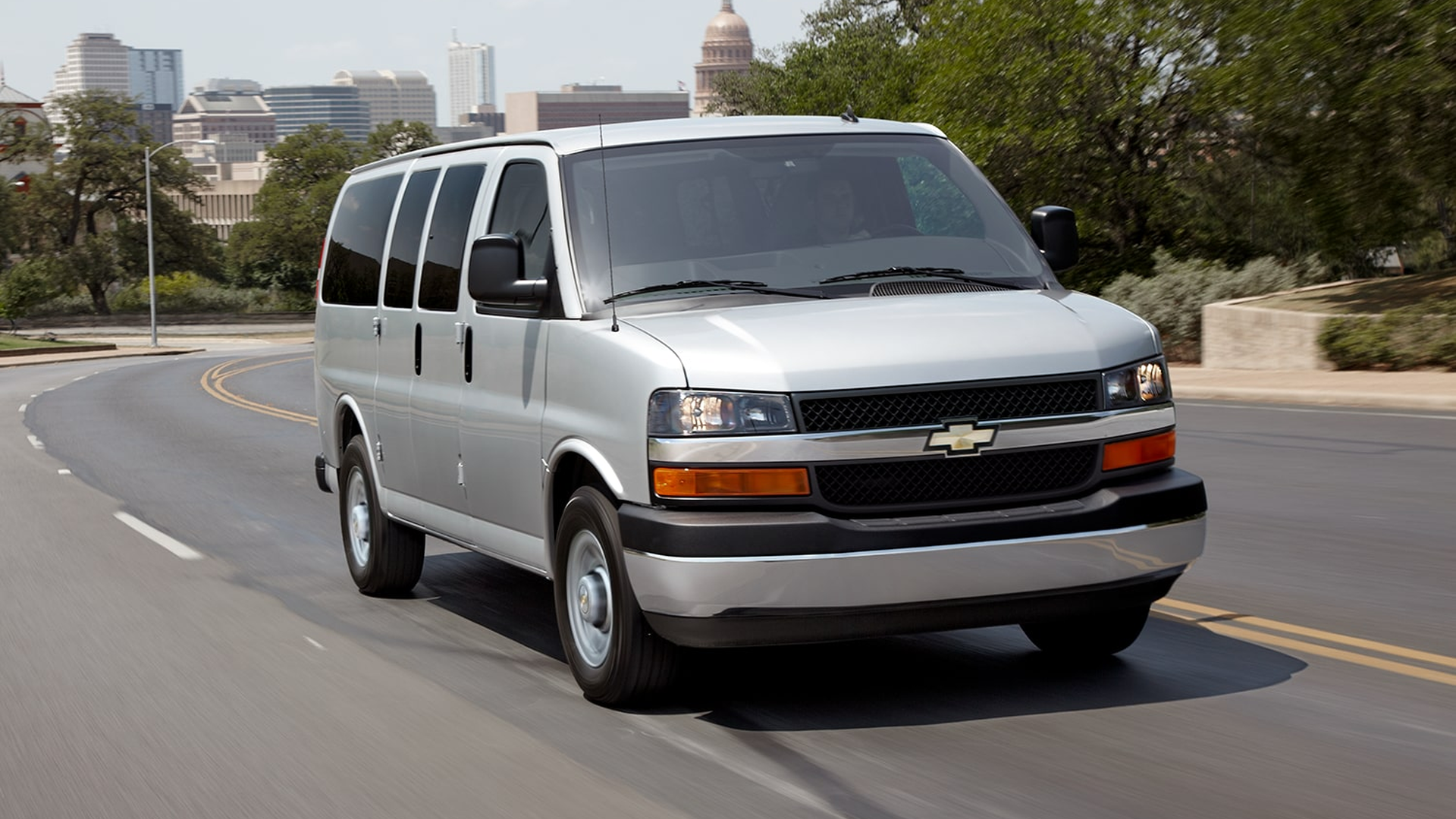
The Definitive Heavyweight: Unpacking the Chevrolet Express Passenger
Forget delicate crossovers and front-wheel-drive minivans. The Chevrolet Express Passenger exists in a realm of unadulterated utility and brute strength. Born from the necessity to move massive amounts of humanity and cargo simultaneously, this full-size leviathan relies on old-school, heavy-duty engineering principles. Chevrolet designed this vehicle to act as the ultimate backbone for the American fleet industry, creating a towering highway presence and a masterclass in mechanical longevity. It rejects fleeting automotive trends, favoring proven steel, massive displacement, and unyielding rear-wheel-drive architecture.
Origins: The End of the Flat-Nose Era
Prior to 1996, the American full-size van market was dominated by older, boxy designs resembling driving bricks. Chevrolet shattered that mold with the introduction of the Express. Replacing the legendary but aging G-Series vans, the Express utilized the entirely new GMT600 platform. Engineers extended the nose significantly, pulling the engine forward of the passenger compartment. This shift dramatically improved crash safety, increased front legroom, and radically enhanced aerodynamics. The swept-back profile cuts through the wind to eliminate the excessive cabin noise that plagued its predecessor. The windshield rake and flush-mounted side glass drastically reduced the coefficient of drag, improving high-speed stability across the barren stretches of interstate highways.
"The introduction of the GMT600 platform didn't just update a van; it entirely redefined the ergonomic and aerodynamic expectations for commercial-grade passenger transport in North America."
Engineering the Foundation: The Ladder Frame
Unlike modern people-movers utilizing unibody construction, the Express relies on a traditional body-on-frame design. A fully boxed steel ladder frame sits underneath the massive steel body. This architecture allows the van to manage immense torsional loads, preventing body flex when fully loaded with fifteen adult passengers and their luggage. The front suspension utilizes an independent Short/Long Arm (SLA) geometry paired with massive coil springs, while the rear suspension depends on a solid live axle suspended by heavy-duty semi-elliptic multi-leaf springs.
To control this mass, early models featured front disc and rear drum brakes, but Chevrolet quickly upgraded the platform to four-wheel vented disc brakes to combat brake fade on long, mountainous descents. The sheer heat generated by stopping a fully loaded 15-passenger van required massive thermal mass in the brake rotors.
Powertrain Evolution: A Symphony of Displacement
The beating heart of the Express Passenger has always been a robust engine lineup, heavily biased toward V8 power. Over its multi-decade production run, the van has hosted some of the most iconic engines ever produced by any OEM.
The Early Vortec Era (1996-2002)
At launch, Chevrolet offered the Express with the final iterations of the legendary Gen I small-block V8s. Buyers could specify the 5.0L, the 5.7L (RPO L31), or the massive 7.4L big-block V8 for extreme towing applications. These cast-iron workhorses prioritized low-end torque over high-RPM horsepower, ensuring the van could surge forward effortlessly even when weighed down by thousands of pounds.
The LS-Based Revolution (2003-2017)
As emissions standards tightened and fuel efficiency demands grew, Chevrolet transitioned the Express to the Gen III and Gen IV LS-architecture engines. These iron-block engines featured advanced fuel injection and significantly improved cylinder head airflow. The 6.0L V8 (RPO LQ4) became a fleet favorite, delivering relentless power delivery and legendary reliability. For operators needing maximum efficiency and towing range, Chevrolet integrated the spectacular 6.6L Duramax turbo-diesel V8, producing earth-moving torque while maintaining respectable highway efficiency.
The Modern Arsenal (2018-Present)
Today, the powertrain lineup looks completely different but remains fiercely capable. Chevrolet replaced the older V8s with a new generation of direct-injected engines. The base engine became the 4.3L V6 (LV1), an incredibly stout motor sharing architecture with the Gen V small-block V8. However, the true crowning achievement for heavy haulers is the massive 6.6L L8T gasoline V8. Designed specifically for heavy-duty trucks and vans, this cast-iron giant relies on an overhead valve pushrod design and a forged steel crankshaft to survive brutal duty cycles.
- Current 6.6L V8 (L8T) Specifications
- Displacement: 6,564 cm3
- Configuration: Naturally Aspirated OHV V8
- Block Material: Cast Iron
- Horsepower: 401 hp @ 5,200 rpm
- Torque: 464 lb-ft @ 4,000 rpm
- Transmission Pairing: Heavy-Duty 6-Speed Automatic (6L90E)
Transmission Tech and Power Delivery
Sending torque to the rear wheels requires transmissions capable of handling constant thermal stress. Early models relied on the ubiquitous 4L60E and 4L80E four-speed automatics. These gearboxes shifted firmly and utilized robust torque converters. As engine technology advanced, so did the transmissions. Chevrolet introduced the heavy-duty 6L90E six-speed automatic, dramatically improving highway cruising noise and acceleration off the line by utilizing a much steeper first gear. A sophisticated ECU manages shift points, holding gears longer during uphill climbs and executing aggressive downshifts to provide engine braking on steep grades.
Fascinatingly, between 2003 and 2014, Chevrolet offered the 1500 series Express Passenger with an incredibly capable AWD system. Utilizing a viscous center differential, this system mechanically transferred torque to the front wheels the instant the rear wheels lost traction. These AWD Express vans remain highly sought after by winter resort operators and overlanding enthusiasts today.
The 2003 Major Overhaul: Enter the GMT610
In 2003, Chevrolet recognized the need to modernize the underlying structure of the van, resulting in the GMT610 platform update. Engineers pushed the front wheels further forward and widened the track. They thoroughly redesigned the front fascia, giving the Express a much more aggressive, truck-like appearance that mirrored the Silverado lineup. Behind the sheet metal, the electrical architecture received a complete overhaul, allowing for the integration of modern safety nets.
- Key GMT610 Advancements
- Addition of standard ABS across all weight classes.
- Implementation of StabiliTrak (Electronic Stability Control).
- Upgraded hydroboost power steering on heavy-duty models for effortless low-speed maneuvering.
- Introduction of multi-stage front airbags.
Interior Packaging: A Masterclass in Volume
The primary mandate of the Express Passenger is seating capacity. Chevrolet offers the vehicle in two distinct wheelbases: the standard 135-inch WB and the massive 155-inch extended WB. The standard wheelbase comfortably seats up to 12 passengers across four rows. The extended version stretches the rear sheet metal to accommodate a fifth row of seating, bringing total capacity to an incredible 15 passengers.
Climbing into the rear cabin reveals a functional, cavernous interior. Rear air conditioning systems, routed through roof-integrated ducting, blast cold air all the way to the final row, combating the immense solar heat gain created by the massive side windows. The seats themselves prioritize durability over outright luxury, wrapped in heavy-duty vinyl or thick, stain-resistant cloth designed to survive decades of continuous passenger ingress and egress. Removing the rear bench seats transforms the passenger van into a cavernous cargo hauler, offering massive square footage to swallow construction materials or oversized luggage.
Emissions and the Fight Against Carbon
Despite its massive size, Chevrolet engineers continually refined the powertrains to meet stringent federal regulations. The integration of advanced catalytic converters and sophisticated oxygen sensors precisely monitor the exhaust stream. By optimizing the air-fuel ratio down to the millisecond, the modern Express meticulously manages its CO2 output. Furthermore, evaporative emissions systems capture unburned fuel vapors from the massive 31-gallon fuel tank, routing them back into the intake manifold to be consumed during normal driving.
Cultural Impact and Fleet Dominance
Walk out of any major airport terminal in the United States, and you will instantly lock eyes with a Chevrolet Express Passenger van. These vehicles form the lifeblood of hotel shuttles, church groups, and specialized transport services. They endure conditions that destroy lesser vehicles: constant idling in extreme heat, aggressive stop-and-go city driving, and drivers who treat the accelerator pedal like an on/off switch.
"The Express endures where delicate unibody platforms disintegrate. It trades the illusion of modern luxury for the reality of bulletproof mechanical permanence."
The appeal lies in sheer predictability. Fleet mechanics understand exactly how to repair the front SLA suspension. Parts availability for the GM V8 engines stretches to every small-town auto parts store in the country. The rear barn doors swing wide to reveal an interior that prioritizes absolute volume over complex seating mechanics. By refusing to reinvent the wheel, Chevrolet created an automotive monolith. The Express Passenger remains a rolling fortress of capability, proving that sometimes, the ultimate solution to moving people is simply a massive ladder frame, a thunderous V8, and millions of miles of proven engineering.