
The Birth of a Legend: The 1958 Bel Air Impala
General Motors celebrated its 50th year of production in 1958 by radically overhauling its entire passenger car lineup. Chevrolet introduced the Impala as the absolute top-tier trim level for the Bel Air series. Conceived under the direction of legendary chief engineer Ed Cole, the Impala was designed to offer Cadillac-level luxury and styling to the surging American middle class. It featured a strikingly wide stance, dual headlamps, and deeply sculpted rear fenders culminating in iconic, symmetrical triple taillights-a visual signature that would define the nameplate for generations.
Beneath the heavy sheet metal, Chevrolet discarded the traditional perimeter frame. Engineers implemented the highly unconventional "Safety-Girder" X-frame. This unique chassis completely eliminated the traditional outer side rails, utilizing a massive, elongated central tubular spine that branched outward precisely at the suspension mounting points. By removing the side rails, engineers successfully dropped the floor pans directly between the frame members. This geometric alteration drastically lowered the vehicle's center of gravity and permitted a sleek, swept-back roofline without sacrificing critical interior passenger headroom.
The Batwing Era and the W-Series V8 (1959-1960)
Chevrolet separated the Impala into its own distinct model line in 1959. Designers Harley Earl and Bill Mitchell pushed the styling to absolute extremes. The rear sheet metal erupted into massive, horizontal "batwing" tailfins hovering over teardrop-shaped taillights. To move this massive steel canvas, Chevrolet deployed the 348 cubic-inch "W-Series" big-block V8. Named for the distinct "W" shape of its scalloped valve covers, this engine featured the combustion chambers machined directly into the engine block rather than the cylinder head, creating immense low-end torque to easily push the 3,600-pound cruiser up to highway speeds.
The Bubbletop and the Dawn of the Super Sport
The 1961 model year stripped away the excessive fins, introducing a clean, linear, and highly aerodynamic aesthetic. The two-door hardtop variant featured thin, sloping A-pillars and an expansive, curved rear window, earning the legendary "Bubbletop" moniker among enthusiasts. More importantly, 1961 marked the genesis of the Super Sport (SS) package. This was not merely a cosmetic trim; it was a dedicated performance upgrade that included heavy-duty springs, sintered metallic brake linings, and an upgraded front anti-roll bar.
To dominate the drag strip, Chevrolet bored and stroked the W-Series engine to create the mythical 409 cubic-inch V8. Equipped with dual four-barrel Carter carburetors and a solid-lifter camshaft, this engine produced a staggering one horsepower per cubic inch.
"The 1961 Impala SS fundamentally altered American automotive engineering. By dropping the monstrous 409 cubic-inch V8 into a standard passenger car chassis, Chevrolet ignited the horsepower wars, proving that straight-line dominance was no longer restricted to specialized track vehicles." - Automotive Engineering Historical Archive
1961 Impala SS 409 V8 Specifications
- Engine Architecture
- W-Series Cast Iron Big-Block V8
- Displacement
- 6,702 cm3 (409 cubic inches)
- Induction System
- Dual 4-Barrel Carter Carburetors
- Peak Output
- 409 HP @ 6,000 RPM
- Transmission
- Borg-Warner T-10 4-Speed Manual
The 1965 Pinnacle: Perimeter Frames and the Mark IV
The Chevrolet Impala broke all industry records in 1965, selling over one million units in a single year-a sales figure that remains entirely unmatched by any single vehicle model in American history. Engineers completely discarded the aging X-frame, returning to a highly robust, fully boxed perimeter frame. This new chassis dramatically improved side-impact protection and provided a vastly superior foundation for isolating road noise and harshness from the cabin.
The suspension kinematics were completely modernized. The front utilized an independent short/long arm (SLA) design, while the rear transitioned to a highly effective four-link trailing arm setup paired with heavy-duty coil springs, eradicating the axle hop associated with earlier leaf-spring designs. Under the hood, Chevrolet introduced the entirely new Mark IV big-block V8, initially displacing 396 cubic inches. This engine utilized "porcupine" splayed valve angles to vastly increase cylinder head airflow, delivering unrelenting high-RPM breathing capabilities.
The Malaise Era and Project 77 Downsizing
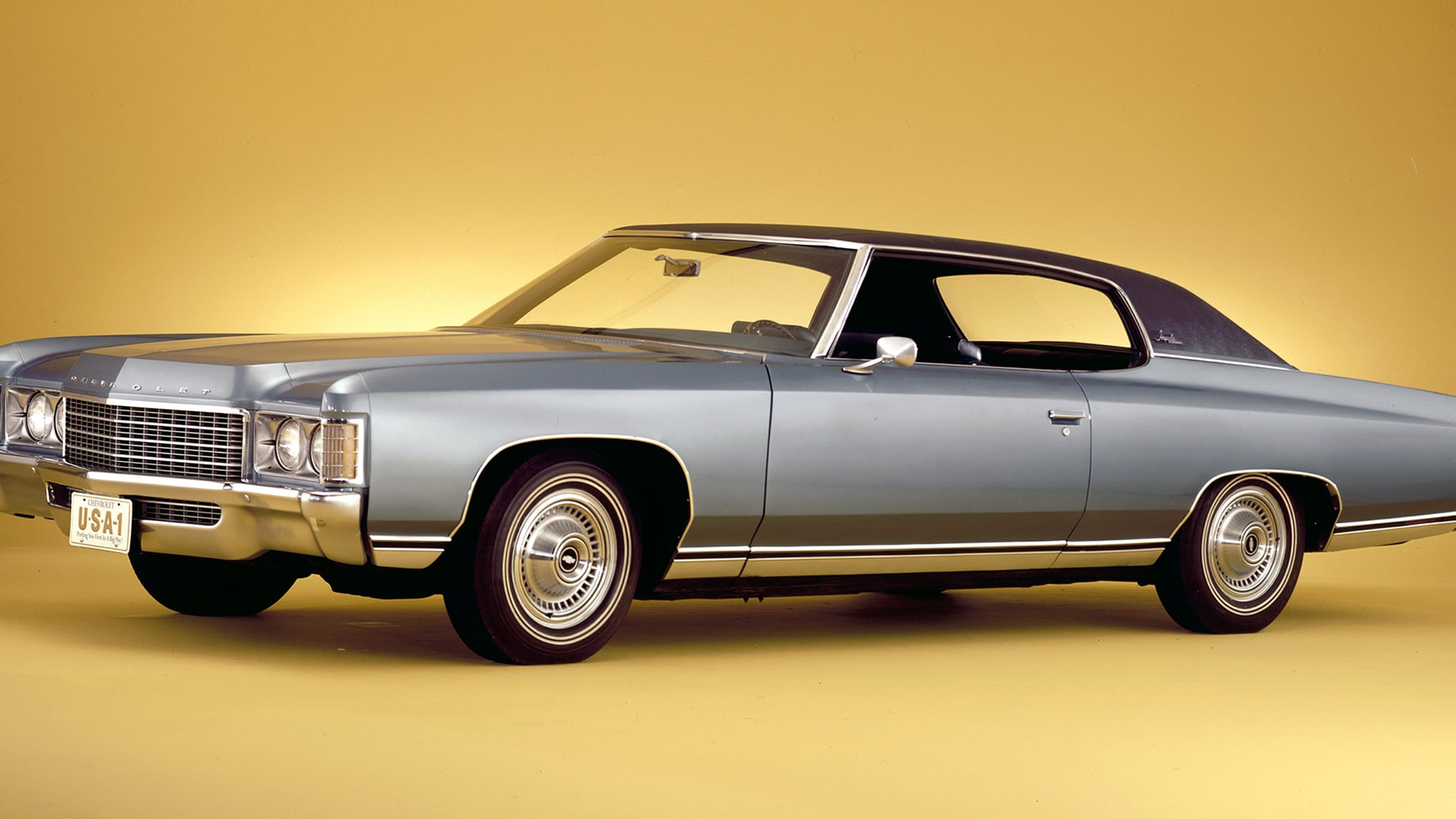
The early 1970s marked the physical peak of the Impala. The B-Body platform stretched to colossal proportions, measuring over 220 inches in length and weighing well over 4,000 pounds. Chevrolet offered the massive 454 cubic-inch V8 to move the bulk. However, the 1973 oil crisis and suffocating federal emissions standards completely fractured the market. Compression ratios plummeted to accommodate unleaded fuel, and the integration of restrictive catalytic converters choked V8 horsepower, reducing CO2 emissions but simultaneously killing acceleration.
General Motors executed "Project 77," a monumental corporate downsizing program. The 1977 Impala was radically shrunken. Engineers carved hundreds of pounds of curb weight and slashed over 10 inches from the overall length. Through brilliant geometric packaging optimization, they actually increased rear legroom and expanded the trunk capacity despite the smaller exterior footprint. This leaner, highly efficient B-Body became the standard for American law enforcement fleets.
The SS Resurrection: The 1994-1996 LT1 Muscle Sedan
After being relegated to mundane fleet duty, the Impala roared back to relevance in 1994. Chevrolet engineer Jon Moss envisioned a sinister, high-performance variant of the Caprice 9C1 police interceptor. The resulting Impala SS was a monochromatic, lowered, widened street brawler. Chevrolet painted it entirely black (initially), stripped away the chrome, and bolted on massive 17-inch aluminum wheels wrapped in wide performance rubber.
The true magic lived under the hood. Chevrolet extracted the 5.7-liter LT1 V8 directly from the C4 Corvette and dropped it into the heavy B-Body sedan. This specific LT1 utilized cast-iron cylinder heads and a camshaft optimized for massive low-end torque. It featured a highly advanced reverse-flow cooling system that routed cold coolant directly to the cylinder heads first, rather than the engine block. This thermal management allowed engineers to safely run a higher 10.5:1 compression ratio on standard pump gas without inducing pre-ignition knock.
1996 Impala SS (LT1) Specifications
- Engine Block Material
- Cast Iron Gen II Small-Block V8
- Cooling System
- Reverse-Flow Gear-Driven Water Pump
- Displacement
- 5,735 cm3 (350 cubic inches)
- Peak Output
- 260 HP @ 5,000 RPM
- Peak Torque
- 330 lb-ft @ 2,400 RPM
The Front-Wheel-Drive Revolution: W-Body Architecture
General Motors retired the RWD B-Body platform in 1996 to focus exclusively on highly profitable SUVs. When the Impala nameplate returned in 2000, it underwent the most radical engineering shift in its history. The new eighth-generation Impala rode on the W-Body platform, transferring power exclusively through a FWD architecture. Placing the engine and transaxle transversely across the engine bay eliminated the bulky transmission tunnel, creating a perfectly flat floor pan and maximizing interior passenger volume.
Propulsion relied on the legendary 3.8-liter 3800 Series II V6. This cast-iron pushrod engine is widely considered one of the most durable, indestructible V6 engines ever manufactured by an OEM. Between 2006 and 2009, Chevrolet pushed the limits of the FWD architecture by introducing the Impala SS equipped with the 5.3-liter LS4 V8. Packaging a 5.3-liter V8 sideways required immense engineering creativity. Chevrolet shortened the crankshaft and utilized a single-belt accessory drive to physically squeeze the massive powerplant between the MacPherson struts. Producing 303 horsepower, the LS4 severely challenged the front tires, requiring aggressive electronic torque management to mitigate violent torque steer during heavy acceleration.
The Final Chapter: Epsilon II and Acoustic Precision
The tenth and final generation of the Chevrolet Impala arrived for the 2014 model year, built upon the highly sophisticated E2XX (Epsilon II) architecture. Chevrolet engineers shifted their focus away from raw horsepower toward absolute refinement, structural rigidity, and acoustic isolation. The chassis heavily integrated ultra-high-strength steel alloys throughout the safety cage.
To eliminate highway wind shear and road noise, engineers deployed triple-sealed doors, acoustic laminated windshield glass, and thick layers of Liquid Applied Sound Deadener (LASD) across the entire interior floor pan. The premium engine offering was the 3.6-liter LFX V6. Utilizing dual overhead camshafts, four valves per cylinder, and high-pressure direct fuel injection, this engine produced a highly refined 305 horsepower without the fuel penalty of a traditional V8.
Despite critical acclaim for its striking design and exceptional ride quality, the American automotive landscape shifted violently in the late 2010s. Consumers overwhelmingly abandoned traditional four-door sedans, demanding the elevated seating position and perceived ruggedness of unibody crossover SUVs. General Motors officially ceased production of the Chevrolet Impala in February 2020, retooling the Detroit-Hamtramck assembly plant to manufacture electric vehicles. The Impala leaves behind an undeniable legacy, surviving exactly ten generations of shifting consumer demands, oil crises, and architectural revolutions to stand as the definitive American full-size sedan.