
Defining the Modern American Pickup
The American road is paved with the legacy of the pickup truck, and few names command as much respect as the Chevrolet Silverado. While Chevrolet had been building trucks for decades prior, the official adoption of the Silverado nameplate in 1999 marked a turning point. It signified a shift from the utilitarian C/K series-named for their drivetrain and weight class-to a branded, lifestyle-oriented vehicle that could serve as a mobile office during the week and a family adventurer on the weekend. This transition mirrored the changing American consumer, who demanded more comfort, safety, and refinement without sacrificing an ounce of capability. The Silverado entered a market dominated by the Ford F-150, a rivalry that remains the fiercest in the automotive industry. To compete, GM didn't just build a truck; they built a fortress. The early GMT800 platform was renowned for its stout frame and reliable Vortec engines. It was a no-nonsense machine that earned a reputation for longevity that persists to this day. You still see them on the road, their clear coat peeling, but their engines purring with the steady rhythm of a well-maintained heart. This durability is the foundation of the Silverado's identity.The GMT800 Generation: Setting the Standard (1999-2006)
The first generation of the Silverado, riding on the GMT800 platform, was a massive leap forward from the square-body trucks of the past. It introduced a hydroformed frame, a process that strengthened the steel rails while reducing weight and improving structural rigidity. This gave the truck a solidity that competitors lacked. The steering was precise for a truck, and the independent front suspension provided a ride quality that didn't rattle your teeth out. Under the hood, the Vortec engine family became legendary. The 5.3L V8 (LM7/L59) became the volume seller, offering a sweet spot of power and fuel economy. The 4.8L V8 served as the base engine, while the 6.0L and 8.1L variants provided the torque needed for heavy hauling. These engines were simple, pushrod designs that prioritized low-end torque and ease of maintenance. Mechanics loved them because you could fix them with a hammer and a wrench. The interiors were functional, if plasticky, featuring the 'dual cockpit' design that Chevrolet experimented with at the time. While the dashboards were prone to cracking in the sun, the seats were comfortable for long hauls, and the visibility was commanding.The 'Vortec' intake manifold design created a swirling air-fuel mixture, improving combustion efficiency and giving the early Silverado a reputation for having the strongest small-block truck engines of its era.
The GMT900: The Pre-Recession Titan (2007-2013)
The second generation, the GMT900, arrived in 2007, just as the American economy was teetering on the brink of recession. Stylistically, it was a evolution of the previous truck, featuring a larger, bolder grille and fender flares that emphasized width. The frame was stiffened further, and the suspension was tuned for a more composed ride. The interior quality saw a marked improvement, with better materials and a more ergonomic layout. However, this generation is often remembered for the controversy surrounding its fuel economy. In a bid to compete, GM introduced the 'XFE' (Xtra Fuel Economy) model and pushed the Active Fuel Management system aggressively. The 5.3L V8 received a power bump, but the transmission tuning prioritized fuel economy over responsiveness, leading to a driving experience that felt lethargic at times. Despite this, the Silverado remained a sales powerhouse, bolstered by the introduction of the Silverado Hybrid, a 'mild hybrid' system that used a 42-volt battery to assist the gasoline engine. It was a technological precursor to today's electrified powertrains, though it sold in limited numbers. The 6.2L V8 also made its appearance in the high-end LTZ trim, offering over 400 horsepower and transforming the truck into a street rod.The K2XX Era: Refinement and Retaliation (2014-2018)
By 2014, the competition had caught up. Ford had introduced aluminum bodies, and Ram had adopted air suspension and upscale interiors. Chevrolet responded with the K2XX platform, arguably the most refined Silverado to date. The exterior styling was contentious-cheese-grater grille aside-but the engineering was solid. The cab was fully boxed, and high-strength steel was used extensively to improve safety and stiffness. The real story was the interior. Chevrolet finally ditched the hard plastics for soft-touch materials, premium leather, and a center console that could swallow a laptop. The EcoTec3 engine family debuted, featuring direct injection and cylinder deactivation. The 4.3L V6, 5.3L V8, and 6.2L V8 all received updates. The 6.2L paired with the new 8-speed automatic transmission became the gold standard for powertrain smoothness in the segment. This generation also saw the introduction of the 'High Country' trim, Chevrolet's entry into the luxury truck wars. With saddlebag-style leather seats and chrome everywhere, it targeted the buyer who wanted a Cadillac with a bed. The Z71 off-road package also became more robust, offering better skid plates and Rancho shocks for the weekend warrior.- EcoTec3 5.3L V8 Specs (K2XX)
- Horsepower: 355 hp @ 5600 RPM
- Torque: 383 lb-ft @ 4100 RPM
- Towing Capacity: Up to 11,100 lbs
- Transmission: 6-Speed / 8-Speed Automatic
The T1 Platform: The Modern Heavyweight (2019-Present)
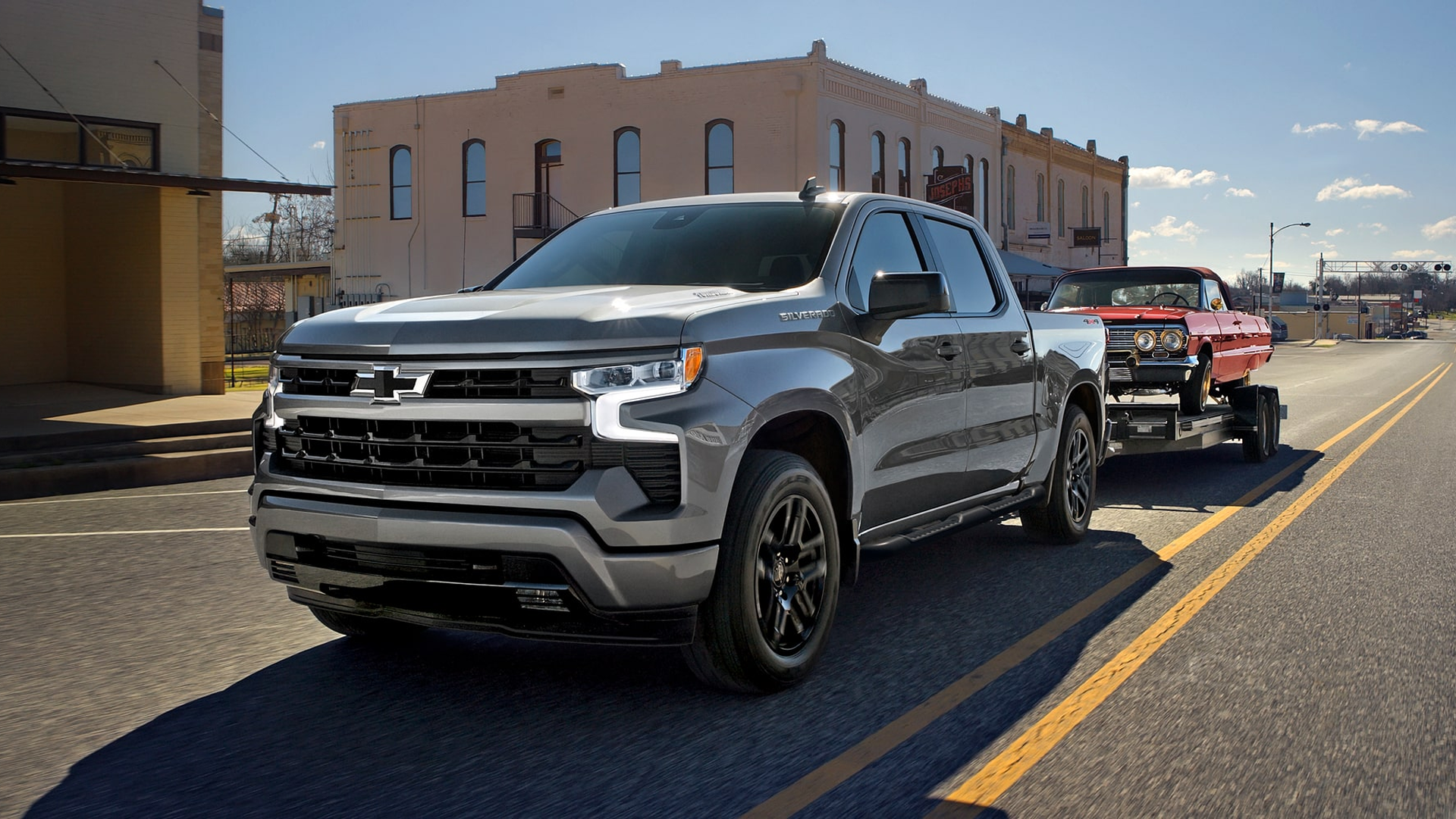
The current Silverado, launched in 2019 on the T1 platform, is a monster. It is larger, taller, and more technologically advanced than any Chevrolet truck before it. The bed is made of high-strength steel, and the tailgate options became a talking point. The MultiPro tailgate, borrowed from the GMC Sierra, offered six different functions, transforming the back of the truck into a workbench, a step, and a load stop. Visually, the T1 Silverado is imposing. The hood sits high, and the 'bowtie' sits proudly in a massive grille. The headlights are stacked vertically, a design cue that polarized critics but gave the truck a distinct presence on the road. The interior received a significant update in 2022 to address early complaints about button layouts, resulting in a massive 13.4-inch touchscreen and a 12.3-inch digital instrument cluster. It is a digital command center, offering navigation, trailering apps, and camera views that let you see everything around the truck.The Duramax Diesel Revolution
For years, the Duramax 6.6L V8 was the domain of the Heavy Duty (HD) trucks. But for the T1 generation, Chevrolet introduced the 3.0L Duramax inline-six turbo-diesel for the 1500 series. This engine was a game-changer. It offered 277 horsepower and a massive 460 lb-ft of torque, all while achieving up to 33 MPG on the highway. It provided the towing capability of a V8 with the range of a hybrid, making it the ultimate choice for long-haul towers. The gasoline 2.7L Turbo High-Output engine also entered the mix, offering impressive low-end torque for a four-cylinder, replacing the aging V6 as the base engine.The Heavy Duty Lineup: 2500 and 3500
While the Silverado 1500 handles the light-duty and lifestyle market, the Silverado HD (2500 and 3500) is the iron fist. Built for commercial use and heavy fifth-wheel towing, these trucks have evolved into industrial machines. The latest HD models feature the L5P Duramax 6.6L V8, a beast that produces 445 horsepower and 910 lb-ft of torque. The Allison 10-speed transmission, standard on diesels, is built to handle immense stress. The chassis of the HD trucks differs significantly from the 1500. It uses a solid front axle on the 4x4 models, providing the ground clearance and strength needed for severe service. The dual rear wheel (DRW) 3500 models can tow upwards of 36,000 pounds, numbers that were previously the domain of medium-duty commercial trucks. These are vehicles for ranchers, oil field workers, and contractors who cannot afford downtime. The 'High Country' trim on an HD truck is a surreal experience-massive capability wrapped in Opus leather and safety tech.Driving Dynamics and Chassis Tuning
Driving a Silverado varies wildly depending on the generation and configuration. A base WT (Work Truck) with the standard suspension is stiff, transmitting every road imperfection to the cabin. Step up to the LTZ or High Country with the Magnetic Ride Control, and the truck glides over bumps. The steering is hydraulic on most trims, providing a heavy, connected feel that truck buyers prefer over the numb electric steering found in some competitors. The ride quality is heavily dependent on the bed load. Unloaded, the rear suspension can feel jittery, a common trait of leaf-spring rear suspensions designed to carry weight. The 'Max Towing Package' often includes heavier springs, which exacerbates the unloaded ride harshness but is essential for stability when hitched to a trailer. The brake tuning is excellent; GM trucks have long had some of the best pedal feel in the segment, allowing for precise modulation when slowing a heavy load.Safety and Technology Integration
Modern Silverados are safety fortresses. The 'Safety Alert' seat vibrates on the left or right side to warn of potential collisions, a feature unique to GM. The camera systems are extensive, with up to 15 camera views available for trailering, including a transparent hood view that lets you see the terrain under the front bumper. Adaptive Cruise Control is available, a feature that is a godsend for long highway drives. The 'Teen Driver' system allows parents to set speed limits and audio volume caps for secondary drivers, a practical feature for work fleets or family use. The integration of Apple CarPlay and Android Auto is standard, seamlessly connecting the driver's digital life to the truck's interface. It is this blend of ruggedness and connectivity that keeps the Silverado relevant in a tech-obsessed world.Market Position and The Ford Rivalry
You cannot discuss the Silverado without mentioning the F-150. The battle for truck supremacy is the core of the American auto industry. Ford often wins on volume and innovation (like aluminum bodies), while the Silverado wins on traditional values: steel construction, pushrod V8 reliability, and a perception of toughness. The Ram 1500 has complicated the fight by dominating the interior quality segment, forcing Chevrolet to up its game significantly with the T1 interior refresh. The Silverado holds its ground by offering a wider variety of configurations. From the stripped-down two-door Work Truck to the loaded High Country and the off-road ZR2 (introduced for 2022), the lineup covers every possible base. The ZR2, with its Multimatic shocks and front locking differential, gave the Silverado a legitimate off-road contender to battle the F-150 Raptor and Ram Rebel, though it focuses more on technical crawling than high-speed desert running.Technical Specifications Summary
The dimensions of the Silverado have grown with each generation. The current Crew Cab/Standard Bed configuration stretches over 231 inches in length.- Dimensions (2024 Silverado 1500 Crew Cab)
- Wheelbase: 147.4 inches
- Overall Length: 231.7 inches
- Width: 81.2 inches
- Height: 75.6 inches