
The Italdesign Genesis and Global Lineage
The story of the Chevrolet Spark does not begin in Detroit, but in the visionary studios of Italdesign in Moncalieri, Italy. Renowned designer Giorgetto Giugiaro initially penned the Lucciola concept as a hybrid city car for Fiat. When that partnership stalled, Daewoo Motors seized the opportunity, transforming the concept into the Daewoo Matiz (internal code M100). This global icon eventually integrated into the General Motors portfolio, adopting the Chevrolet bow tie and evolving into a sophisticated A-segment contender known for maximizing every millimeter of its footprint.
Engineers prioritized vertical space, creating an upright silhouette that allowed four adults to sit without feeling cramped. This 'high-roof' architecture became a hallmark of the Spark's identity. The chassis utilized a traditional MacPherson strut front suspension, but the true genius lay in the ultra-compact rear torsion beam design. This setup minimized mechanical intrusion into the cabin, allowing for a surprisingly versatile cargo area despite a wheelbase measuring just under 94 inches. By the time the nameplate officially landed in North America, it carried the weight of millions of global sales and a reputation for bulletproof reliability in dense urban environments like Seoul, Rome, and Mexico City.
The original Matiz was so impactful that it saved Daewoo during the Asian financial crisis of the late 1990s. Its styling was so beloved that several rival manufacturers in emerging markets were accused of mimicking its friendly, bug-eyed front fascia and nearly vertical rear hatch.
The M300 Era: Designing a Subcompact Powerhouse
Chevrolet launched the third-generation Spark (M300) in the United States for the 2013 model year. This was a radical departure from the soft, rounded lines of its predecessors. Drawing inspiration from the 2007 Chevrolet Beat concept, the M300 featured an aggressive, swept-back profile. Designers utilized oversized headlamps that stretched almost to the A-pillars, giving the car a much larger presence on the road than its physical dimensions suggested. To maintain a sleek, coupe-like look, the rear door handles were cleverly hidden in the C-pillar-a design flourish usually reserved for premium European hatchbacks.
Under the hood, the North American Spark featured an all-aluminum 1.2-liter Ecotec four-cylinder engine. This powerplant utilized Dual Overhead Cams and four valves per cylinder to optimize airflow. Engineers focused on low-end torque to ensure the Spark felt peppy when pulling away from city traffic lights. The engine utilized a cast-aluminum block and head to save weight, directly benefiting the car's front-to-rear balance. Drivers could choose between a crisp five-speed manual gearbox or a CVT designed to keep the engine in its most efficient power band during constant stop-and-go driving.
Technical Specifications (2013-2015 M300)
- Engine Displacement
- 1,249 cm3 (1.2L) Inline-4
- Horsepower Output
- 84 hp @ 6,400 RPM
- Torque Peak
- 83 lb-ft @ 4,200 RPM
- Curb Weight
- 2,269 lbs
- Fuel Efficiency
- Up to 38 MPG Highway
The Spark EV: A High-Torque Electric Sleeper
Perhaps the most fascinating chapter in the Spark's history is the limited-production Spark EV. Produced as a compliance vehicle for specific markets like California and Oregon, this car was an engineering masterpiece hidden in an economy-car shell. Chevrolet replaced the gasoline engine with a permanent-magnet electric motor that produced a staggering 400 lb-ft of torque (later adjusted to 327 lb-ft for the 2015 model year). This tiny hatchback could sprint from 0 to 60 MPH in just over 7 seconds, faster than many contemporary sport sedans and hot hatches.
The Spark EV utilized a 21.3 kWh lithium-ion battery pack tucked low in the chassis, which lowered the center of gravity and drastically improved cornering stability. It was one of the first vehicles to offer the CCS fast-charging standard, allowing owners to replenish 80 percent of the battery in roughly 20 minutes. Its thermal management system was particularly advanced, using liquid cooling to keep the battery cells at an optimal temperature even during aggressive acceleration runs or rapid DC charging. This ensured the battery retained its longevity and capacity far better than air-cooled contemporaries.
The M400 Evolution: Refinement and Safety
The fourth and final generation of the Spark (M400) arrived in 2016 with a more mature aesthetic and a significantly improved powertrain. Chevrolet engineers lowered the roofline to reduce aerodynamic drag and increased the wheelbase slightly to improve high-speed stability. The front fascia adopted the signature Chevrolet dual-port grille, while the interior received a massive upgrade in material quality. Soft-touch plastics replaced the hard surfaces of the previous generation, and the dashboard integrated a high-resolution 7-inch touchscreen featuring the first-ever standard implementation of Apple CarPlay and Android Auto in the A-segment.
The heart of the M400 was the 1.4-liter LV7 Ecotec engine. This larger displacement allowed for a more relaxed highway cruising experience. The engine block featured high-pressure direct fuel injection and a variable-flow oil pump, reducing internal friction and maximizing every drop of fuel. The ECU was programmed to work in harmony with a new generation of CVT, simulating 'steps' during hard acceleration to provide a more natural, traditional automatic transmission feel while maintaining the efficiency benefits of a stepless design.
Technical Specifications (2016-2022 M400)
- Engine Displacement
- 1,399 cm3 (1.4L) Inline-4
- Horsepower Output
- 98 hp @ 6,200 RPM
- Torque Peak
- 94 lb-ft @ 4,400 RPM
- Safety Structure
- High-Strength Steel Safety Cage with 10 Standard Airbags
- CO2 Efficiency
- Optimized for low urban carbon footprint
Engineering the Safety Cage
A primary concern for city car buyers is safety in a world of massive SUVs. Chevrolet addressed this by engineering the Spark's body as a rigid safety cell. Over 60 percent of the body structure consisted of high-strength and ultra-high-strength steels. These advanced alloys were strategically used in the A and B-pillars, as well as the rocker panels, to prevent cabin intrusion during a collision. In the United States, the Spark was the only car in its class to offer 10 standard airbags, protecting the knees, thorax, and heads of all occupants.
Active safety also saw a leap forward. The StabiliTrak electronic stability control system utilized a sophisticated suite of sensors to monitor steering input and vehicle path. If the OEM sensors detected a skid, the system could selectively apply the brakes on individual wheels to pull the car back into line. This was crucial for a short-wheelbase car, which can be naturally more 'twitchy' during emergency maneuvers. Later models even offered Forward Collision Alert and Lane Departure Warning, bringing premium driver-assistance technology to the entry-level market.
The Urban Dynamics of the Spark ACTIV
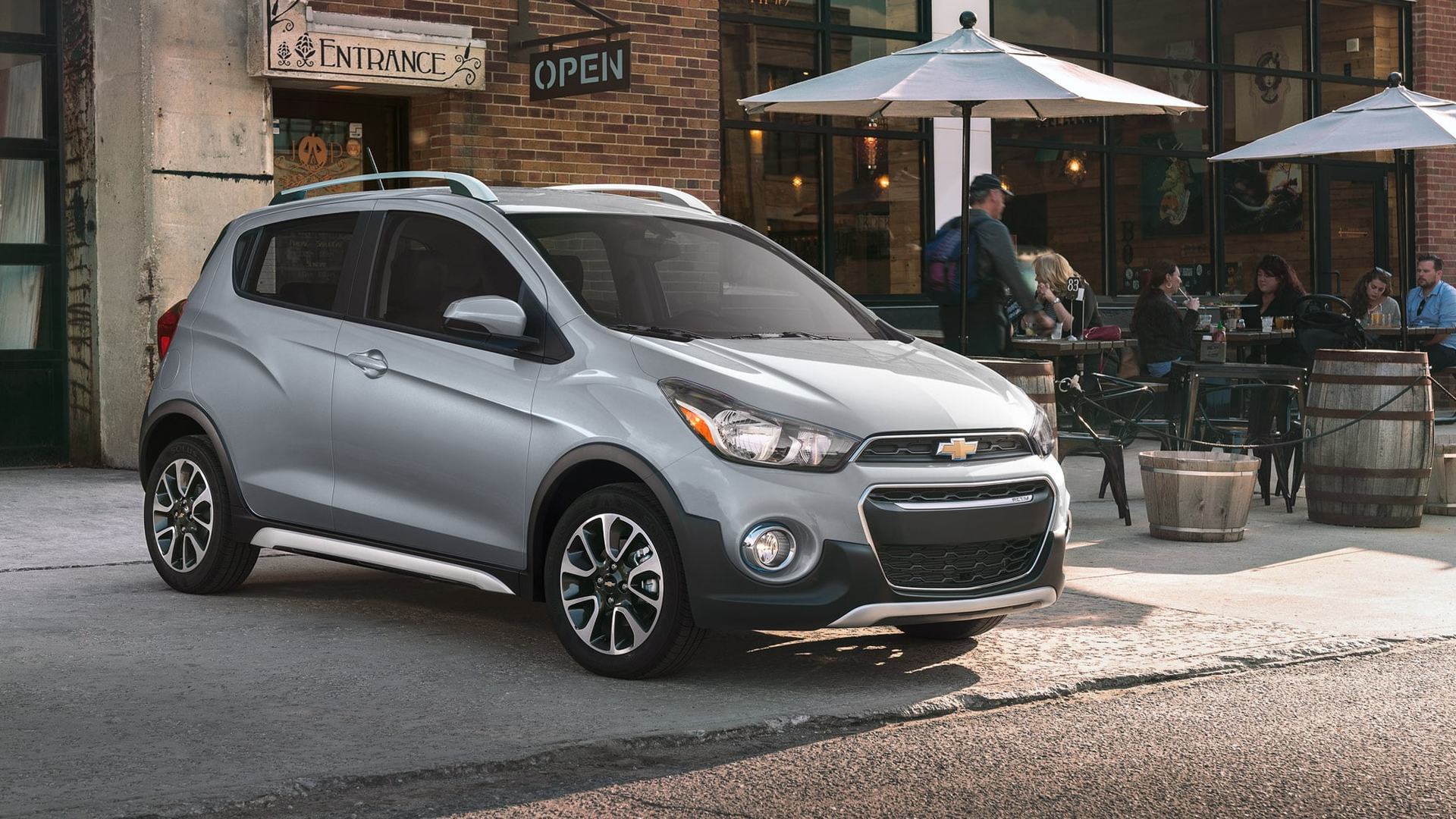
Recognizing the shift toward crossover styling, Chevrolet introduced the Spark ACTIV in 2017. This variant featured a suspension lift of 0.4 inches (10mm), providing a slightly higher vantage point and better clearance for city potholes and steep driveway transitions. It wasn't an off-roader, but the addition of rugged plastic body cladding and roof rails appealed to the urban adventurer who occasionally needed to haul a bike rack or kayak. The recalibrated suspension offered a slightly softer ride, absorbing the harshness of cobblestone streets and cracked pavement better than the standard trim.
Despite these changes, the Spark maintained its legendary 33.8-foot turning circle. This mechanical agility is what made the Spark a favorite for city dwellers. While drivers in larger sedans circled the block looking for a spot, the Spark driver could slip into 'un-parkable' gaps with ease. The electric power steering was tuned to be feather-light at low speeds, allowing for effortless one-handed parallel parking, while gaining weight at highway speeds to provide a centered, confident feel.
Cabin Practicality and Connected Tech
Inside, the Spark maximized utility through 'smart' packaging. The rear seats featured a 60/40 split-fold design, expanding the cargo capacity from 11.1 cubic feet to 27.2 cubic feet. This volume was enough to fit a full mountain bike or several large suitcases. The dashboard design in the M300 generation famously featured a motorcycle-inspired gauge cluster that moved with the steering column, ensuring the driver always had a clear view of the digital tachometer and analog speedometer. This was replaced in the M400 by a more traditional, yet highly legible, digital driver information center.
The inclusion of 4G LTE Wi-Fi and the OnStar system transformed the Spark into a mobile hub. For young buyers, this connectivity was a non-negotiable feature. The MyLink system allowed for seamless navigation and music streaming, bypassing the need for expensive, built-in GPS units. The cabin used acoustic-laminated glass to mitigate the high-frequency wind noise often found in lightweight hatchbacks, making the Spark a surprisingly quiet companion on longer journeys.
The Legacy of the Smallest Chevy
Chevrolet officially ended production of the Spark for the North American market in August 2022. Its departure marked the end of the line for the truly affordable, sub-$15,000 new car in America. However, the Spark's legacy lives on in the millions of units still traversing global cities. It proved that budget-friendly transportation didn't have to be a penalty box. By providing a safe, tech-forward, and dynamically engaging experience, the Spark became the entry point into the automotive world for an entire generation of drivers.
Whether in its gasoline form or the high-torque EV variant, the Spark remains a masterclass in packaging efficiency. It stood as the final guardian of the A-segment in the U.S., a car that embraced its small size with pride and engineering excellence. For researchers and enthusiasts, the Spark represents the pinnacle of what a global partnership between Korean manufacturing prowess and American brand ambition can achieve.