
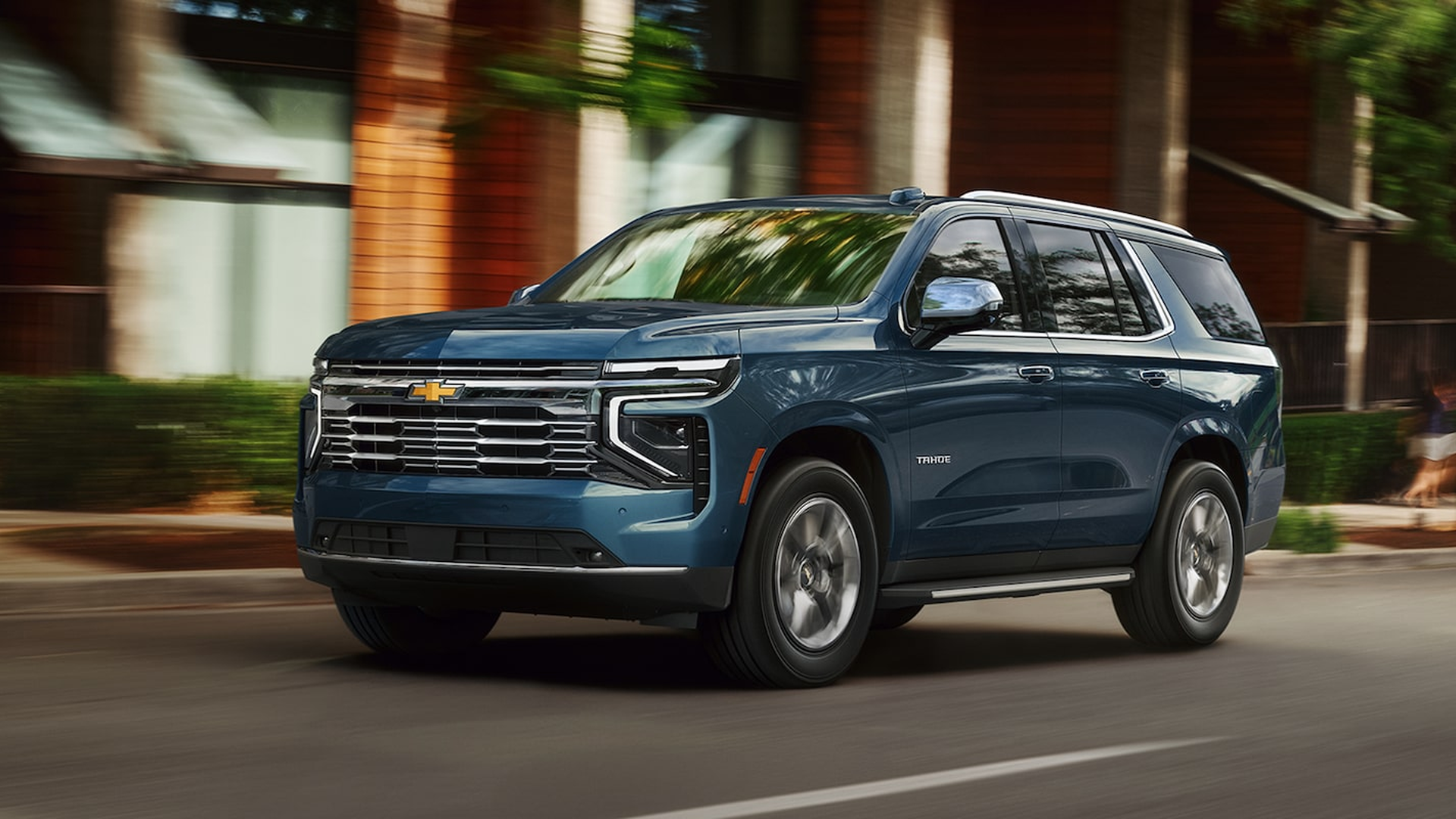
The Iron Backbone of American Utility
The Chevrolet Tahoe is not merely a vehicle; it is an institution. For nearly three decades, this full-size SUV has served as the default choice for those who need to move people and cargo with equal authority. While competitors have migrated to unibody chassis in pursuit of car-like handling, the Tahoe has steadfastly retained its body-on-frame construction. This adherence to truck fundamentals has earned it a loyal following among boaters, campers, and large families who prioritize towing capacity and durability over fuel economy. It is the vehicular equivalent of a skilled laborer who cleans up nice enough for Sunday dinner. The Tahoe's story begins in 1995, though its DNA traces back to the rugged K5 Blazer of the 1960s. As the two-door SUV fell out of favor with the American consumer, Chevrolet needed a four-door family hauler that could still handle a horse trailer. The Tahoe filled that void perfectly, effectively inventing the modern four-door full-size SUV segment alongside its twin, the GMC Yukon. Since then, it has weathered changing tastes, fluctuating fuel prices, and the rise of the crossover, emerging each time as the segment leader.The GMT400 Era: Establishing the Name (1995-2000)
The first-generation Tahoe arrived with a tough act to follow-the beloved square-body K5 Blazer. However, by the mid-90s, the market demanded four doors. The GMT400 platform, shared with the Silverado pickup, provided the foundation. The early Tahoes were distinct for their crisp, squared-off lines and chrome bumpers that seemed to stretch for miles. Under the hood, the GM 5.7L Vortec V8 was the engine of choice, delivering 255 horsepower and a bulletproof reputation for reliability. This generation is fondly remembered for its pure, mechanical feel. The steering was heavy, the brakes required a firm foot, and the interior was a cavern of plastic and cloth designed to be hosed out. It was a tool, unapologetic in its purpose. The "Vortec" badging became a symbol of torque-rich performance, allowing the Tahoe to tow up to 7,000 pounds-a staggering figure for the time. It set the template: if you wanted a family car that could also pull a boat, you bought a Tahoe.The GMT800: The Golden Age (2000-2006)
If the first generation introduced the concept, the second generation refined it. Rolling out on the GMT800 platform, the 2000 Tahoe featured rounded aerodynamics and a significant leap in interior quality. This era marked the arrival of the Vortec 4800 and 5300 engines, which offered improved power and efficiency. The 5.3L Vortec (LM7/L59) became a legend in its own right, powering countless American families. One of the critical updates during this cycle was the introduction of the Autoride suspension system on higher trim levels. This technology used real-time damping to smooth out the choppy ride often associated with solid rear axles. Suddenly, the Tahoe wasn't just a truck; it was a comfortable cruiser. The interior adopted the dual-zone climate control and premium audio systems that were becoming standard in luxury sedans, bridging the gap between workhorse and family hauler.The 2000 model year Tahoe was the first to feature the industry-changing OnStar safety system integrated directly into the vehicle, marking a turning point in automotive connectivity.
The GMT900: Controversy and Power (2007-2014)
The third generation, the GMT900, is often noted for its striking design language. The Tahoe grew larger, featuring flared fenders and a more aggressive stance. The interior quality took a massive leap forward, utilizing softer materials and tighter gaps. However, this generation faced scrutiny for fuel economy at a time when gas prices spiked. Chevrolet responded by introducing the Active Fuel Management system, which shut down four cylinders under light load to save fuel. The standard powerplant remained the 5.3L Vortec, now generating 320 horsepower. A 6.2L V8 was introduced on the top-tier LTZ model, providing Cadillac Escalade levels of thrust. The hybrid model, a two-mode system co-developed with Chrysler and BMW, also appeared, though it sold in limited numbers due to its complexity and cost. Despite the market turbulence, the Tahoe remained the best-seller, proving that Americans still had an appetite for size.The K2XX: Luxury and Technology (2015-2020)
By 2015, the Tahoe had moved decisively upmarket. The K2XX generation introduced the EcoTec3 engine family. The standard 5.3L V8 (L83) now featured direct injection, boosting output to 355 horsepower and 383 lb-ft of torque. This generation is characterized by its quietness. Chevrolet employed active noise cancellation and acoustic glass to turn the cabin into a sanctuary, insulating passengers from the outside world. The suspension saw significant upgrades, particularly with the availability of Magnetic Ride Control on the Premier trim. This technology, borrowed from the Corvette, utilized magnetorheological fluid in the shock absorbers to adjust damping stiffness every millisecond. It was a technological marvel that solved the age-old problem of truck ride quality. However, the solid rear axle remained, meaning the third row often felt like sitting on a teeter-totter over bumps.- 2018 Chevrolet Tahoe Engine Specs (5.3L EcoTec3 V8)
- Horsepower: 355 hp @ 5600 RPM
- Torque: 383 lb-ft @ 4100 RPM
- Towing Capacity: Up to 8,600 lbs
- Transmission: 6-Speed Automatic (later 10-Speed)
The T1 Platform: The Independent Revolution (2021-Present)
The current generation represents the most significant engineering shift in the model's history. For 2021, the Tahoe moved to the T1 platform and finally adopted an Independent Rear Suspension (IRS). This was a paradigm shift. For decades, die-hard truck fans argued that a solid axle was necessary for strength, but the IRS proved them wrong. It improved ride quality dramatically, increased third-row legroom by a staggering 10 inches, and allowed for a lower load floor. The visual transformation is equally dramatic. The Tahoe now features a commanding, upright grille and lighting elements that stretch into the front fenders. The interior is dominated by a vertical 10.2-inch touchscreen. Under the hood, the engine lineup offers three distinct paths: the reliable 5.3L V8, the thundering 6.2L V8 (standard on the High Country), and the 3.0L Duramax turbo-diesel inline-six. The Duramax engine is a standout. It offers a driving range of over 600 miles on a single tank of diesel, making the Tahoe a legitimate cross-country cruiser. The 6.2L V8, producing 420 horsepower, transforms the nearly three-ton SUV into a hot rod, capable of hitting 60 MPH in under six seconds.Trim Levels and The High Country Lifestyle
The modern Tahoe lineup is a study in market segmentation. The base LS model offers the essentials-cloth seats and the 5.3L engine-serving primarily as fleet vehicles for police departments and rental agencies. The LT adds leather and heated seats, targeting the middle class. The RST (Rally Sport Truck) injects street style with blacked-out trim and performance-oriented styling. The Premier and High Country trims are where the Tahoe competes with luxury marques. The High Country features unique saddle leather, real wood trim, and a standard 6.2L V8. It is a vehicle designed for the ranch owner who also owns a downtown loft. The inclusion of a Head-Up Display and a rear-camera mirror (which uses a camera feed to see past headrests and cargo) adds a layer of tech that makes piloting the behemoth surprisingly easy.Off-Road Capability: The Z71 Package
While the Tahoe is often seen in suburban cul-de-sacs, the Z71 package is a nod to its rugged roots. It adds a two-speed transfer case, all-terrain tires, a skid plate, and Rancho shocks. The air suspension on Z71 models can raise the vehicle for increased ground clearance, allowing it to tackle trails that would swallow a standard crossover. It is a capable machine, though its width often limits it on tight forest trails.Driving Dynamics: Handling the Mass
Driving a Chevrolet Tahoe requires a specific mindset. It is not a sports car. You sit high, looking over the traffic, with a clear view of the horizon. The steering is light and requires constant micro-adjustments on windy highways. The brakes are robust four-wheel discs, but stopping 5,800 pounds of momentum takes planning. The 10-speed automatic transmission, introduced in later years, is a masterpiece of engineering. It keeps the big V8 in its power band regardless of the situation, shifting smoothly under acceleration and downshifting aggressively when braking to utilize engine braking. The cylinder deactivation system is seamless; you would never know the engine is running on four cylinders unless you watched the dash indicator. Parking used to be a nightmare. Now, with the Surround View camera and Park Assist, the Tahoe practically parks itself. The technology has democratized the size; you do not need to be a truck driver to handle it. This accessibility is a key reason why the Tahoe outsells its competitors like the Ford Expedition and Toyota Sequoia.Safety and Driver Assistance
The Tahoe has evolved from a vehicle where safety meant "mass" to a vehicle where safety means technology. Standard features now include Automatic Emergency Braking, Front Pedestrian Braking, and Lane Keep Assist. The structure of the T1 platform utilizes high-strength steel to create a safety cage, ensuring that in a collision, the massive frame absorbs the impact. Teen Driver technology is a standout feature for parents. It allows parents to set speed limits and audio volume caps, and it generates a report card that tells parents if safety systems were activated during a drive. It is a tool that turns the Tahoe into a teaching aid for the next generation of drivers.Comparing the Tahoe to the Suburban
The eternal question for GM buyers is Tahoe vs. Suburban. The Tahoe offers the same width and powertrain options but with a shorter wheelbase. This makes the Tahoe more maneuverable in urban environments and standard garages. The trade-off is cargo space behind the third row. The Tahoe offers a respectable amount, but the Suburban is the king of luggage capacity. For most families who tow a boat occasionally and don't need to haul 4x8 sheets of plywood with the seats up, the Tahoe is the logical choice.The Competitive Landscape
The segment is fiercely contested. The Ford Expedition, with its aluminum body and EcoBoost V6, offers a powerful alternative. The Toyota Sequoia, recently redesigned, brings hybrid efficiency to the table. However, the Tahoe retains the edge in towing capacity and raw V8 character. The interior volume figures and the dealer network support give the Tahoe an undeniable advantage in rural America, where bowtie loyalty runs deep.Technical Specifications Summary
For the enthusiast, the numbers tell a story of capability. The T1 chassis is stiff, the engines are potent, and the cooling systems are designed for heavy-duty cycling.- 2024 Chevrolet Tahoe Dimensions
- Wheelbase: 120.9 inches
- Overall Length: 210.7 inches
- Width: 81.0 inches
- Height: 75.4 inches
- Curb Weight: 5,600 - 5,800 lbs