
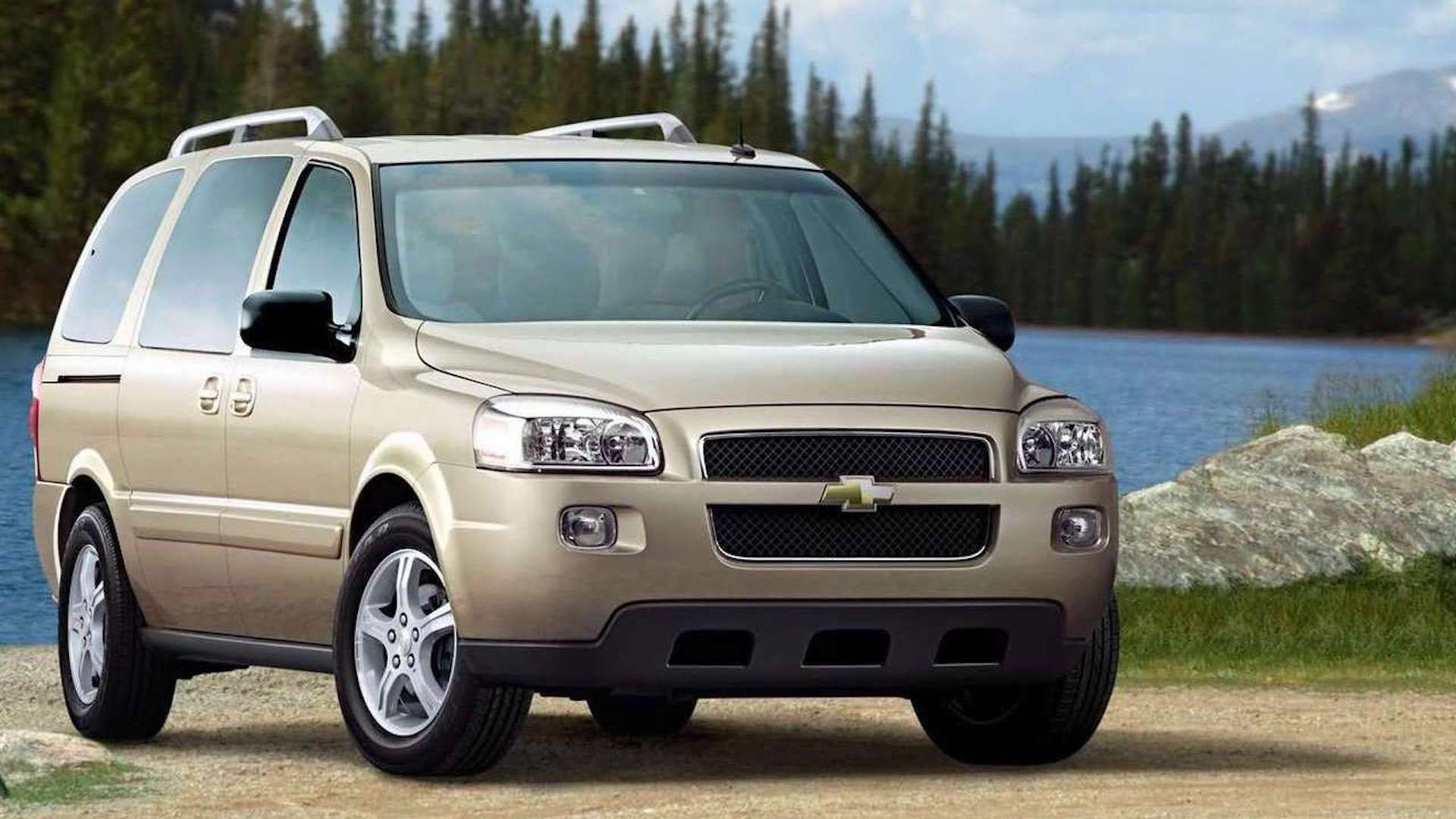
The Genesis of the Crossover Sport Van (CSV)
By the early 2000s, the American automotive consumer had ruthlessly rejected the traditional minivan silhouette. Buyers actively demanded the rugged, commanding aesthetic of a Sport Utility Vehicle (SUV), yet they secretly still required the unmatched internal cargo volume and low step-in height that only a sliding-door van could provide. General Motors retaliated against this shifting market dynamic by introducing a completely new marketing and engineering paradigm for the 2005 model year: the Crossover Sport Van (CSV). The Chevrolet Uplander, alongside its corporate siblings (the Saturn Relay, Pontiac Montana SV6, and Buick Terraza), was engineered to aggressively mask its minivan roots behind a prominent, elongated truck-style hood and bold, sweeping front grilles.
To execute this design shift without investing billions in a completely new architecture, Chevrolet engineers heavily modified the existing front-wheel-drive U-body platform, which previously underpinned the outgoing Chevrolet Venture. They stretched the front clip considerably, pushing the engine further forward. This geometric alteration completely eliminated the slanted, wedge-like "dustbuster" profile of 1990s minivans, replacing it with a flat, horizontal hood line that successfully mimicked a traditional body-on-frame Chevrolet TrailBlazer.
Structural Reinforcement and Acoustic Engineering
Stretching the front chassis structure provided significant engineering benefits beyond mere aesthetic deception. The elongated nose allowed engineers to design massive, highly effective forward crush zones. During a severe frontal collision, these extended frame rails were engineered to accordion inward, absorbing tremendous amounts of kinetic energy before the impact forces could breach the passenger safety cell. To further fortify the cabin, Chevrolet integrated high-strength steel throughout the A-pillars and the sliding door impact beams.
General Motors recognized that previous U-body vans suffered from severe wind noise and highway drone. To transform the Uplander into a premium highway cruiser, the engineering team deployed their proprietary "Quiet Steel" technology. This involved utilizing a specialized constrained-layer damping material sandwiched directly between two sheets of stamped steel on the firewall, actively absorbing engine vibrations before they entered the dashboard. Engineers sprayed thick layers of Liquid Applied Sound Deadener (LASD) across the entire interior floor pan and utilized acoustic laminated windshield glass to deflect high-frequency wind shear away from the driver's ears.
Powertrain Evolution: The High Value V6 Era
Initial propulsion for the 2005 Uplander relied on the 3.5-liter LX9 "High Value" V6 engine. This traditional cast-iron block, 60-degree V6 produced 200 horsepower and 220 lb-ft of torque. While adequate for daily commuting, this powerplant struggled violently to merge onto the interstate when the heavy 4,300-pound vehicle was loaded with seven passengers and their cargo. Chevrolet immediately recognized this massive power deficit.
For the 2006 model year, Chevrolet dropped an absolute engineering marvel into the Uplander's engine bay: the 3.9-liter LZ9 V6. This engine drastically altered the vehicle's driving dynamics. The LZ9 was an incredibly significant powerplant in automotive history because it was the first mass-produced OHV (pushrod) engine to successfully integrate VVT. Traditional pushrod engines relied on a fixed camshaft profile, forcing engineers to compromise between low-end torque and high-RPM horsepower. Chevrolet bypassed this limitation by installing a hydraulically controlled cam phaser on the end of the camshaft. The engine's ECU actively manipulated oil pressure to physically rotate the camshaft in relation to the timing chain, instantly advancing or retarding the valve timing based on immediate driver throttle input.
"Implementing Variable Valve Timing on a traditional pushrod V6 was a massive engineering triumph for General Motors. The 3.9L LZ9 allowed the Uplander to deliver explosive low-end torque for immediate city acceleration, while seamlessly shifting the cam profile to provide deep breathing and high-horsepower passing power at highway speeds." - Automotive Powertrain Analysis Archive
2006 3.9L LZ9 V6 Specifications
- Engine Block Architecture
- 60-Degree Cast Iron V6
- Cylinder Heads
- High-Flow Aluminum
- Displacement
- 3,880 cm3 (237 cubic inches)
- Valvetrain
- OHV, 2 Valves Per Cylinder, Cam-in-Block VVT
- Peak Output
- 240 HP @ 6,000 RPM
- Peak Torque
- 240 lb-ft @ 4,800 RPM
Driveline Dynamics and the Versatrak AWD System
Power delivery was managed exclusively by the heavily fortified 4T65-E four-speed automatic transaxle. This electronically controlled gearbox featured a heavy-duty torque converter and highly optimized shift mapping designed specifically to prevent gear-hunting while towing up to 3,500 pounds. While the vast majority of Uplanders utilized a standard FWD architecture, Chevrolet offered an incredibly sophisticated All-Wheel Drive system known as Versatrak during the early production years.
Versatrak was a fully passive, on-demand AWD system that required zero driver intervention. The rear differential housed two specialized gerotor pumps. Under dry, steady highway cruising, the Uplander operated purely as a FWD vehicle to maximize fuel economy. If the front tires encountered ice and began to spin faster than the rear tires, this specific speed differential physically forced the gerotor pumps to spin. The spinning pumps generated intense hydraulic pressure inside the differential casing. This hydraulic pressure physically squeezed wet clutch packs, instantly transferring engine torque to one or both of the rear wheels to immediately restore forward traction. Because the system relied purely on mechanical fluid pressure rather than complex electronic sensors, it was remarkably reliable in harsh winter climates.
Suspension Kinematics and Load Leveling
To handle the varying dynamic loads of seven passengers, the Uplander required a highly adaptable suspension geometry. The front end utilized an independent MacPherson strut design paired with a massive 34mm hollow stabilizer bar to resist aggressive body roll during emergency lane changes. FWD models utilized a twisted-beam rear axle suspended by heavy-duty coil springs. This semi-independent rear setup minimized intrusion into the rear cargo floor pan while providing exceptional load-carrying capacity.
AWD models, requiring space for the rear differential and half-shafts, utilized a fully independent short/long arm (SLA) rear suspension. Chevrolet frequently equipped the Uplander with an automatic rear load-leveling system. This system utilized electronic ride-height sensors attached to the rear control arms. If a driver loaded the rear cargo bay with heavy concrete bags or hitched a heavy travel trailer to the bumper, the sensors detected the chassis sagging. An onboard electric air compressor automatically pumped highly pressurized air directly into the rear shock absorbers, forcing the rear of the van back up to a perfectly level driving stance to prevent the headlights from blinding oncoming traffic.
Interior Packaging: Overhead Rails and PhatNoise
The interior of the Chevrolet Uplander was a masterclass in modular family utility. The defining feature of the cabin was the innovative Overhead Rail System. Twin aluminum tracks ran the entire length of the headliner from the front seats to the third row. Owners could purchase and easily snap-in various modular accessory pods along these rails. These pods included drop-down storage bins, intense LED reading lamps, rear HVAC controls, and a flip-down LCD screen for the rear-seat DVD entertainment system.
For the ultimate digital experience, Chevrolet offered the highly advanced Mobile Digital Media System, powered by PhatNoise. Long before the era of streaming audio or massive smartphone storage, the PhatNoise system utilized a heavy-duty, shock-resistant 40-gigabyte hard drive cartridge. Owners connected the cartridge to their home desktop computer, loaded it with thousands of MP3s, digital movies, and video games, and then physically slotted the cartridge directly into a specialized receiver mounted in the overhead rail of the Uplander. It was a groundbreaking piece of automotive entertainment engineering for the mid-2000s.
The Cargo War and the Stow 'n Go Dilemma
Despite its VVT engine and acoustic refinement, the Chevrolet Uplander faced a catastrophic competitive disadvantage in the interior packaging war. In 2005, Chrysler debuted the revolutionary "Stow 'n Go" seating system in their minivans, allowing both the second and third rows to fold completely flat into deep floor tubs, instantly transforming the van into a cavernous cargo hauler.
The U-body architecture of the Uplander physically prevented this. The Uplander's 50/50 split third-row seats folded flat, but they sat directly on top of the floor plan, creating a high, uneven liftover height. To achieve maximum cargo volume, the heavy second-row captain's chairs had to be physically unlatched and manually hoisted completely out of the vehicle and stored in a garage. This severe ergonomic limitation actively drove retail buyers toward rival showrooms.
Safety Engineering and StabiliTrak Integration
General Motors aggressively prioritized active safety to protect families. The Uplander was equipped with StabiliTrak, Chevrolet's advanced electronic stability control system. By continuously monitoring steering wheel angle, vehicle yaw rate, and individual wheel speeds, the ECU could detect if the vehicle was sliding on a wet corner. In milliseconds, StabiliTrak would automatically cut engine power and apply aggressive, targeted hydraulic brake pressure to individual wheels, physically forcing the heavy van back onto its intended path and preventing catastrophic rollover scenarios.
The Final Years and the Lambda Transition
By 2008, retail sales of the Uplander in the United States plummeted as the minivan stigma proved entirely impossible to mask with an elongated hood. The true unibody crossover SUV had arrived, rendering the "Crossover Sport Van" concept obsolete. General Motors finally achieved the perfect blend of SUV styling and minivan utility with the introduction of the massive Lambda-platform crossovers (the Chevrolet Traverse, Buick Enclave, and GMC Acadia). These vehicles offered three rows of seating and massive interior space without carrying the fatal cultural baggage of sliding rear doors.
Chevrolet discontinued the Uplander in the United States after the 2008 model year, though it survived through 2009 in Canada and Mexico, where it enjoyed immense popularity as a highly reliable, low-cost commercial cargo and delivery fleet vehicle. The Chevrolet Uplander remains a fascinating, highly engineered stopgap in automotive history. It represents the exact moment Detroit realized they could no longer force American consumers to buy traditional minivans, bridging the critical evolutionary gap between the 1990s dustbuster vans and the massive, three-row crossover SUVs that completely dominate the modern highways today.