Dacia: The Smartest Buy in Europe

Dacia is the automotive equivalent of a cheat code. Born in Romania and transformed by Renault, they proved that a cheap car doesn't have to be bad. By using proven Renault technology and eliminating unnecessary gadgets, Dacia became Europe's fastest-growing brand, offering rugged simplicity in a complex world.

Dacia Hero Vehicle

Model Lineup

Explore the current production vehicles.

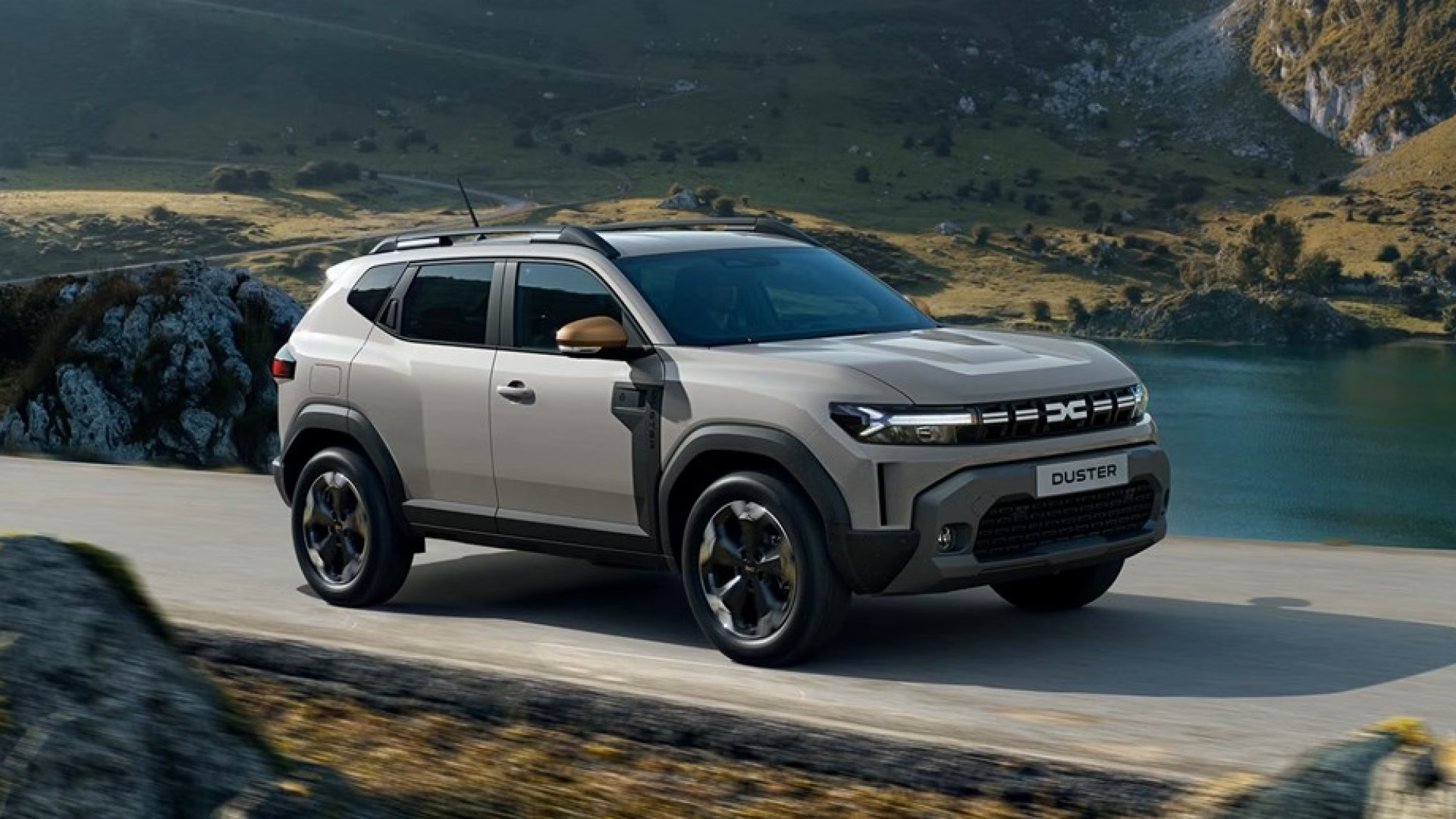
Duster

The icon of affordable adventure. The Duster is a simple, rugged, and incredibly capable compact SUV that offers unbeatable value. With its available 4x4 system, it's a no-nonsense, go-anywhere machine beloved for its honesty and toughness.

Production 2010-Present

Sandero

Europe's best-selling retail car and the champion of value. The Sandero is a spacious and reliable supermini that delivers everything you need and nothing you don't. The rugged Stepway version has become a massive success story on its own.

Production 2008-Present

Jogger

A brilliantly clever and affordable 7-seat family car. The Jogger is a unique blend of a station wagon, an SUV, and an MPV, offering an incredible amount of space and versatility for a shockingly low price. A masterpiece of practical design.

Production 2021-Present

Spring

Europe's most affordable electric car. The Dacia Spring is a game-changing, no-frills city EV designed to make zero-emissions driving accessible to everyone. It's a simple, lightweight, and incredibly efficient solution for urban mobility.

Production 2021-Present

Logan

The car that started the Dacia revolution. The original Logan was a robust and spacious sedan designed to be affordable for emerging markets. It became a huge success and established the brand's formula of simple, reliable, and value-focused engineering.

Production 2004-Present

1300 / 1310

The car that defined a nation. A license-built version of the Renault 12, the Dacia 1300 was the backbone of personal transportation in Romania for over 30 years. It is a symbol of endurance and a true national icon.

Production 1969-2004

Bigster

The future of the brand's adventurous spirit. The Bigster concept previews a larger, more rugged C-segment SUV that will take Dacia's 'robust and outdoor' philosophy to the next level, promising even more capability and value.

Production Announced

Author

HugeGarage Editor

Published

Updated

5 Min Read

From Pitesti to Paris

The story of Dacia is one of the greatest turnarounds in business history. Founded in 1966 in Romania to build Renaults under license, it spent decades building simple, somewhat crude cars for the Eastern Bloc.

In 1999, Renault bought the factory. But instead of just building old Clios, they had a radical idea: "Can we build a modern, reliable car for €5,000?" The result was the Logan. It was boxy and basic, but it had massive interior space and could handle rough Romanian roads. It became a global hit.

The Sandero and Duster Phenomenon

Dacia creates cars for people who buy a car with their calculator, not their heart.
The Sandero: It is frequently the best-selling car in Europe (beating the VW Golf and Tesla Model Y). Why? Because it offers the size of a Ford Fiesta for the price of a shoebox.
The Duster: An SUV that actually goes off-road. Because it is light and has short overhangs, a Duster can often follow a Land Rover Defender into the mud, much to the annoyance of the Land Rover driver.

"Good News!"

You cannot talk about Dacia without mentioning Top Gear. James May’s running gag—shouting "Good News! The Dacia Sandero!"—turned a boring budget brand into a pop culture icon. It made Dacia "cool" in an ironic, anti-snob way.

The "Parts Bin" Genius

How are they so cheap? Dacia is a master of recycling.
A Dacia might use a steering wheel from a Clio, door handles from a Megane, and window switches from a Twingo. The engines are modern Renault units, but the platform is often a generation older (and therefore fully paid for). You aren't buying "old" tech; you are buying "proven" tech.

The New Era: Bigster and Beyond

Recently, Dacia changed its logo to a rugged "Dacia Link" emblem and started using recycled plastics for body panels. The upcoming Bigster concept shows their ambition to enter larger segments, but the philosophy remains: No heated massaging seats, just a car that works.

Buying Advice: The Rational Choice

Buying a Dacia is the most financially sound decision a driver can make.

  • Depreciation: surprisingly, Dacias hold their value incredibly well. Because they are so cheap to begin with, they have less value to lose.
  • Safety: Don't expect 5-star autonomous safety systems. Dacia argues that their customers don't want to pay for sensors that beep at them. You get airbags and a strong cage, but you are the pilot.

Dacia isn't a status symbol; it is a badge of honor that says, "I have better things to spend my money on than a badge."

Frequently Asked Questions

Can I buy a new Dacia car in the USA in 2026?

As of 2026, Dacia does not officially sell vehicles in the United States. The brand, owned by the Renault Group, focuses on European and Mediterranean markets. While there are no current plans for a US launch, many of Dacia's platforms and technologies are shared with Renault and Nissan, brands that do have a global and North American presence.

Which Dacia models are eligible for US import in 2026?

Under the 25-year import rule, any Dacia manufactured in 2001 or earlier is officially eligible for legal import to the USA in 2026. This allows collectors to bring in classic models like the Dacia 1310 (a 1970s/80s icon based on the Renault 12) or early versions of the Dacia SupeRNova. These vehicles are exempt from modern FMVSS and EPA restrictions once they reach 25 years from their specific production date.

What are the 2026 performance specs for the Dacia Duster?

The 2026 Dacia Duster continues to be a rugged, budget-friendly SUV icon. The latest iteration features the TCe 130 mild-hybrid powertrain, which combines a 1.2-liter 3-cylinder turbocharged engine with a 48V starter-generator, producing 130 hp. For those seeking off-road capability, it offers a 4x4 version with impressive approach and departure angles, making it a favorite for enthusiasts who value utility over luxury.

How much does the 2026 Dacia Bigster cost?

The Dacia Bigster, launched in 2025 as the brand's largest SUV, is positioned as a C-segment family vehicle. In 2026, it is priced competitively in European markets, starting at approximately €25,000 to €30,000. It offers a more spacious interior than the Duster, designed to accommodate five passengers with significant luggage capacity, targeting the same segment as the Nissan Rogue or Volkswagen Tiguan.

What is the range of the 2026 Dacia Spring electric car?

The 2026 Dacia Spring is one of the most affordable electric vehicles (EV) in the world. It features a 26.8 kWh battery providing a WLTP range of approximately 140 miles (225 km). With a 48 kW (65 hp) motor, it is designed strictly as an urban commuter. While its range is lower than most US-market EVs, its price point—starting under €20,000 in Europe—makes it a benchmark for accessible zero-emission mobility.

Does the 2026 Dacia Sandero support Apple CarPlay and Android Auto?

Yes, the 2026 Dacia Sandero and its rugged sibling, the Sandero Stepway, come equipped with modern connectivity. Higher trim levels feature a 10-inch touchscreen with Wireless Apple CarPlay and Android Auto integration. Even base models include the "Media Control" system, which allows users to use their smartphone as the car's primary infotainment interface via a dedicated app.

What is the "Eco-G" powertrain in 2026 Dacia models?

Dacia remains a leader in LPG (Autogas) technology with its Eco-G 100 powertrain. This bi-fuel system allows the 1.0L turbocharged engine to run on both gasoline and LPG. In 2026, this setup is highly popular in Europe for its low CO2 emissions and fuel costs. A Dacia Sandero or Duster equipped with Eco-G can achieve a total combined range of over 745 miles (1,200 km) using both tanks.

How safe are 2026 Dacia cars according to Euro NCAP?

Dacia vehicles in 2026 are designed to meet essential safety standards rather than chasing high-star ratings through expensive electronic gadgets. While they often receive 2 or 3 stars from Euro NCAP, this is primarily due to the lack of complex "active" safety systems. Structurally, the cars are built on the CMF-B platform (shared with the Renault Clio), ensuring robust occupant protection in the event of a collision.

Is the Dacia Jogger available as a hybrid?

The 2026 Dacia Jogger—a versatile 7-seater crossover—is available with the Hybrid 140 powertrain. This system uses a 1.6L gasoline engine paired with two electric motors and a multi-mode clutchless gearbox. It can operate in all-electric mode for up to 80% of urban driving, significantly reducing fuel consumption while providing the seating capacity of a minivan in a more compact footprint.

What is the "Extreme" trim level on 2026 Dacia models?

The Extreme trim is Dacia's flagship outdoor-oriented specification for 2026. It features Copper Brown exterior accents, "MicroCloud" washable upholstery, and Extended Grip technology—an electronic system that optimizes the traction control for slippery surfaces like mud or snow. It is designed for adventurers who need a practical vehicle for camping and light trail use without the high cost of a dedicated 4x4.