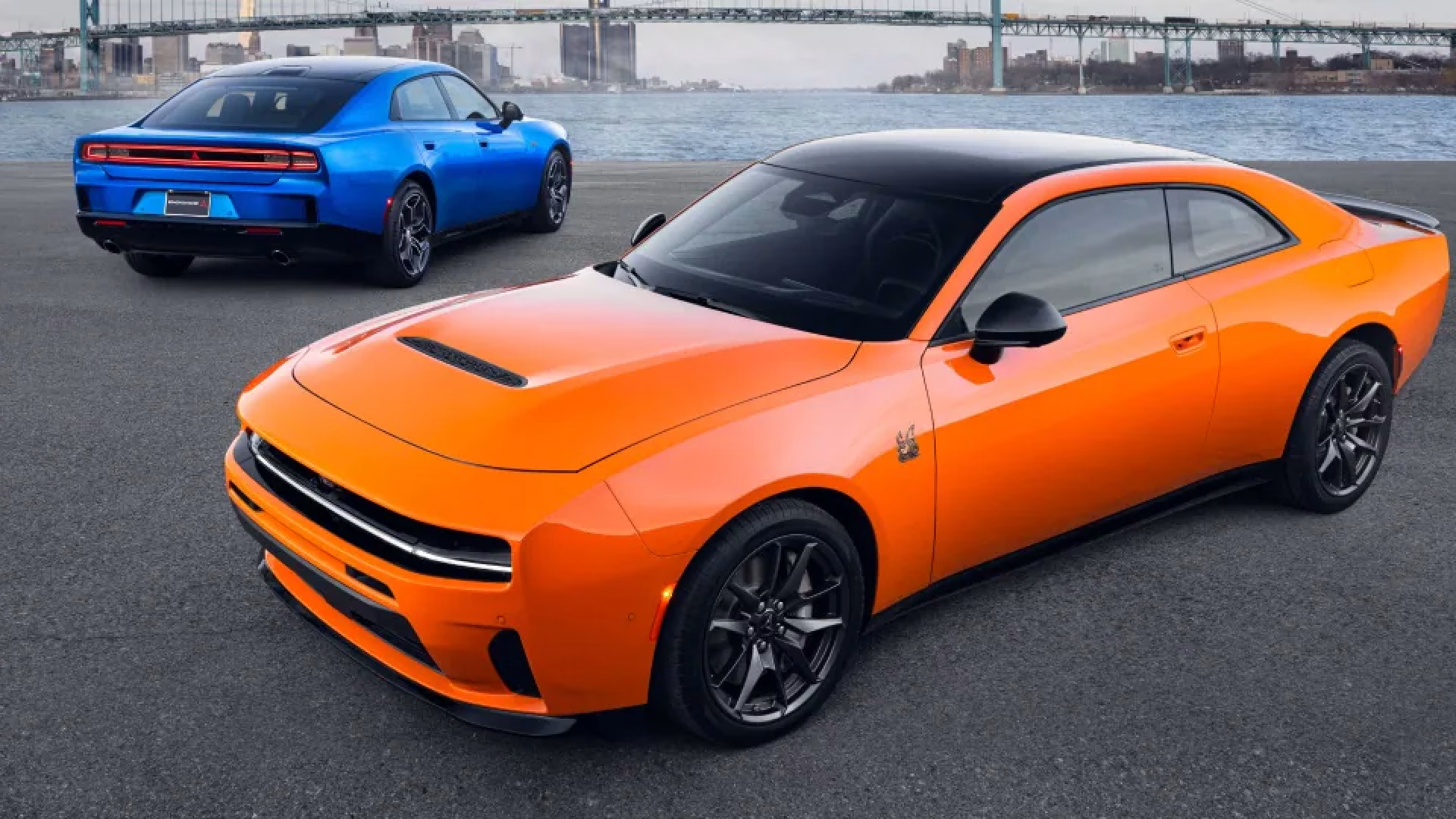
Dodge: The Brotherhood of Muscle

Dodge doesn't build cars for quiet commutes; they build adrenaline pumps. As the guardian of American muscle, Dodge is executing a bold maneuver: transitioning from legendary Hellcat V8s to electric "Banshee" and twin-turbo "Hurricane" engines without losing an ounce of attitude. It's the brotherhood of muscle, evolved.

Dodge Hero Vehicle

Model Lineup

Explore the current production vehicles.

Charger

An icon of American muscle. From the legendary R/T of the '60s to the world's only four-door muscle car, the Charger has always been about rebellious performance. Now, it's set to redefine the future with electric and Hurricane inline-six power.

Production 1966-Present

Challenger

The ultimate tribute to the golden age of muscle. The modern Challenger perfectly captured the retro style and street-dominating presence of its ancestor, packing it with extreme HEMI V8 power, culminating in the demonic, record-shattering SRT Demon 170.

Production 1970-1974, 2008-2023

Durango

The three-row SUV with the soul of a muscle car. The Durango stands alone by offering HEMI V8 power, including the ferocious SRT Hellcat version, giving it best-in-class towing and a thrilling driving experience no other family SUV can match.

Production 1998-Present

Hornet

Dodge's electrifying entry into the compact utility segment. The Hornet injects a lethal dose of performance into the class, with a powerful R/T plug-in hybrid model that delivers instant torque and attitude. It's the new king of the CUV hive.

Production 2023-Present

Viper

America's unapologetic, brutal, and legendary supercar. With its monstrous V10 engine and raw, driver-focused design, the Viper was a pure, untamed beast. It remains an icon of extreme performance and a testament to American automotive audacity.

Production 1992-2017

Grand Caravan

The vehicle that invented the minivan segment and became a cornerstone of American family life. For decades, the Grand Caravan was the go-to choice for practicality, known for its innovative Stow 'n Go seating and unbeatable value for families on the move.

Production 1984-2020

Journey

The affordable and versatile family crossover. The Journey offered the flexibility of available three-row seating and a budget-friendly price point, making it a popular choice for families needing space, practicality, and value in one package.

Production 2009-2020

Magnum

The bold, aggressive, and unforgettable muscle wagon. The Magnum combined the rear-wheel-drive platform and HEMI V8 power of the Charger with the utility of a station wagon. It’s a modern cult classic for enthusiasts who crave both power and practicality.

Production 2005-2008

Dart

A versatile nameplate that ranged from a sensible compact to a giant-killing muscle car. The classic Dart, especially in Demon and Swinger 340 form, was a lightweight terror on the streets. The modern version was a stylish and feature-packed compact sedan.

Production 1960-1976, 2013-2016

Avenger

The mid-size sedan with the aggressive attitude of a baby Charger. The Avenger offered a more muscular and bold alternative in a segment of conservative family cars, bringing a dose of Dodge's signature styling to the everyday commute.

Production 1995-2000, 2008-2014

Neon

The friendly-faced compact that hid a monster within. While the base Neon was a fun and affordable commuter, the turbocharged SRT-4 variant was a legend. It was a factory-built tuner car that terrorized V8s and redefined compact performance in America.

Production 1995-2005

Stealth

The high-tech, all-wheel-drive sports car of the 90s. A collaboration with Mitsubishi, the Dodge Stealth R/T Turbo was a futuristic machine with a twin-turbo V6, all-wheel steering, and active aerodynamics that could challenge the world's best.

Production 1991-1996

Daytona

The quintessential front-wheel-drive American sports coupe of the 80s and 90s. The Daytona, especially in its Shelby and IROC R/T trims, brought turbocharged power and sharp, angular styling to a new generation of performance enthusiasts.

Production 1984-1993

Coronet / Super Bee

A cornerstone of Dodge's muscle car dominance. The Coronet was a versatile mid-size platform that gave birth to the legendary Super Bee, a no-frills, budget muscle machine built for street performance with a powerful big-block engine and an attitude to match.

Production 1949-1976

Omni GLH

The original American hot hatch that 'Goes Like Hell'. Developed with Carroll Shelby, the Omni GLH and the ultra-rare GLHS were lightweight, turbocharged terrors. They were the spiritual ancestors to the SRT-4, proving that big fun could come in a small package.

Production 1984-1986

Author

HugeGarage Editor

Published

Updated

12 Min Read

If Toyota is a balanced breakfast and Volvo is a safety seminar, Dodge is a shot of whiskey and a fistfight in a biker bar. For the last two decades, this brand has had a singular focus: Horsepower. While other manufacturers were worrying about drag coefficients and mpg, Dodge was stuffing 700+ horsepower supercharged V8s into family sedans. They are the "Brotherhood of Muscle," a brand that celebrates the noise, the smoke, and the visceral violence of acceleration.

The End of an Era: The Last Call

We have to address the elephant—or rather, the Hellcat—in the room. The era of the Hemi V8 is over. The Challenger and Charger as we knew them (the LC/LD platforms) have bowed out. This wasn't a quiet exit; it was a viking funeral known as the "Last Call" editions, culminating in the Demon 170, a street-legal drag racer that runs a 9-second quarter-mile on corn whiskey (E85).

Why does this matter? Because it cemented Dodge’s legacy. They didn't let the V8 die with a whimper; they pushed it until it exploded with glory. That attitude is what fans are banking on for the future.

The New Reality: Fratzog and e-Muscle

How do you sell an electric car to a guy who has "No Replacement for Displacement" tattooed on his arm? That is Dodge’s current challenge. Their answer is the Charger Daytona.

This isn't a jelly-bean-shaped eco-pod. It looks like a muscle car. It has an actual wing on the front (the R-Wing) for aerodynamics. But the real kicker is the Fratzonic Chambered Exhaust. Dodge realized that silence is the enemy of emotion. So, they built an exhaust system for an electric car. It pushes air through pipes to create a 126-decibel roar that rivals the old Hellcat. Is it synthetic? Maybe. Is it loud? Absolutely. It’s Dodge telling the world, "We will not go quietly."

The Hurricane: Inline-6 Dominance

Not everyone is ready to plug in. For the petrolheads, Dodge is deploying the Hurricane Twin-Turbo Inline-6. Found in the new Charger "Sixpack" and the Durango, this engine is an engineering marvel. It produces more horsepower and torque than the outgoing 5.7L and 6.4L Hemis.

It’s smoother, revs faster, and hits harder. While we miss the V8 burble, the physics don't lie: the Hurricane is a better engine. It turns the Charger into a precision weapon rather than just a blunt instrument.

The Icons: Domestic, Not Domesticated

1. The Charger (Next-Gen)

The new Charger is a massive gamble. It’s available as a coupe (two-door) and a sedan (four-door), and as an EV or a gas burner. It is built on the STLA Large platform, which means it finally has a modern chassis capable of handling corners as well as it handles drag strips. It is the bridge between the analog past and the digital future.

2. The Durango: The 3-Row Muscle Car

The Dodge Durango is for the parent who had to sell the Challenger because they had twins. It is technically an SUV, but it drives like a muscle car that ate a Thanksgiving dinner. With best-in-class towing (up to 8,700 lbs), it can haul your race car to the track, or it is the race car. The SRT Hellcat versions (while they last) are collectibles, capable of embarrassing sports cars at stoplights while the kids watch cartoons in the back.

3. The Hornet: The Gateway Drug

Dodge needed an entry-level car. Enter the Hornet. It’s a compact crossover (sharing DNA with the Alfa Romeo Tonale), but Dodge injected it with testosterone. The Hornet R/T is a Plug-in Hybrid (PHEV) that offers a "PowerShot" feature—pull both paddle shifters, and you get an instant boost of electric horsepower for passing. It’s marketed as the most powerful compact utility vehicle in the segment. It’s aggressive, nimble, and surprisingly quick.

The Culture: Mopar or No Car

Dodge owners are a different breed. They don't just drive; they modify. The Direct Connection program allows you to buy factory-backed performance parts—stage kits, tuners, even crate engines—straight from the dealer without voiding your warranty. This is unheard of in the modern automotive world. It keeps the hot-rodding spirit alive in an era of locked ECUs and proprietary software.

Styling: The "Angry Kitchen Appliance" Factor

Most modern cars look like angry kitchen appliances. Dodge leans into the "angry" part but keeps the retro soul. The widebody kits, the hood scoops, the vibrant "High Impact" colors like Plum Crazy Purple, Sublime Green, and Destroyer Grey—Dodge treats paint color as a personality test. You don't buy a Dodge to blend in with traffic; you buy one to part it.

The "Banshee" Future

The top-tier electric performance trim is now called Banshee. It uses an 800-volt architecture (twice the voltage of most EVs), allowing for faster charging and cooler running during back-to-back drag runs. It features a multi-speed transmission (eRupt) to give drivers the "shift" feeling that is missing in single-gear EVs. Dodge is trying to engineer "imperfection" back into the driving experience, because perfection is boring.

Why Dodge Matters to You

You choose a Dodge because you reject the sanitization of the driving experience. You want to feel the road. You want a car that has a face, not a fascia. Whether it’s the utilitarian aggression of the Durango or the futuristic muscle of the Charger Daytona, a Dodge is a statement that you still enjoy the act of driving.

The Hugegarage Verdict

Dodge is walking a tightrope over a canyon of fire. They are ditching their most famous asset (the V8) to embrace a future their core audience is skeptical of. But if any brand has the swagger to pull off an "Electric Muscle Car" that actually feels cool, it’s Dodge. They are the antidote to the soulless commuter car.

Frequently Asked Questions

Why did Dodge discontinue the Hemi V8 Charger and Challenger?

The decision to end production of the current generation Charger and Challenger (and the Hemi® V8 platform) after the 2023 "Last Call" models was driven by tightening federal emissions regulations and the brand's strategic shift toward performance electrification.

Dodge is transitioning to the STLA Large platform, which supports the new "Charger Daytona" electric muscle cars and the "Hurricane" Twin-Turbo Inline-6 engines, aiming to deliver higher performance figures than the outgoing V8s while meeting future efficiency standards.

What is the difference between the R/T and Scat Pack trims?

While both are high-performance V8s, they offer significantly different driving experiences:

  • R/T (Road/Track): Features the 5.7L Hemi V8 (approx. 370-375 hp). It is a great daily driver with classic muscle car sound.
  • Scat Pack: Steps up to the massive 6.4L (392 cubic inch) Hemi V8 (485 hp). It includes upgraded Brembo® brakes, stiffer suspension, and launch control. It is often considered the "sweet spot" for naturally aspirated power.
What does SRT stand for on a Dodge?

SRT stands for Street & Racing Technology. It is the high-performance automobile group within the company responsible for developing the most extreme vehicles in the lineup.

When you see an SRT badge (like on a Hellcat or Durango SRT 392), it means the vehicle features track-tuned suspension, high-performance braking systems, and the highest output engines available. It represents the pinnacle of the "Brotherhood of Muscle."

Is the new Dodge Charger only electric?

No. While the headline-grabber is the all-electric Charger Daytona (the world's first electric muscle car), Dodge understands that not everyone is ready for EVs.

The new Charger lineup will also include the "SIXPACK" models. These will be powered by the high-output 3.0L Hurricane Twin-Turbo Inline-6 engine, delivering 420 or 550 horsepower, offering a gas-powered alternative with V8-beating performance.

What is the Dodge "Red Key" vs. "Black Key"?

This is a legendary feature found specifically on SRT Hellcat models. The car comes with two distinct key fobs:

  • Black Key: Limits the engine output to "only" 500 horsepower. This is for valet parking, daily commuting, or letting a friend drive.
  • Red Key: Unlocks the full potential of the Supercharged 6.2L Hemi V8 (707+ horsepower), adjusting the transmission shift points and suspension for maximum attack.
Is the Dodge Durango good for towing?

The Dodge Durango is arguably the best towing SUV in its class. While most mid-size unibody SUVs top out around 5,000 lbs, the Durango is built differently.

When equipped with the Tow N Go package and the 5.7L Hemi or the 6.4L SRT engine, the Durango can tow up to 8,700 lbs. This rivals many full-size truck-based SUVs (like the Tahoe), allowing you to haul heavy boats or campers without needing a pickup truck.

What is the "Fratzog" logo seen on new Dodge concepts?

The Fratzog is a triangular logo that was originally used by Dodge on its vehicles from 1962 to 1976 during the golden age of muscle cars.

Dodge has revived this symbol to represent its electrified future. You will see the illuminated Fratzog badge on the grille of the new Charger Daytona EV. It serves as a bridge, connecting the brand's heritage of performance with its modern electric technology.

Does Dodge make an AWD muscle car?

Yes, Dodge offers All-Wheel Drive (AWD) on both the Charger and Challenger, but primarily on the V6 models (SXT and GT trims).

This makes them viable year-round daily drivers for people living in snowy states like Michigan or Colorado. The AWD system includes an active transfer case and front-axle disconnect to save fuel when traction isn't needed. Note that the V8 models (R/T, Scat Pack, Hellcat) are almost exclusively Rear-Wheel Drive (RWD).

What is the Dodge Hornet?

The Dodge Hornet is the brand's entry into the compact utility vehicle (CUV) segment. It is marketed as a "performance gateway" vehicle.

Unlike typical crossovers that focus solely on fuel economy, the Hornet prioritizes speed and handling. It comes in two flavors: the GT (2.0L Turbo) and the R/T (a Plug-in Hybrid Performance vehicle) which features the PowerShot feature, giving a temporary 30-horsepower boost for passing power.

Are Dodge Hellcat engines reliable?

Despite their massive power output, the Hellcat 6.2L Supercharged engines have proven to be surprisingly robust when maintained correctly.

The engine block, crankshaft, and pistons are forged and over-engineered to handle the stress of 700+ horsepower. Common issues usually relate to the peripheral components like supercharger bearing whine or cooling system hoses rather than internal engine failure. However, consumables like tires and brake pads will wear out very quickly if driven aggressively.