
The B-Body Genesis: Designing a Fastback Brawler
Dodge arrived slightly late to the mid-1960s youth market explosion, but they arrived with heavy artillery. The original 1966 Charger emerged as a fastback variant of the mid-size Coronet, utilizing the robust Chrysler B-body architecture. Designers aimed directly at the emerging premium muscle segment, giving the car a sweeping roofline, hidden electrically actuated headlamps, and a stunning full-length center console. While the standard 318 cubic-inch V8 provided adequate cruising power, the true mechanical terror lurked on the options sheet: the 426 cubic-inch Elephant motor.
The 1968 model year completely rewrote automotive design history. The fastback roof vanished, replaced by a flying buttress "tunnel roof" and an aggressive "Coke-bottle" side profile that physically bulged over the wheel arches. This second-generation Charger looked like it was traveling at 100 mph while parked. Caging the massive torque of the 440 Magnum and 426 HEMI required severe structural reinforcement. Engineers utilized a rugged unibody construction, heavy-duty torsion bar front suspension, and asymmetrical rear leaf springs to prevent axle hop under violent acceleration.
Aerodynamic Warfare: The Charger Daytona
Brute force alone cannot conquer atmospheric resistance at high speeds. During the late 1960s, Dodge engaged in a fierce aero-war within NASCAR. The standard recessed grille and tunneled rear window of the '68 Charger created massive aerodynamic drag, causing the car to lift dangerously at super-speedways. The engineering response was the 1969 Charger Daytona. Dodge bolted a massive 18-inch sheet metal nose cone directly to the front fenders, slicing through the air and creating critical front-end downforce.
To eliminate rear lift, they installed a towering 23-inch cast-aluminum rear stabilizer wing, bolted directly to the rear subframe through the trunk floor. The rear window was fitted with a flush-mounted aerodynamic plug. These radical modifications dropped the drag coefficient to a remarkably sleek 0.28. The result was absolute, terrifying speed.
On March 24, 1970, buddy Baker piloted a Dodge Charger Daytona around Talladega Superspeedway at 200.447 mph, becoming the first driver in NASCAR history to shatter the 200 mph barrier on a closed course. The vehicle proved so aerodynamically superior that racing officials completely banned the "Wing Cars" the following season.
1969 Dodge Charger R/T 426 HEMI Specifications
- Engine Architecture
- 426 cu in (6980 cm3) V8, Hemispherical Combustion Chambers
- Induction
- Dual Carter AFB Four-Barrel Carburetors
- Peak Horsepower
- 425 hp @ 5,000 RPM
- Peak Torque
- 490 lb-ft @ 4,000 RPM
- Transmission
- A833 4-Speed Manual with Hurst Shifter
The Malaise Era and the L-Body Anomaly
The 1970s oil crisis and suffocating emissions regulations strangled the American V8. The Charger nameplate lost its muscular identity, briefly morphing into a bloated personal luxury coupe cloned directly from the Chrysler Cordoba. By the early 1980s, the landscape had shifted entirely. Dodge resurrected the Charger badge on a front-wheel-drive, L-body subcompact architecture. While purists wept, Carroll Shelby saw potential.
The Shelby Charger utilized a heavily modified 2.2-liter turbocharged inline-four cylinder. By manipulating fuel delivery and increasing boost pressure to 12 psi, the lightweight hatchback produced up to 174 horsepower in the GLHS (Goes Like Hell S'more) variants. It lacked the visceral roar of a big-block V8, but the turbo lag and sudden surge of boost provided a distinct, frenetic driving experience that dominated the emerging hot-hatch segment while severely restricting tailpipe CO2 emissions compared to its ancestors.
The LX Resurrection: Adding Doors, Restoring Fury
Dodge stunned the industry in 2006 by bringing the Charger back to its RWD roots-but with four doors. Built upon the LX platform developed during the DaimlerChrysler merger, the chassis utilized a short/long arm front suspension loosely derived from the Mercedes-Benz W220 S-Class and a five-link rear suspension from the W211 E-Class. This provided a level of handling compliance never before seen in an American muscle car.
The 5.7-liter HEMI V8 returned, utilizing a modern pushrod design with dual spark plugs per cylinder for optimal combustion efficiency. To balance aggression with highway MPG, engineers integrated the Multi-Displacement System. Hydraulic lifters selectively deactivated the intake and exhaust valves on four cylinders during light-load cruising, essentially turning the 340-horsepower V8 into a hyper-efficient four-cylinder until the driver demanded full throttle.
The Hellcat Phenomenon: Caging 707 Horsepower
The true architectural renaissance arrived with the LD generation, specifically the 2015 introduction of the SRT Hellcat. Dodge assigned the Street and Racing Technology (SRT) team a singular goal: build the fastest, most powerful four-door sedan in global production. The heart of this monster is a heavily reinforced 6.2-liter V8 topped with a 2.38-liter twin-screw IHI supercharger.
Compressing massive volumes of air generates extreme thermal friction. The supercharger features integrated dual water-to-air charge coolers that drop the intake air temperature dramatically before it enters the cylinders, preventing catastrophic pre-ignition. The fuel delivery system is equally violent, utilizing a dual-stage fuel pump and massive half-inch fuel lines. At full throttle, the Hellcat can drain its entire 18.5-gallon fuel tank in just 13 minutes.
All 707 horsepower routes through a specialized ZF 8HP90 eight-speed automatic transmission. The ECU cuts torque for a fraction of a millisecond during upshifts, allowing the heavy-duty clutch packs to engage seamlessly. This powertrain transformed a heavy family sedan into a 204-mph cruise missile, forcing high-end European OEM brands to completely re-evaluate their performance benchmarks.
The Hellcat engine requires 30,000 liters of ambient air per minute at maximum RPM. To feed this mechanical leviathan, engineers hollowed out the inner driver-side headlight, creating a direct ram-air intake channel that funnels high-velocity oxygen straight into the airbox.
SRT Hellcat Redeye Specifications
- Engine Block
- 6.2L (6166 cm3) Cast-Iron Block, Forged Steel Crankshaft
- Forced Induction
- 2.7-Liter Twin-Screw Supercharger, 14.5 psi Boost Pressure
- Peak Horsepower
- 797 hp @ 6,300 RPM
- Peak Torque
- 707 lb-ft @ 4,500 RPM
- Top Speed
- 203 mph
Widebody Dynamics and Contact Patch Management
Pushing nearly 800 horsepower through two rear tires creates a severe traction deficit. To keep the vehicle out of the ditch, Dodge engineered the Widebody package. Massive composite fender flares extend the vehicle's width by 3.5 inches, allowing engineers to stuff 11-inch-wide forged aluminum wheels at all four corners. Wrapped in sticky 305/35ZR20 Pirelli P-Zero tires, the physical contact patch increased exponentially.
The suspension geometry was completely overhauled to manage the increased lateral grip. Stiffer spring rates, upgraded anti-roll bars, and adaptive three-mode Bilstein dampers keep the 4,500-pound sedan planted during high-speed cornering. Stopping power relies on massive 15.4-inch two-piece slotted rotors clamped by six-piston Brembo calipers up front, shedding kinetic energy with absolute violence.
The STLA Large Platform and the EV Horizon
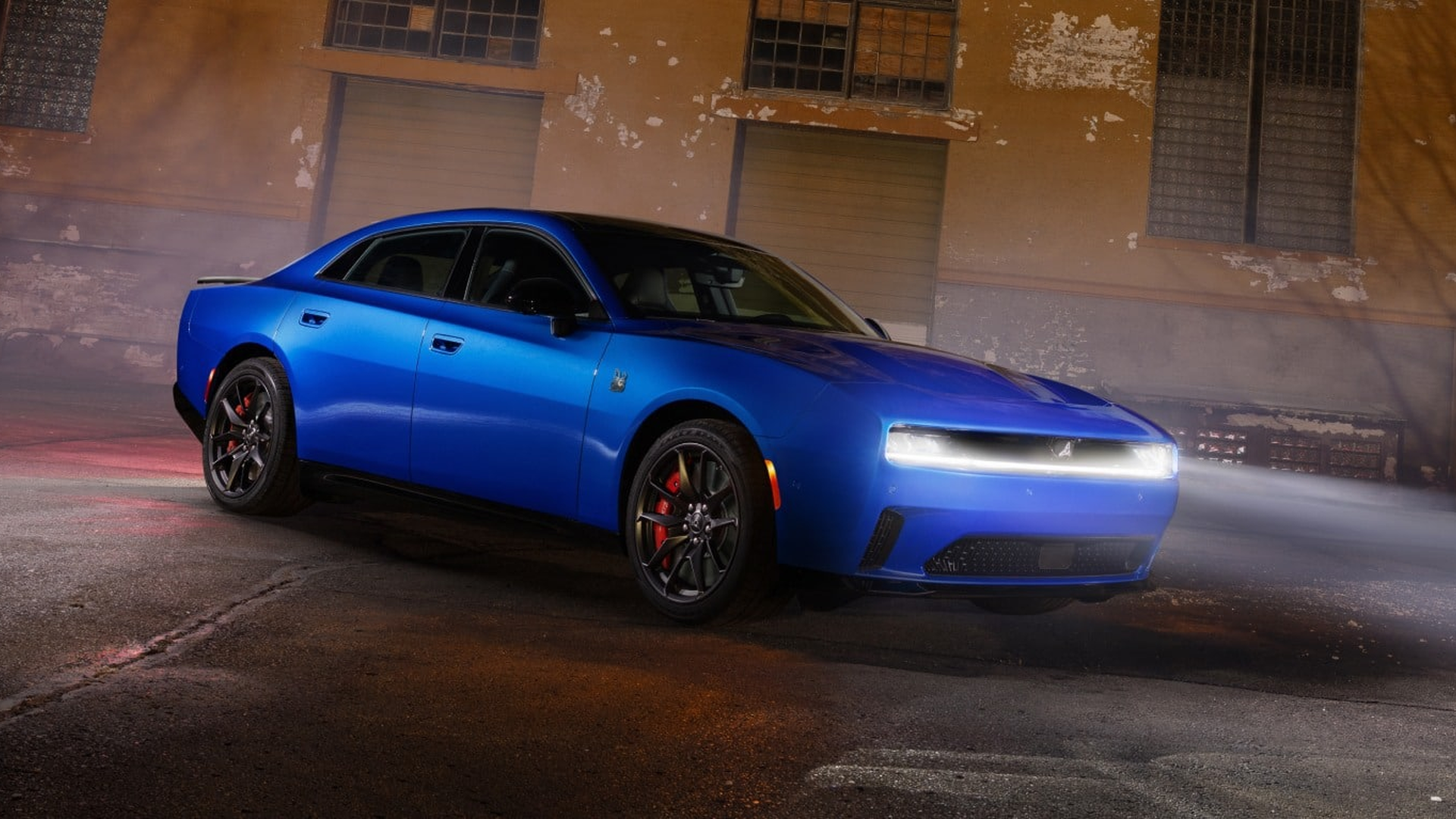
The era of the supercharged HEMI V8 officially concluded in 2023, making way for the most radical shift in the Charger's history. The forthcoming generation migrates to the highly modular STLA Large platform. Dodge refuses to let the muscle car die in the electric age. The Charger Daytona SRT EV utilizes an 800-volt "Banshee" propulsion system, utilizing standard AWD to instantly vector torque and deliver off-the-line acceleration that humiles the outgoing Hellcat.
To retain the visceral, acoustic theater of a muscle car, engineers developed the Fratzonic Chambered Exhaust. This system does not rely on cheap artificial speaker noise. It pushes air through a physical amplifier and tuning chamber located at the rear of the vehicle, generating a bone-rattling 126-decibel roar that physically mimics the sound pressure level of a supercharged V8.
For buyers resisting total electrification, the chassis also accepts the new Hurricane engine. This 3.0-liter twin-turbocharged inline-six discards heavy displacement for pressurized efficiency. By utilizing Plasma Transfer Wire Arc cylinder coatings to reduce friction and twin low-inertia turbochargers to eliminate lag, the High Output Hurricane produces 550 horsepower. The Dodge Charger proves that whether burning high-octane fuel or draining high-voltage lithium-ion batteries, American muscle will never quietly fade away.