
The 1981 Genesis and the D/W Series Architecture
Chrysler officially resurrected the Ram hood ornament for the 1981 model year, applying it to their aging but fiercely durable D-Series (two-wheel drive) and W-Series (four-wheel drive) pickup trucks. The underlying architecture relied on a traditional, heavy-gauge stamped steel ladder frame. Engineers prioritized absolute rigidity over ride comfort, utilizing massive front and rear leaf springs that allowed the vehicle to carry immense payloads without suffering severe chassis sag. This era of the Dodge Ram was an unapologetic workhorse, devoid of luxury and focused entirely on physical labor.
Propulsion options included the legendary 225 cubic-inch Slant-6 engine. By canting the cylinder block 30 degrees, engineers accommodated unusually long, equal-length intake manifold runners that generated exceptional low-end torque. Buyers requiring heavier towing capacity selected the 318 cubic-inch (5.2-liter) or 360 cubic-inch (5.9-liter) LA-series V8 engines. While these carbureted blocks were virtually indestructible, they lacked the raw thermodynamic efficiency necessary to conquer the emerging heavy-duty recreational towing market.
The 1989 Cummins Turbo Diesel Intervention
By the late 1980s, Dodge truck sales were languishing. Domestic rivals utilized anemic, naturally aspirated V8 diesels that struggled under heavy loads. Dodge executed a brilliant corporate pivot by partnering with Cummins Engine Company. Rather than designing a light-duty diesel from scratch, engineers physically shoehorned an industrial-grade 5.9-liter 12-valve inline-six engine (the 6BT) directly into the heavy-duty W250 and W350 chassis.
This engine represented a massive paradigm shift. It utilized direct fuel injection powered by a robust Bosch VE rotary injection pump, completely eliminating the inefficient pre-combustion chambers used by competitors. A high-flow Holset turbocharger forced dense atmospheric oxygen into the cast-iron cylinder head. The result was 160 horsepower and an earth-moving 400 lb-ft of torque available just above idle. You engage the heavy clutch, apply light throttle, and the immense rotational mass of the inline-six pulls a 10,000-pound dual-axle trailer up a steep grade without breaking a sweat.
The integration of the 5.9-liter Cummins inline-six single-handedly rescued the Dodge truck division from the brink of extinction. It proved that American consumers demanded authentic, commercial-grade diesel architecture in a consumer-packaged three-quarter-ton chassis.
1989 Cummins 6BT Technical Specifications
- Engine Architecture
- 5.9L (5883 cm3) Inline-6, Cast-Iron Block and Cylinder Head
- Valvetrain
- Overhead Valve (OHV), 2 Valves per Cylinder (12-Valve)
- Induction
- Holset Turbocharger with Direct Fuel Injection
- Peak Horsepower
- 160 hp @ 2,500 RPM
- Peak Torque
- 400 lb-ft @ 1,700 RPM
The 1994 "Big Rig" Redesign: Shattering Industry Aesthetics
Entering the 1990s, the physical design of the American pickup truck was stagnant, defined by flat, aerodynamic brick profiles. Executive Bob Lutz demanded a complete psychological overhaul of the Dodge Ram. Designers observed highway semi-trucks, translating their imposing, aggressive structures to a consumer half-ton platform. The resulting 1994 BR/BE generation dropped the front fenders dramatically below the hood line, creating a towering, crosshair grille that immediately dominated rear-view mirrors.
This "Big Rig" aesthetic was backed by serious structural engineering. The cab was significantly enlarged, creating the most spacious interior in the class. The center console doubled as a mobile office, featuring integrated clipboards and massive storage vaults for contractors. The aerodynamics were highly functional; the sloped windshield and sculpted front bumper drastically reduced highway wind noise, allowing the truck to slice through the atmosphere far more efficiently than its boxy predecessors, subsequently improving highway fuel range and lowering tailpipe CO2 output.
Magnum Power and the Iron V10
To support the aggressive new sheet metal, Dodge revolutionized their internal combustion lineup. They upgraded the aging LA-series V8s into the Magnum family. Engineers integrated multi-port electronic fuel injection and completely redesigned the cylinder heads. High-flow intake runners and optimized combustion chambers allowed the 5.9-liter Magnum V8 to exhale efficiently, producing a highly responsive 230 horsepower and 330 lb-ft of torque.
For buyers demanding maximum towing capacity but despising the acoustic clatter of a diesel engine, Dodge cast a massive 8.0-liter iron-block V10. Based loosely on the Magnum architecture, this heavy-duty ten-cylinder engine was engineered strictly for brute force rather than high-RPM horsepower. Generating 300 horsepower and 450 lb-ft of torque, it routed power through a heavy-duty NV4500 five-speed manual transmission, providing relentless, linear thrust capable of hauling massive fifth-wheel campers over high-altitude mountain passes without suffering thermal degradation.
The SRT-10: Caging the Viper
In 2004, the Street and Racing Technology (SRT) division executed one of the most unhinged engineering projects in automotive history. They extracted the all-aluminum 8.3-liter V10 engine from the Dodge Viper supercar and dropped it directly into a standard-cab, short-bed Ram 1500 chassis. This was not a visual appearance package; it was a dedicated track weapon disguised as a pickup.
Producing a staggering 500 horsepower, the SRT-10 required massive chassis intervention to prevent it from tearing itself apart. The heavy-duty Tremec T-56 six-speed manual gearbox channeled power to a Dana 60 rear axle. To mitigate violent wheel hop during aggressive drag-strip launches, engineers installed an additional horizontal shock absorber mounted directly to the rear differential housing. Stiffer spring rates and custom-valved Bilstein dampers dropped the ride height, allowing the 5,000-pound truck to corner remarkably flat.
Aerodynamics played a critical role in keeping the truck planted. The deep front splitter reduced high-speed underbody turbulence, while the functional rear spoiler generated essential downforce over the unloaded rear axle. In February 2004, the Ram SRT-10 shattered the Guinness World Record for the fastest production pickup truck, achieving a verified top speed of 154.587 mph.
Ram SRT-10 Engineering Metrics
- Engine Block
- 8.3L (8275 cm3) V10, Aluminum Block and Cylinder Heads
- Peak Horsepower
- 500 hp @ 5,600 RPM
- Peak Torque
- 525 lb-ft @ 4,200 RPM
- Transmission
- Tremec T-56 6-Speed Manual
- Braking Hardware
- 15.0-inch Front Rotors, TRW 4-Piston Calipers
The Mega Cab and Kinematic Expansion
Observing a massive consumer shift toward using pickup trucks as primary family vehicles, Dodge introduced the Mega Cab in 2006. Achieving this required brilliant modular engineering. Rather than designing an entirely new unibody skeleton, engineers utilized the existing heavy-duty (2500/3500) long-bed ladder frame. They bolted a short box onto the rear, dedicating the remaining 20 inches of wheelbase entirely to the passenger cabin.
This structural expansion provided unprecedented interior volume. Rear passengers enjoyed expansive legroom, and the rear seats gained the ability to physically recline-a feature entirely absent in the pickup truck segment at the time. The Mega Cab proved that extreme towing capability and premium passenger comfort could successfully coexist on a single OEM platform.
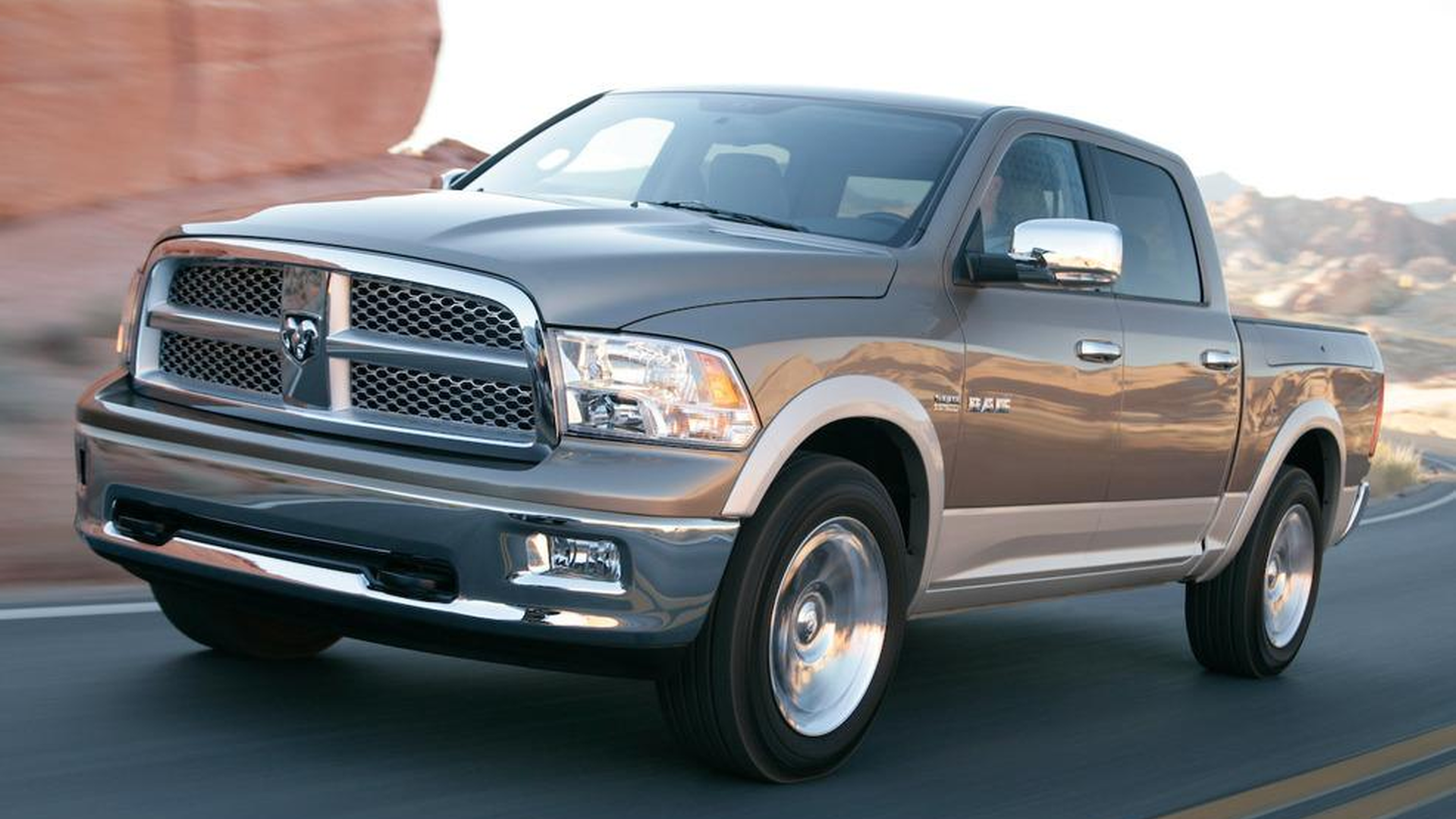
The 2009 DS Generation: Coil-Spring Revolution
For decades, half-ton trucks suffered from a harsh, unforgiving ride quality when their cargo beds were empty, completely dependent on heavy, stacked rear leaf springs designed solely for maximum payload capacity. With the 2009 DS generation Ram 1500, Dodge engineers executed a radical architectural shift. They completely abandoned rear leaf springs.
The new chassis utilized a highly sophisticated five-link rear suspension supported by heavy-duty coil springs. Four longitudinal links managed axle wrap and acceleration forces, while a massive lateral panhard bar prevented the solid rear axle from shifting side-to-side during high-speed cornering. This geometric overhaul completely eradicated the violent "bed bounce" that plagued trucks over highway expansion joints. It provided the compliant, smooth ride of a large luxury sedan while actively maintaining a competitive 1,000-plus pound payload rating.
The bed walls were completely redesigned to incorporate the RamBox cargo management system. By utilizing the hollow cavities above the rear wheel wells, designers created lockable, illuminated, and drainable storage bins integrated directly into the exterior sheet metal. This allowed owners to securely store power tools or pack the bins with ice and beverages without sacrificing the flat 4x8 footprint of the primary cargo bed.
The Evolution into an Independent Brand
By 2010, the Dodge Ram had evolved far beyond its agricultural roots. The truck lineup possessed a distinct mechanical identity, vastly different from the high-performance muscle cars occupying Dodge showrooms. Recognizing this market divergence, Chrysler executed a massive corporate restructuring, officially separating the vehicles into their own dedicated brand. While the modern vehicles drop the "Dodge" prefix, they remain the direct mechanical descendants of this aggressive, boundary-pushing lineage. The Dodge Ram serves as the definitive blueprint for modern truck engineering, proving that heavy-duty towing capability and premium aerodynamic design are not mutually exclusive concepts.