
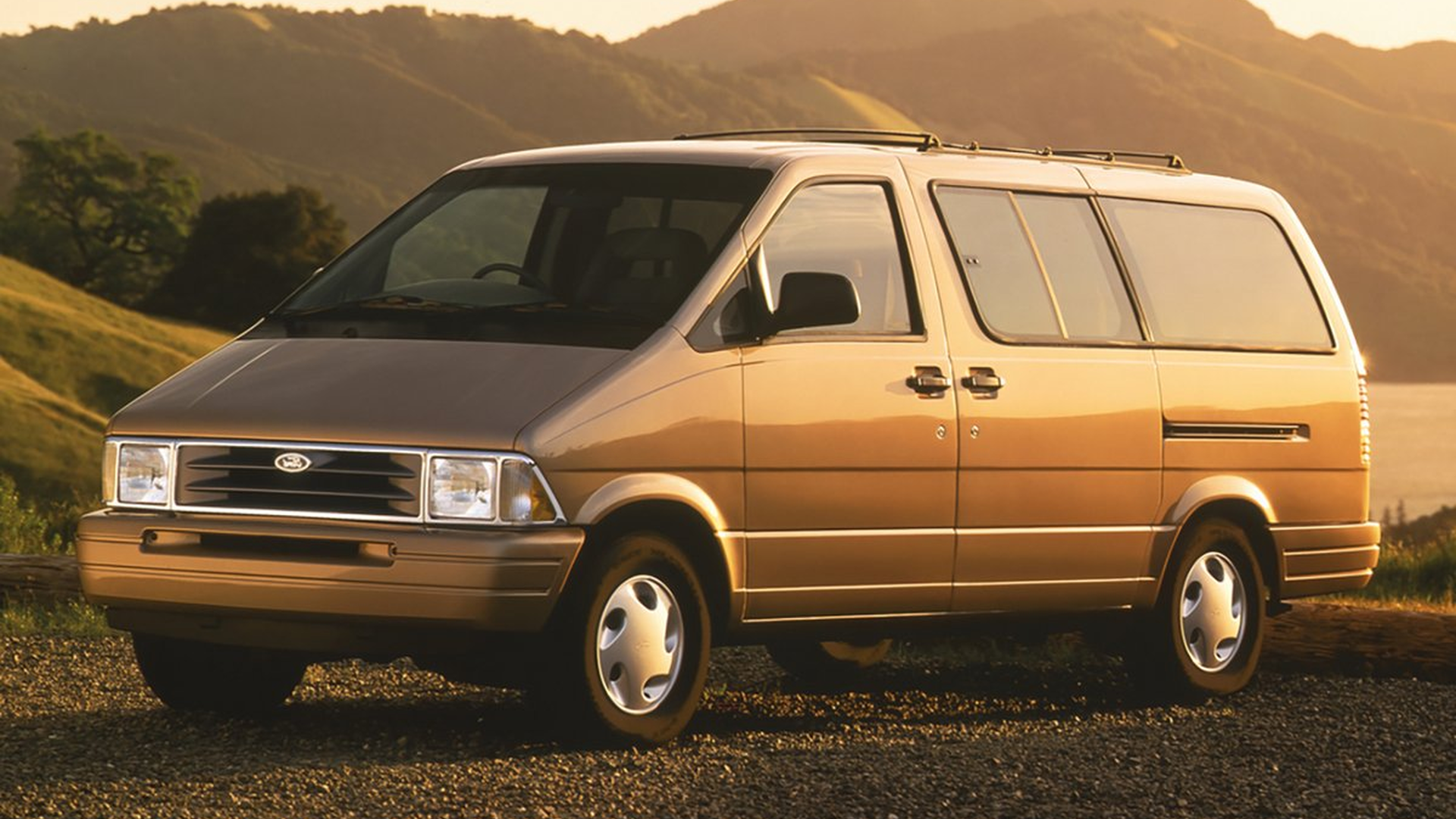
The Space Age Workhorse
In the mid-1980s, the automotive world was changing fast. Chrysler had invented the minivan segment with the front-wheel-drive Caravan, which drove like a car. Fordâs answer was different. They looked at the needs of American families who owned boats, campers, and horse trailers, and built the Ford Aerostar. It was a unibody van, but it sat on a rear-wheel-drive chassis with a solid rear axle, sharing suspension DNA with the Ford Ranger pickup. It was tough, capable, and styled like a NASA shuttlecraft.
When you browse the Aerostar listings on Hugegarage, you are looking at a relic of a time when minivans were treated as serious utility vehicles. While modern vans struggle to tow a jet ski, the Aerostar was rated to tow nearly 5,000 lbs. It was the preferred choice for the blue-collar family who needed one vehicle to do everything: the school run, the hardware store run, and the weekend camping trip.
The E-4WD Innovation: In 1990, Ford introduced the Electronic 4-Wheel Drive (E-4WD) system. It was one of the first sophisticated AWD systems in a van, using a dedicated computer to monitor wheel speed and engage the front axle instantly in snow. It made the Aerostar a tank in winter conditions, further separating it from the FWD competition.
Engineering: The Truck-Van Hybrid
The Aerostar was unique because it straddled two worlds.
Unibody Construction: Unlike the full-size Econoline (which had a separate frame), the Aerostar was a unibody for better space efficiency.
Truck Suspension: The rear suspension used coil springs and a solid live axle with a 3-link setup. This gave it a stiff ride when empty but exceptional stability when fully loaded.
Powertrain: The Cologne Dynasty
The Aerostar relied on heavy-duty iron-block engines imported from Ford of Germany.
- 3.0L Vulcan V6
- The Base Engine. Shared with the Taurus. 145 HP. Reliable but struggled to move the heavy, brick-shaped van at highway speeds.
- 4.0L Cologne V6
- The Towing King. Introduced in 1990. 160 HP / 225 lb-ft Torque. This pushrod engine is legendary for its durability. It provided the low-end grunt needed to pull a trailer up a boat ramp.
The 5-Speed Manual Rarity
Believe it or not, early Aerostars could be ordered with a 5-speed manual transmission (Toyo Kogyo or Mitsubishi). A manual, rear-wheel-drive minivan is a unicorn today and highly sought after by eccentric collectors.
Interior: Function Over Form
The interior was utilitarian. The dashboard was digital on high-trim Eddie Bauer models, featuring a futuristic vacuum fluorescent display.
The Seats: The rear bench seats were heavyâremoving them required two strong adultsâbut once out, the Aerostar offered 170 cubic feet of cargo space. You could slide a 4x8 sheet of plywood flat on the floor.
The Eddie Bauer Edition
The Aerostar was one of the first trucks to receive the full luxury treatment. The Eddie Bauer trim added two-tone tan paint, captainâs chairs with lumbar support, a premium sound system, and a roof console with a trip computer. It was the Lincoln Town Car of minivans.
Common Issues Maintenance
1. Transmission Overheating (A4LD)
The A4LD 4-speed automatic was the weak link. It was a light-duty transmission asked to do heavy-duty work. Towing in Overdrive would cook the fluid and destroy the bands. Always tow in Drive (3rd gear) and install an auxiliary transmission cooler.
2. Rust (Rocker Panels)
The Aerostar had complex lower body cladding that trapped road salt. The rocker panels and sliding door tracks are prone to severe rot in northern states.
3. Power Steering Whine
The Ford C2 power steering pump is famous for its Ford Whine. It usually doesn't affect performance, but it is loud. Flushing the fluid with Type F or Mercon V can help quiet it down.
Why Was It Cancelled?
The Aerostar was a sales success, selling over 2 million units. However, by 1997, the market had shifted decisively to front-wheel drive for better interior packaging and ride comfort. The Ford Windstar (introduced in 1995) was the future. Ford kept the Aerostar in production alongside the Windstar for two years because fleet buyers and towing enthusiasts refused to give it up, but it was finally discontinued on August 22, 1997.
Conclusion: The Last of the RWD Vans
The Ford Aerostar represents a path not taken. It proved that a minivan could be tough, capable, and fun to drive (in a truck-like way). Today, a clean AWD Aerostar is a cult classic for Van Life builders who want something smaller than a Sprinter but more capable than a Sienna. It is the only minivan that earns respect at a truck stop. Explore the dimensions below.