
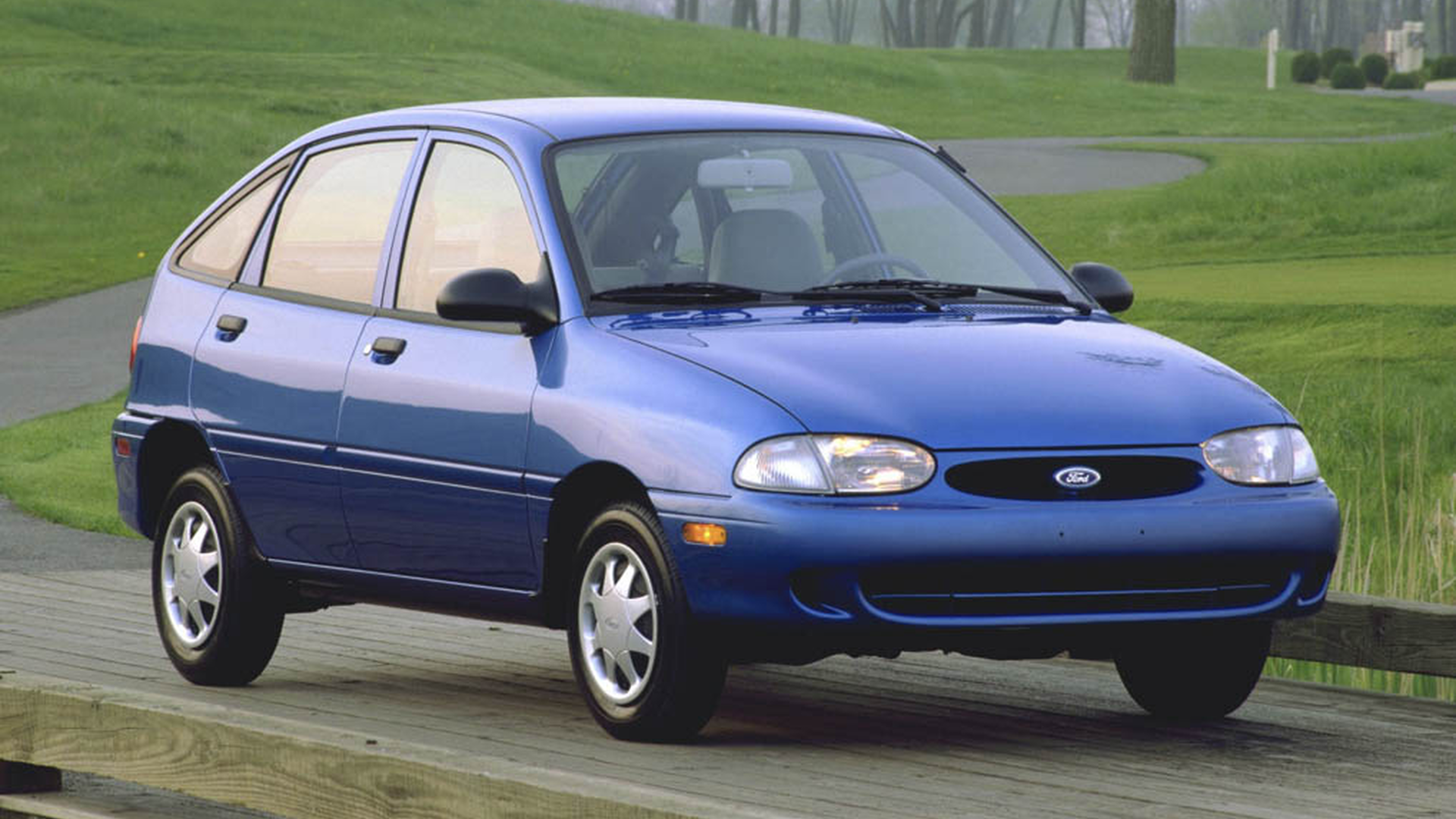
The Happy Jellybean
In 1994, the sharp-edged Ford Festiva was retired. Its replacement was the Ford Aspire. Like the Festiva, it was designed by Mazda and built by Kia in South Korea. But unlike the Festiva, it was round. Very round. It looked like a jellybean or a computer mouse. It was the cheapest car Ford sold, and it made no apologies for it. The marketing tagline was The first car you can really aspire to, which was perhaps a bit optimistic, but it was honest transportation.
When you browse the Aspire listings on Hugegarage, you are looking at a survivor of the disposable car era. Most Aspires were driven hard and scrapped, but the ones that remain are testaments to the durability of 90s Korean/Japanese engineering. It is not fast, it is not luxurious, but it will start every morning and get you to work for pennies.
The Avella Connection: In the rest of the world, this car was known as the Kia Avella. It was one of the cars that helped Kia establish a global manufacturing footprint before they started selling cars in the US under their own name.
The Engineering: 63 Horsepower of Fury
The Aspire kept things simple.
- 1.3L Mazda B3 Inline-4
- Specs: 63 HP.
The Experience: 0-60 MPH took about 16 seconds with the manual transmission. With the 3-speed automatic, it took... longer. Merging onto a modern freeway requires planning, patience, and a heavy right foot.
The Upside: It gets 42-45 MPG on the highway. It rivals hybrid cars without any complex batteries.
Trims and Body Styles
The Aspire was available as a 3-door hatchback and a 5-door hatchback.
- Base: Vinyl floors, manual steering, manual windows. A stripper model in the truest sense.
- SE: The Sport Edition. It added a tachometer, fog lights, a rear spoiler, and nicer cloth seats. It looked surprisingly spunky.
The Safety Upgrade
The biggest selling point of the Aspire over the Festiva was safety. It was the first car in its sub-compact class to come standard with dual front airbags. It also had optional anti-lock brakes (ABS), which was unheard of for a budget car in 1994.
Common Issues Maintenance
1. Wheel Bearings
Like the Festiva, the Aspire eats front wheel bearings. The tiny 13-inch wheels spin fast, and the bearings wear out, causing a loud drone.
2. Alternator Failure
The alternator is located low in the engine bay and is prone to failure, especially if the splash shield is missing.
3. Rust
The rear wheel arches and the hatch area are prone to rust. However, the Aspire generally resisted rust slightly better than the Festiva due to better factory rustproofing.
Why Was It Cancelled?
The Aspire was discontinued in 1997. Kia was launching its own brand in the US with the Sephia, and Ford was moving away from captive imports. The Aspire was effectively replaced by the even cheaper (and arguably worse) Ford Ka in Europe, but in the US, the entry-level slot remained empty until the Focus arrived.
Conclusion: The Anti-Status Symbol
The Ford Aspire is a car that smiles at you. It is goofy, slow, and basic. But in an era where cars are becoming increasingly complex and expensive to fix, there is a refreshing honesty to the Aspire. It is a car you can fix with a socket set and a hammer. If you need a reliable city runabout that costs less than a fancy bicycle, the Aspire is waiting. Explore the specs below.