
"The Car You Always Promised Yourself"
In the late 1960s, Ford had a problem. The Mustang was a massive hit in America, but it was too big and thirsty for Europe. So, Ford of Europe created the Capri. It used the same formula: a long hood, a short rear deck, and humble mechanicals underneath (mostly from the Cortina). It was an instant sensation.
When you browse the Capri listings on Hugegarage, you are likely looking for the Mk I (1970-1974) or Mk II (1976-1977) models imported to the USA. These cars were sold as "The Capri" (no Ford badges) at Lincoln-Mercury dealerships. They offered something the Mustang didn't: precise rack-and-pinion steering and a sophisticated European suspension tune. At one point, the Capri was the second best-selling import in the US, right behind the VW Beetle.
The "German" Ford: While Capris were built in the UK and Germany, US-bound cars were built in Cologne, Germany. This gave them a reputation for build quality that was superior to domestic Fords of the time.
Generation 1: The Mk I (1970â1974)
The classic shape. It featured a distinct "hockey stick" crease along the side.
The Engines:
- 1.6L Kent I4: The base engine. Slow.
- 2.0L Pinto I4: Better.
- 2.6L / 2.8L Cologne V6: The ones to have. With about 107-120 HP, a V6 Capri was a genuine sports coupe that could keep up with much more expensive machinery.
Generation 2: The Mk II (1976â1977)
For 1976, the Capri got a hatchback (increasing practicality) and softer, larger styling. In the US, it was marketed as the Capri II. It kept the V6 engine but lost some of the aggressive edge of the original.
The "Fox Body" Capri (1979â1986)
Confusion Alert: From 1979 to 1986, the "Mercury Capri" was just a rebadged Ford Mustang (Fox Body) with a different grille and flared fenders. While mechanically identical to the Mustang, it is technically a Mercury, not a Ford Capri.
The Australian Revival (1991â1994)
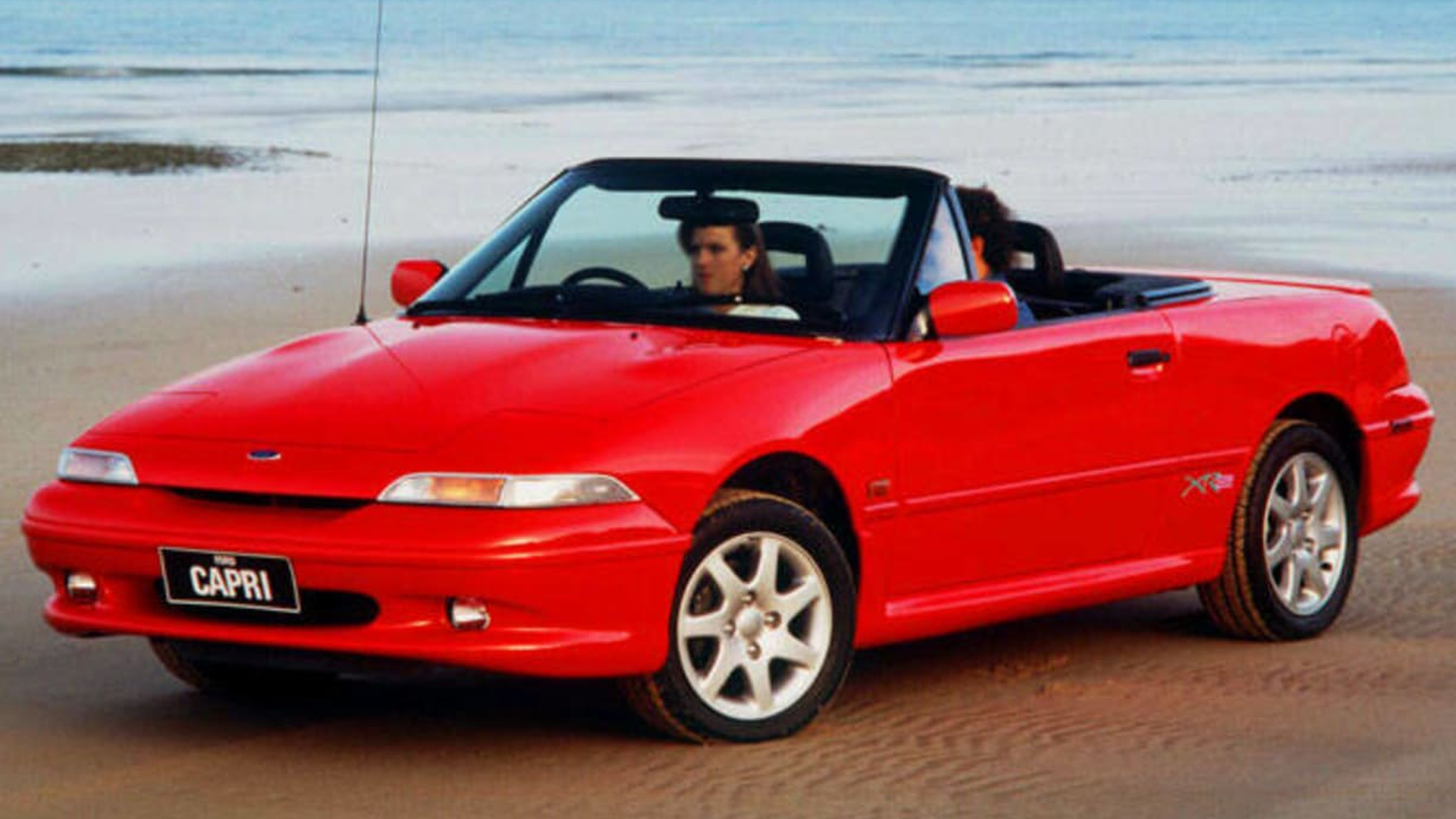
In the early 90s, the name returned on a front-wheel-drive convertible built by Ford Australia. Sold in the US as the Mercury Capri, it was a rival to the Mazda Miata. It was based on the Mazda 323 chassis and was available with a turbo engine. While quirky, it never matched the handling of the Miata.
Common Issues & Maintenance
1. Rust (A-Pillars)
On Mk I and Mk II cars, check the A-pillars (windshield posts) and the McPherson strut tops. Rust here is structural and very difficult to repair.
2. Fiber Timing Gears
The V6 engines used a fiber timing gear to reduce noise. These gears strip over time, causing the engine to stop dead. Upgrading to a steel gear is a mandatory modification for reliability.
3. Dashboard Cracks
The vinyl dashboards on European Capris disintegrate in the sun. Good replacements are nearly impossible to find.
Conclusion: The Cult Classic
The Ford Capri (Mk I/II) is a style icon. It represents a time when "economy car" didn't mean boring. A V6 Capri with a 4-speed manual is a joy to drive, offering a visceral, mechanical connection to the road. It is the perfect classic for someone who loves the Mustang aesthetic but wants the handling finesse of a European sports car. Explore the specs below.