
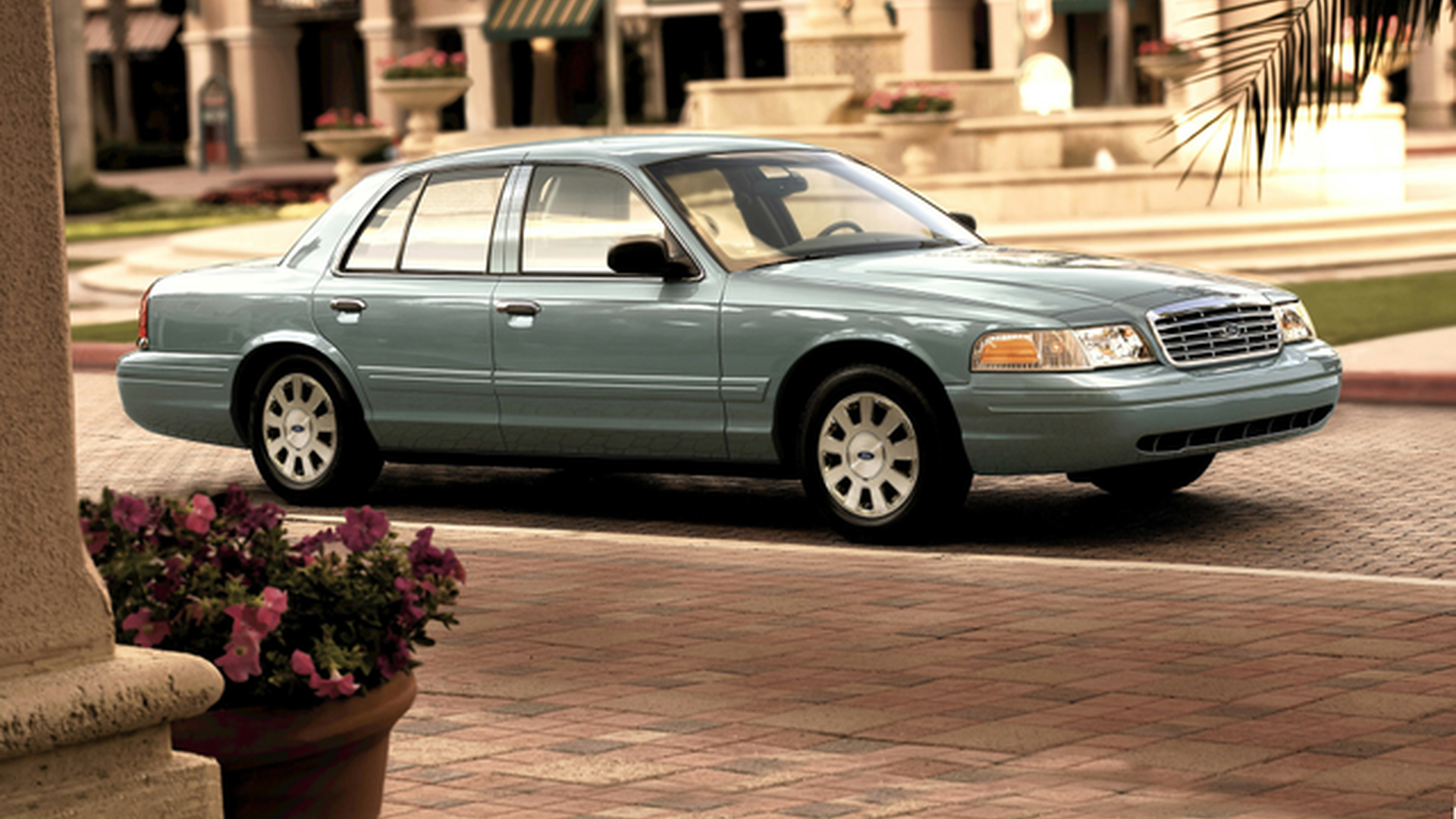
The End of an Era
When the final Ford Crown Victoria rolled off the assembly line in St. Thomas, Ontario, in 2011, it marked the extinction of a species. It was the last traditional American full-size sedan: body-on-frame construction, a solid rear axle, and a naturally aspirated V8 driving the rear wheels. While the industry chased unibody construction, front-wheel drive, and smaller engines, the Crown Vic stayed true to a formula that dated back to the 1950s. And because of that refusal to change, it became the most durable vehicle of the modern age.
When you browse the Crown Victoria listings on Hugegarage, you are looking at the backbone of North American society for two decades. It was the car that picked you up at the airport, the car that pulled you over for speeding, and the car your grandmother drove to church. Today, it has found a second life as a cult classic. Enthusiasts prize the Panther Platform (the chassis code) for its cheap parts, easy maintenance, and ability to absorb abuse that would snap a modern Honda in half.
The P71 Legend: The Police Interceptor (Option Code P71, later P7B) is the most famous version of the Crown Vic. It wasn't just a badge; it featured a stiffer frame, aluminum driveshaft, heavy-duty suspension, and oil coolers for the engine and transmission. It was built to hop curbs and idle for 12 hours a day.
The History: From LTD to Aero
The name Crown Victoria first appeared in the 1950s as a trim level, but it became a standalone model in 1992.
Generation 1: The Aero Vic (1992â1997)
Replacing the boxy LTD Crown Victoria, the 1992 model shocked the public with its rounded, aerodynamic shape (inspired by the Ford Taurus). It introduced the 4.6L Modular V8, replacing the old pushrod 5.0L Windsor. While controversial at launch due to its lack of a front grille (it had a slotted nose), it set the template for the modern police cruiser.
Generation 2: The Definitive Shape (1998â2011)
This is the car everyone knows. It adopted a more formal roofline (sharing panels with the Mercury Grand Marquis) and massive headlights. It survived for 13 years with only minor cosmetic updates but massive mechanical overhauls underneath.
Engineering the Panther Platform
To understand the Crown Vic, you must understand the chassis.
Body-on-Frame: Like a pickup truck, the body sits on rubber mounts atop a separate steel ladder frame. This isolates the passengers from road noise and allows the car to be easily repaired after a collision. If a unibody car gets hit hard, it is totaled. If a Crown Vic gets hit, you just unbolt the fender and bolt on a new one.
The 2003 Suspension Overhaul
Hugegarage Technical Note: If you are buying a Crown Vic, buy a 2003 or newer model.
In 2003, Ford completely redesigned the frame and suspension.
Front: Switched from an ancient recirculating ball steering box to a modern Rack and Pinion system. The front suspension utilized hydroformed aluminum control arms.
Rear: The shock absorbers were moved outboard of the frame rails for better stability.
The Result: The handling transformed. A 2003+ Crown Vic drives with surprising precision compared to the boat-like wallow of the 1990s models.
The Heart: 4.6L Modular V8
Every modern Crown Victoria is powered by the 4.6L SOHC 2-Valve V8.
Specs: 224-250 HP / 275-297 lb-ft Torque (depending on year and exhaust).
The Reputation: It is not a powerhouse by modern standards (a V6 Camry is faster), but it is unkillable. It is common to see taxi fleets running these engines to 500,000 miles with only basic maintenance. It uses a timing chain (no belt) and features a massive oil capacity.
The Intake Manifold Issue
The one Achilles heel of the 4.6L (specifically 1996-2001 models) was the Plastic Intake Manifold. The coolant crossover passage at the front would crack, dumping coolant into the engine valley.
The Fix: Ford updated the design with an aluminum crossover. Virtually every surviving Crown Vic has had this replaced by now, but always check for coolant smells under the hood.
P71 Police Interceptor vs. LX Civilian
Which one should you buy? The experience is vastly different.
- Crown Victoria LX (Civilian)
- The Couch on Wheels.
- Suspension: Soft springs, air suspension in the rear (often fails, but rides like a cloud).
- Gearing: Tall highway gears (2.73:1) for maximum MPG.
- Interior: Velour or leather bench seats, wood grain trim, quiet exhaust.
- Best For: Road trips and comfort. - Crown Victoria P71 / Police Interceptor
- The Workhorse.
- Suspension: Stiff springs, heavy-duty sway bars. You feel every bump, but the car corners flat.
- Gearing: Shorter gears (3.27:1 or 3.55:1) for better acceleration.
- Engine: Aggressive idle tune, silicone cooling hoses, dual exhaust (adds ~15 HP).
- Interior: Cloth buckets (stab-proof plates removed), rubber flooring, no center console.
- Best For: Enthusiasts, budget builds, and durability.
Common Issues What to Watch
1. Idle Hours (P71s)
When buying a police car, mileage is irrelevant; Idle Hours matter.
Police cars sit idling for hours while officers do paperwork.
The Formula: 1 Idle Hour = Approx 33 Miles of wear.
A car with 100,000 miles and 5,000 idle hours actually has the engine wear of a 265,000-mile vehicle. You can check this on the digital odometer (press the trip stem) on 2006+ models.
2. Transmission Shudder
The 4R70W / 4R75E 4-speed automatic is robust, but the torque converter can develop a shudder around 45 MPH if the fluid is old. A fluid flush (Mercon V) typically fixes it. These transmissions generally last 150,000-200,000 miles before needing a rebuild.
3. Spark Plug Blowout
On early engines (pre-2004), the spark plug threads in the cylinder head were very short (only 4 threads). If plugs were over-torqued or worked loose, they could literally shoot out of the engine through the hood. Repair kits (Time-Serts) exist, but it is a known anxiety for owners of older models.
4. Paint Peeling
White Crown Victorias (Performance White) from the late 2000s are notorious for peeling paint. Ford skipped a primer step, causing sheets of white paint to flake off the steel, leaving gray e-coat exposed. It is purely cosmetic but ugly.
The Marauder Connection
We cannot discuss the Panther platform without mentioning the Mercury Marauder (2003-2004).
It was a Crown Vic LX Sport on steroids. It featured the 4.6L DOHC 4-Valve V8 from the Mustang Mach 1 (302 HP), blackened trim, and 18-inch wheels. It is the highly collectible muscle sedan version of this chassis.
Living with a Crown Vic Today
Why buy a car designed in the 1970s?
1. Visibility: The greenhouse is massive. You have almost zero blind spots.
2. Space: The trunk is 20.6 cubic feet. You can fit four golf bags, a week of groceries, and a spare tire without stacking anything.
3. The Cop Effect: Even today, seeing the headlights of a Crown Vic in the rearview mirror causes other drivers to slow down and move out of the way. It commands presence on the road.
Conclusion: The King of the Road
The Ford Crown Victoria is the automotive equivalent of a hammer: simple, heavy, and effective. It doesn't have Bluetooth, lane-keep assist, or turbochargers. What it has is a soul forged in millions of miles of public service. It is a car that asks for nothing but gas and oil, and in return, it gives you a ride quality that no modern unibody crossover can replicate. Whether you preserve a pristine LX or build a P71 drift car, the Crown Vic is an American legend that deserves its crown. Explore the specs below.