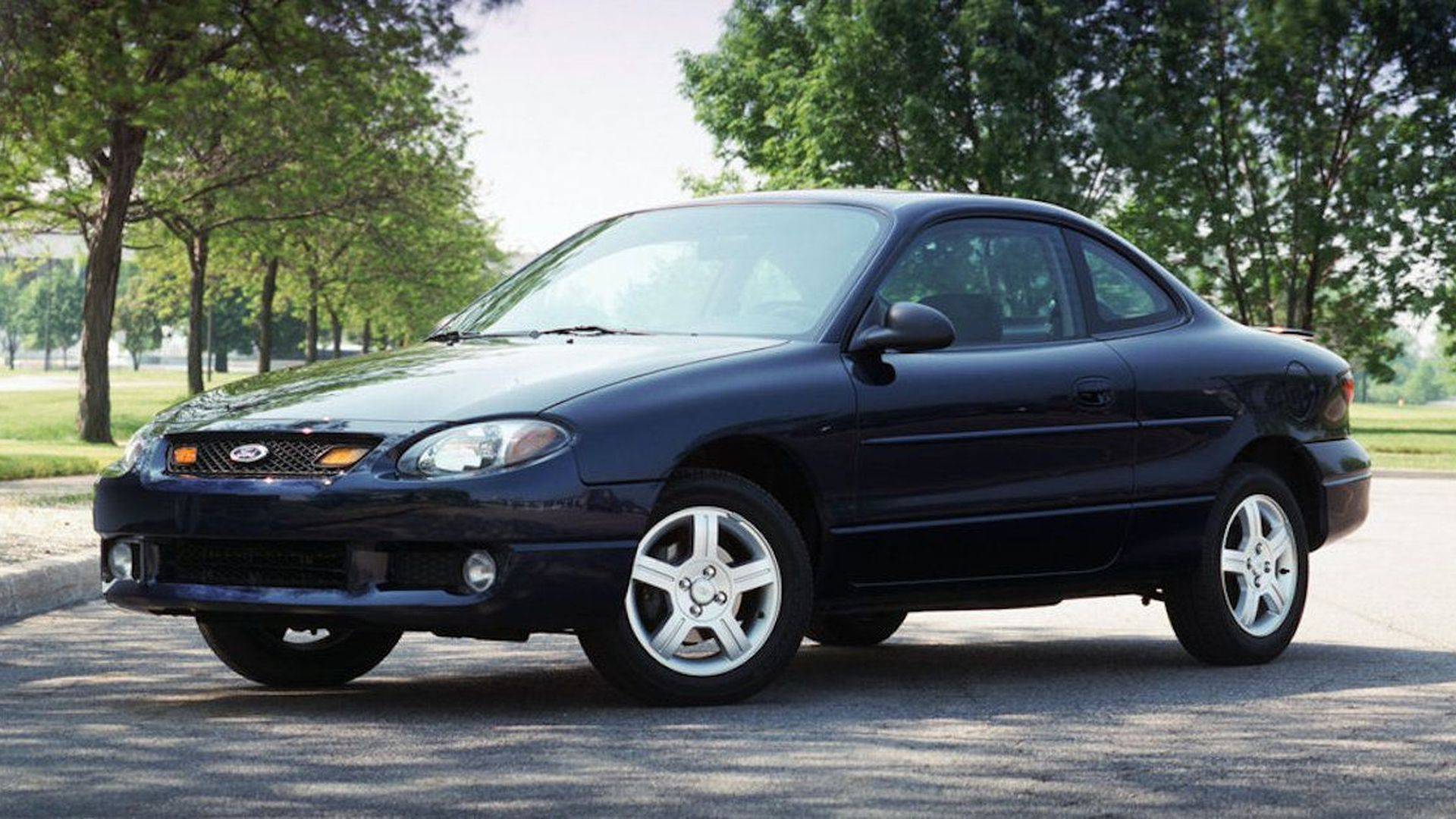
Ford Escort: The Honest Economy Car That Replaced a Legend

The Ford Escort wore two faces. In Europe, it was a rally-winning legend. In America, it was the honest economy car that replaced the Pinto. From the boxy "world car" of the 80s to the sporty ZX2 coupe, the Escort was the unpretentious hero of the daily commute, offering affordable transportation to millions.

Production: 1981-2003
30 Min Read
Ford Escort Exterior Photo

Author

HugeGarage Editor

Published

Updated

30 Min Read

The "World Car" Experiment

In 1981, Ford needed a fresh start. The Pinto was dead, and the Japanese were dominating the small car market. Ford's answer was the Escort. Advertised as a "World Car" designed by teams in North America and Europe, it became the best-selling car in America for much of the 80s. While it never achieved the legendary status of its European rally cousins (like the Cosworth), the American Escort was a honest, durable, and fuel-efficient machine that mobilized a generation.

When you browse the Escort listings on Hugegarage, you are looking at the evolution of the American economy car. From the angular, utilitarian hatchbacks of the early 80s to the rounded, Mazda-influenced sedans of the 90s, the Escort was always about value. Today, finding a clean Escort GT or a ZX2 is a cheap way to get into a fun, tossable front-wheel-drive survivor.

The Mazda Connection: Starting in 1991, the US Escort ceased to be a true Ford design. It moved to the Ford CT120 platform, which was essentially a re-bodied Mazda Protegé (323). This was a brilliant move, as it gave the Escort Japanese reliability and excellent handling dynamics.

Generation 1: The Box (1981–1990)

The first-gen US Escort was boxy and practical. It was available as a 3-door hatch, 5-door hatch, and a wagon.
The Engine: The 1.6L CVH engine. It was noisy and coarse but got the job done.
The Escort GT (1983-1990): This was Ford's attempt at a "hot hatch." It featured a high-output 1.9L engine (110 HP), stiffer suspension, fog lights, and aggressive body cladding. It was a legitimate competitor to the VW Golf GTI.

The Escort EXP

Ford also built a bizarre two-seater version called the EXP. It had a unique "frog-eye" front end. It was sporty looking but slow, and remains one of the weirdest Fords of the 80s.

Generation 2: The Mazda Era (1991–1996)

This is the best Escort generation. Because it was a Mazda underneath, it drove beautifully.
The GT Returns: The 1991-1996 Escort GT used the Mazda 1.8L DOHC engine (the same BP engine found in the Miata). With 127 HP, 4-wheel disc brakes, and independent rear suspension, this car is a hidden gem for autocross racers.

Generation 3: The Oval Design (1997–2002)

For 1997, the Escort got rounder and quieter. The hatchback was dropped, leaving only a sedan and wagon. It was a solid, boring appliance.

The Escort ZX2 (1998-2003)

To replace the sporty Probe, Ford launched the Escort ZX2 coupe.
The Engine: It used the 2.0L Zetec engine (130 HP) with variable cam timing (VCT).
The Drive: It was surprisingly quick (0-60 in under 8 seconds) and handled well. The ZX2 S/R was a factory tuner version with Eibach springs, Tokico struts, and a Borla exhaust. Only 2,110 were made, making it a rare collectible.

Common Issues & Maintenance

1. Dropped Valve Seats (1.9L/2.0L SPI)

The Ford 1.9L and 2.0L SPI (Split Port Induction) engines are infamous for dropping valve seats. The hardened seat falls out of the aluminum head, bounces around the cylinder, and destroys the piston. This usually happens around 100,000 miles. The Mazda 1.8L and Zetec engines do not have this problem.

2. Rust (Rocker Panels)

Like all 90s economy cars, the Escort dissolves in road salt. Check the rocker panels (under the doors) and the rear wheel arches.

3. Automatic Transmission Failure

The F-4EAT automatic transmission was weak. The manual transmissions (especially the Mazda G-series) are bulletproof.

Conclusion: The Budget Fun Car

The Ford Escort is gone, replaced by the Focus, but it shouldn't be forgotten. If you want cheap, reliable transportation, a 1997+ Escort sedan is unbeatable. But if you want a smile on your face, hunt down a 1991-1996 Escort GT or a ZX2 S/R. You get Miata reliability and handling in a practical front-wheel-drive package for less than the price of a used laptop. Explore the specs below.

Frequently Asked Questions

What is the difference between the North American and European Ford Escort?

For decades, they were two completely entirely different vehicles that simply shared the same name. The European Escort (starting in 1968) began as a lightweight, rear-wheel-drive car that became a massive global rally racing legend. The North American Escort (introduced in 1981) was a completely different front-wheel-drive platform, co-developed with Mazda, designed strictly as an affordable, high-MPG economy commuter to combat rising gas prices and cheap Japanese imports.

What makes the Ford Escort RS Cosworth so legendary?

The 1990s Escort RS Cosworth is one of the most iconic homologation rally cars in automotive history. Built strictly to qualify Ford for Group A World Rally Championship racing, it featured a massive, unmistakable "whale tail" rear spoiler. Feel the violent surge of boost as the longitudinally mounted 2.0L turbocharged Cosworth YB engine sends over 220 HP to a highly advanced permanent All-Wheel Drive (AWD) system, allowing it to grip gravel and tarmac like a supercar.

What is the most common engine problem with a 1990s Ford Escort?

If you are buying a 1991–2002 North American Escort equipped with the standard 1.9L or 2.0L SPI (Split Port Induction) 4-cylinder engine, you must be hyper-aware of dropped valve seats.

Hugegarage Technical Tip: The steel valve seats pressed into the aluminum cylinder head are notoriously prone to failing. They detach, drop directly into the combustion chamber, and are instantly smashed by the piston, catastrophically destroying the engine block. If a used Escort has a loud "ticking" noise from the top of the engine, walk away immediately.

What is the Ford Escort ZX2?

Introduced in 1998, the Escort ZX2 was a sporty, youthful coupe designed to replace the aging Escort GT. It abandoned the standard, sluggish economy engines for Ford's much more robust 2.0L Zetec DOHC 4-cylinder engine (producing 130 HP). Featuring a sweeping, aerodynamic roofline, aggressive front fascia, and a much stiffer suspension setup, the ZX2 was a highly popular, budget-friendly "tuner" car for high school and college students in the late 90s and early 2000s.

Which engine is better in the US Escort: the 1.9L or the 1.8L DOHC?

If you are looking at the second-generation Escort (1991–1996), the engine choice is critical.

1.9L CVH 4-Cylinder
The standard engine found in LX models. It produces a mere 88 HP and is notorious for the dropped valve seat issue mentioned above. It is strictly a low-speed commuter engine.
1.8L DOHC 4-Cylinder
Found exclusively in the Escort GT and LX-E, this engine was sourced entirely from Mazda. It produces a robust 127 HP, revs incredibly smoothly to a high redline, and is vastly more reliable, making the Escort GT a phenomenal hidden gem.
Is the Ford Escort Front-Wheel Drive (FWD) or Rear-Wheel Drive (RWD)?

This depends entirely on the era and the continent. Classic European Escorts (Mk1 and Mk2 from 1968 to 1980) were highly agile Rear-Wheel Drive (RWD) cars. However, in 1980 (Europe) and 1981 (North America), Ford completely transitioned the Escort to a modern Front-Wheel Drive (FWD) architecture to maximize interior passenger space and improve traction in the snow. Aside from the rare AWD Cosworth models, all modern Escorts pull from the front wheels.

Why did Ford stop making the Escort in the United States?

Ford officially retired the Escort nameplate in North America after the 2002 model year (the ZX2 coupe lingered until 2003). The decision was part of a massive corporate strategy to unify Ford's global vehicle lineup. Instead of building completely different compact cars for Europe and America, Ford invested billions into developing a single, highly advanced "world car." This revolutionary new vehicle—featuring independent rear suspension and bold "New Edge" styling—was launched globally as the Ford Focus, making the aging Escort platform obsolete.

Are replacement parts hard to find for a classic Ford Escort?

It is a frustrating scenario for restorers. Mechanical parts are incredibly cheap and abundant. Because Ford built millions of Escorts and shared the powertrains with the Mazda Protege and Ford Tracer, you can easily find brakes, alternators, and water pumps at any auto parts store. However, cosmetic and interior parts are virtually extinct. Almost all exterior body panels, dashboard plastics, and weatherstripping have been discontinued, meaning a cracked bumper or broken interior door handle requires a deep dive into local junkyards.

Can the Ford Escort tow a small trailer?

Towing with a Ford Escort is highly discouraged. It is a very lightweight subcompact car (weighing barely 2,400 pounds) with a unibody chassis designed strictly for carrying passengers. Ford explicitly states in the owner's manual that models equipped with the fragile automatic transmission should not tow anything. If you have a manual transmission, the absolute maximum towing capacity is 1,000 pounds, which is barely enough for a very small utility trailer. Towing heavier loads will quickly warp the brakes and overheat the engine.

What kind of gas mileage (MPG) does a Ford Escort get?

Fuel economy was the Escort's greatest selling point throughout its lifespan. Because it is incredibly lightweight and utilizes small displacement engines, it remains highly efficient even by modern standards. A standard 1990s Escort equipped with a 5-speed manual transmission will easily achieve an EPA-estimated 25 to 28 MPG in the city and 33 to 38 MPG on the highway. Models with the 4-speed automatic see those numbers drop slightly to roughly 23 MPG city and 31 MPG highway, making it an excellent budget commuter.