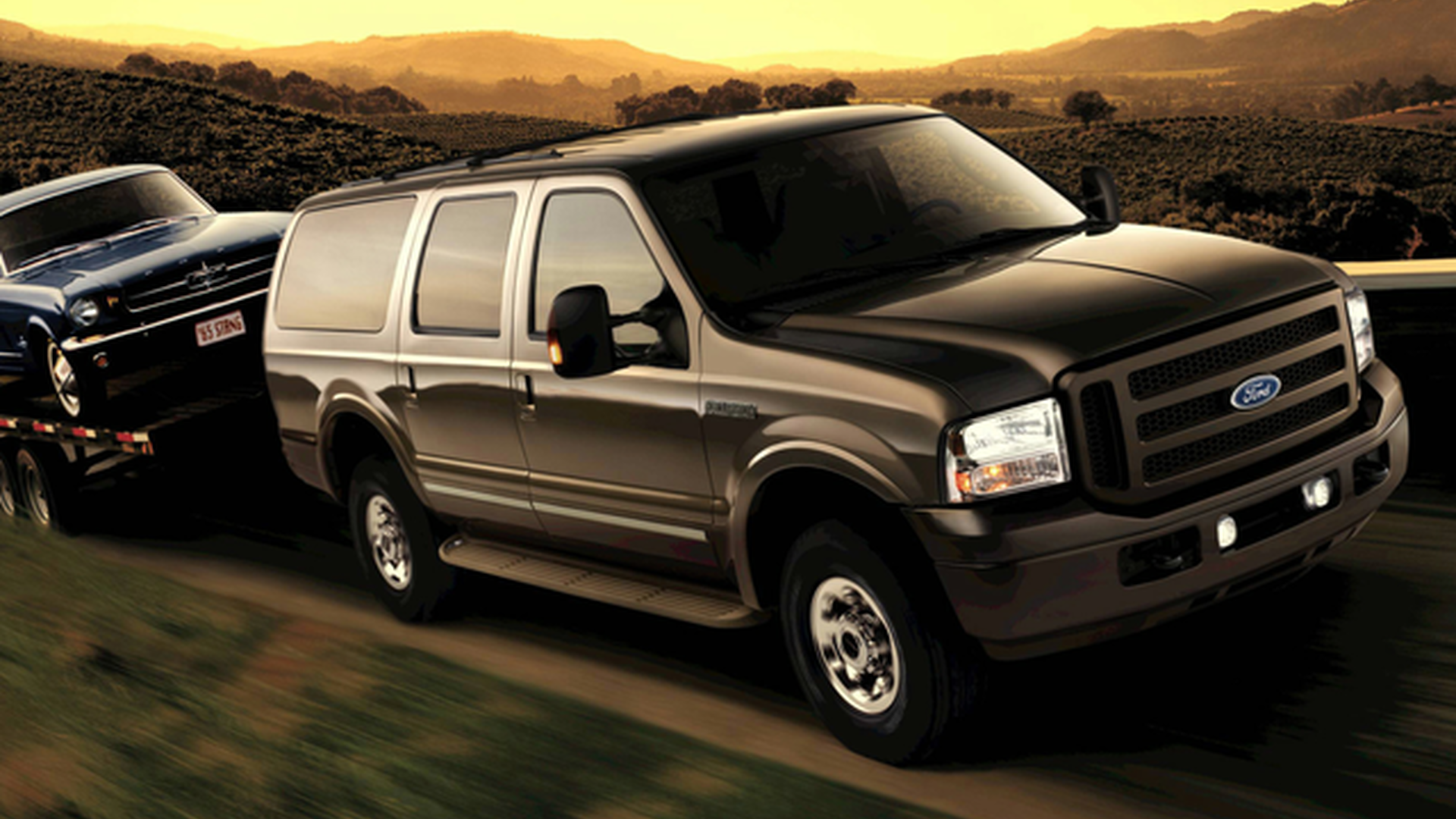
Ford Excursion: The Largest SUV Ever Built

The Ford Excursion remains the heavyweight champion of the SUV world. Built on the F-250 Super Duty chassis, this 19-foot behemoth was designed to dominate the road and tow anything. With legendary engines like the 7.3L Power Stroke diesel and the V10, the Excursion is the ultimate symbol of the bigger-is-better era.

Production: 2000-2005
15 Min Read
Ford Excursion Exterior Photo

Author

HugeGarage Editor

Published

Updated

15 Min Read

The Unapologetic Giant

In the late 1990s, gas was cheap, the economy was booming, and Americans wanted bigger vehicles. Chevrolet had the Suburban, a long-wheelbase SUV that dominated the market. Ford, not content with simply matching the competition, decided to crush it. They took their heavy-duty F-250 Super Duty pickup, enclosed the bed, added a third row of seats, and created the Ford Excursion. It was nearly 19 feet long, 7 feet tall, and weighed nearly 4 tons. It was, and remains, the largest mass-produced SUV in automotive history.

When you browse the Excursion listings on Hugegarage, you are looking at a vehicle that defies modern logic. It is too big for most parking garages, it drinks fuel at an alarming rate, and it drives like a commercial truck. Yet, it is currently one of the most sought-after used vehicles on the planet. Why? Because it offers capability that no modern SUV can match. It can seat nine adults comfortably, carry their luggage, and tow an 11,000-lb boat simultaneously. It is the ultimate tool for big families with big toys.

The Ford Valdez Controversy: The Excursion launched in 2000 to immediate backlash from environmental groups. Sierra Club dubbed it the Ford Valdez (a reference to the oil spill tanker). Because its GVWR exceeded 8,500 lbs, it was exempt from EPA fuel economy ratings. Ford actually installed a Blocker Beam a tubular steel bar under the front bumper—to prevent the massive SUV from riding up and crushing smaller cars like the Honda Civic in a collision.

Super Duty DNA: Built Ford Tough

To understand the Excursion, you must understand that it is not an oversized Expedition. The Expedition is built on the F-150 (half-ton) chassis. The Excursion is built on the F-250/F-350 (three-quarter ton) platform.

Chassis and Suspension

  • Frame: Fully boxed steel ladder frame.
  • Front Suspension (4x4): Leaf springs and a solid Dana 50 axle. This setup is incredibly durable but results in a stiff, bouncy ride.
  • Front Suspension (4x2): Twin-I-Beam coil spring setup. Rides significantly smoother but lacks off-road capability.
  • Rear Suspension: Leaf springs and a Sterling 10.5 solid axle.

The Engine Trinity

The Excursion offered four engines over its short lifespan, but three defined its legacy.

6.8L Triton V10
The Gas King. Standard on most models.
Specs: 310 HP / 425 lb-ft Torque.
Pros: Cheaper to buy, massive torque curve, simpler maintenance than a diesel.
Cons: Thirsty. Expect 8-10 MPG everywhere. However, with the standard 44-gallon tank, you still get decent range.
7.3L Power Stroke V8 Turbo Diesel
The Holy Grail (2000-2003).
Specs: 250 HP / 505-525 lb-ft Torque.
Why buy it? This engine is legendary for lasting 500,000+ miles. It lacks complex emissions equipment (no DEF, no DPF). Excursions with this engine command prices double that of gas models.
6.0L Power Stroke V8 Turbo Diesel
The Gamble (2003.5-2005).
Specs: 325 HP / 560-570 lb-ft Torque.
The Risk: Replaced the 7.3L to meet emissions standards. It is faster and quieter but prone to head gasket failures, EGR cooler ruptures, and oil cooler clogs.
Hugegarage Advice: Only buy a 6.0L if it has been bulletproofed (aftermarket head studs, EGR delete/upgrade). A sorted 6.0L is a rocket ship; a stock one is a ticking time bomb.

Interior: The 9-Passenger Living Room

The interior is pure late-90s Ford truck—hard plastics and simple gauges—but the space is unrivaled.
Seating Configurations:
- Front: Bench (3 seats) or Captain's Chairs (2 seats).
- Second Row: Bench (3 seats).
- Third Row: Bench (3 seats). Crucially, the third row has massive legroom and sits far behind the rear axle, unlike modern SUVs where the third row is for toddlers.
Cargo: Even with the third row up, there is 48 cubic feet of cargo space behind it. Remove the third row (it is heavy but removable), and you have 146 cubic feet—enough to haul 4x8 sheets of plywood flat with the doors closed.

The Tri-Panel Doors

Instead of a massive liftgate that would hit your garage door, the Excursion uses Tri-Panel Rear Doors. The top glass lifts up, and two lower Dutch doors swing out. This allows for easy loading of small items without opening the whole back.

The Achilles Heel: Steering Wander

Almost every Excursion suffers from wandering steering, requiring constant corrections on the highway.
The Cause: Ford tuned the suspension softer than the F-250 to appeal to SUV buyers, which compromised caster angles. Combined with a steering box that wears out, it creates play.
The Fix: The RedHead steering gear box upgrade and adding a heavy-duty rear sway bar (Hellwig) are almost mandatory upgrades for owners.

Towing: The Ultimate Platform

With the right hitch, an Excursion can tow 11,000 lbs.
Because of its long wheelbase (137 inches) and heavy curb weight (~7,200 lbs), it is incredibly stable when towing travel trailers. It resists tail wagging much better than lighter trucks. This makes it the premier choice for families towing Airstreams across the country.

Why Was It Cancelled?

Ford killed the Excursion after 2005.
Reason 1: Rising gas prices. In 2005, gas hit record highs, and sales of 10-MPG SUVs plummeted.
Reason 2: The Super Duty redesign. The F-250 got a new frame in 2006, and Ford didn't want to spend the money to re-engineer the Excursion to fit it. They replaced it with the Expedition EL (Extended Length), which was more efficient but less capable.

The Modern Excursion Market

Today, there is a thriving industry of companies (like Custom Autos by Tim) that take modern 2017+ F-250 Super Dutys and graft the Excursion rear body onto them, creating new Excursions for $150,000+. This proves the demand for a heavy-duty SUV never died.

Conclusion: The Last of the Titans

The Ford Excursion is a relic of a time when excess was celebrated. It is unapologetically huge, loud, and thirsty. But for the driver who needs to tow a house while carrying a baseball team, there is simply no substitute. A clean 7.3L Excursion is not just a used car; it is an investment asset that continues to appreciate. It stands as a monument to the peak of American heavy metal. Explore the heavy-duty specs below.

Frequently Asked Questions

Is the Ford Excursion basically just an F-250 Super Duty SUV?

Yes, essentially. When Ford designed the Excursion to compete with the Chevrolet Suburban, they didn't start from scratch; they utilized the heavy-duty F-250 Super Duty pickup truck architecture. From the front bumper to the rear doors, it shares the exact same chassis, powertrains, solid front axle, and heavy-duty steering components as the Super Duty. This makes it one of the only true three-quarter-ton, heavy-duty SUVs ever mass-produced for the civilian market.

Which engine is better in a used Ford Excursion: the 7.3L or the 6.0L Power Stroke?

This is the most critical decision when buying a diesel Excursion.

7.3L Power Stroke Turbo-Diesel (2000-2003)
This is the undisputed holy grail. It produces 250 HP and 505 lb-ft of torque. While loud and somewhat slow, it is legendary for its bulletproof reliability, frequently surpassing 400,000 miles with basic maintenance.
6.0L Power Stroke Turbo-Diesel (2003.5-2005)
This engine is vastly more powerful and features a much smoother 5-speed transmission. However, it is infamous for catastrophic EGR cooler and head gasket failures. Unless a previous owner has spent thousands to "bulletproof" it with aftermarket studs, the 6.0L is a highly risky purchase.
What is the maximum towing capacity of the Ford Excursion?

Because it is built on a heavy-duty truck frame, the Excursion is a phenomenal towing machine. When properly equipped with the 6.8L V10 gas engine or the Power Stroke diesel engines, and utilizing a weight-distributing hitch, the Excursion boasts a maximum conventional towing capacity of 11,000 pounds. This allows large families to comfortably pull massive 30-foot travel trailers, heavy dual-axle boats, or enclosed car haulers while seating up to nine passengers inside the cabin.

Why did Ford stop making the Excursion?

Ford officially discontinued the Excursion after the 2005 model year. Its demise was heavily influenced by a massive spike in global gas prices during the mid-2000s, which severely crippled sales of massive, gas-guzzling SUVs. Furthermore, Ford realized they could achieve similar profit margins by stretching the lighter, more fuel-efficient Ford Expedition into the "Expedition EL" (now MAX), which satisfied the cargo needs of most families without requiring a heavy-duty commercial truck frame.

What kind of gas mileage (MPG) does the Ford Excursion V10 get?

You cannot cheat physics; pushing an 8,000-pound, aerodynamically blunt vehicle down the highway requires massive amounts of fuel. Because of its extreme GVWR, the Excursion was legally exempt from EPA fuel economy testing. However, real-world data from owners with the 6.8L Triton V10 gas engine consistently shows an average of 9 to 11 MPG in the city, and roughly 12 to 14 MPG on the highway. If you are towing a heavy trailer, expect single-digit fuel economy.

Are there any common suspension problems with the Ford Excursion?

Yes, the Excursion is notorious for "steering wander" on the highway. To make the heavy-duty F-250 suspension more comfortable for soccer moms, Ford installed softer leaf springs on the Excursion. Over time, these heavy, massive vehicles cause the factory leaf springs to severely sag.

Hugegarage Technical Tip: If your used Excursion feels completely terrifying and floaty over 65 MPH, it is likely suffering from spring wrap and worn steering box gears. The most common and effective permanent fix in the enthusiast community is swapping out the original Excursion leaf springs for genuine F-250 Super Duty leaf springs (often called the V/B spring swap) and upgrading the steering stabilizer.

How many passengers can fit inside a Ford Excursion?

The Ford Excursion was the ultimate family hauler of its era. Depending on the seating configuration ordered from the factory, it could comfortably seat up to nine passengers. The front row could be optioned with a three-person bench seat, followed by a three-person second row, and a three-person third row. Feel the cavernous expanse of the interior as even full-sized adults find genuine, long-haul comfort in the third row, while still leaving over 48 cubic feet of cargo space behind them for luggage.

Will a Ford Excursion fit in a standard residential garage?

In most modern suburban homes, no, it will not fit. The Ford Excursion is a behemoth, measuring nearly 19 feet long (226.7 inches), over 6.5 feet wide, and roughly 6.5 feet tall. Most standard residential garage bays are approximately 20 feet deep, meaning even if you perfectly back the Excursion in until the bumper touches the drywall, you may not have enough clearance to close the garage door. Always take a tape measure to your garage before bringing one home.

Is Ford going to build a new Excursion?

Ford currently has no official plans to resurrect the Excursion nameplate, as the modern extended Ford Expedition MAX fulfills the three-row, heavy-towing family demographic. However, the demand for a modern heavy-duty diesel SUV is so massive that a dedicated aftermarket industry has emerged. Custom coachbuilders (such as Custom Autos by Tim) will literally slice a brand-new aluminum-body F-250 Super Duty in half, meticulously graft on the rear roofline of a classic Excursion, and sell you a "brand new" 6.7L diesel Excursion for upwards of $150,000.

Are the spark plugs a problem on the Excursion's 5.4L V8 and 6.8L V10?

Yes, this is a highly documented issue on early Ford Modular engines. For Excursions built between 2000 and 2003, the aluminum cylinder heads had very few threads holding the spark plugs in place. Under heavy load, the engines were known to literally blow the spark plug completely out of the cylinder head, destroying the ignition coil and sounding like a machine gun under the hood. If you purchase a used gas Excursion, ask if the spark plug holes have been professionally repaired with steel threaded inserts (like the Time-Sert kit) to permanently resolve this factory flaw.