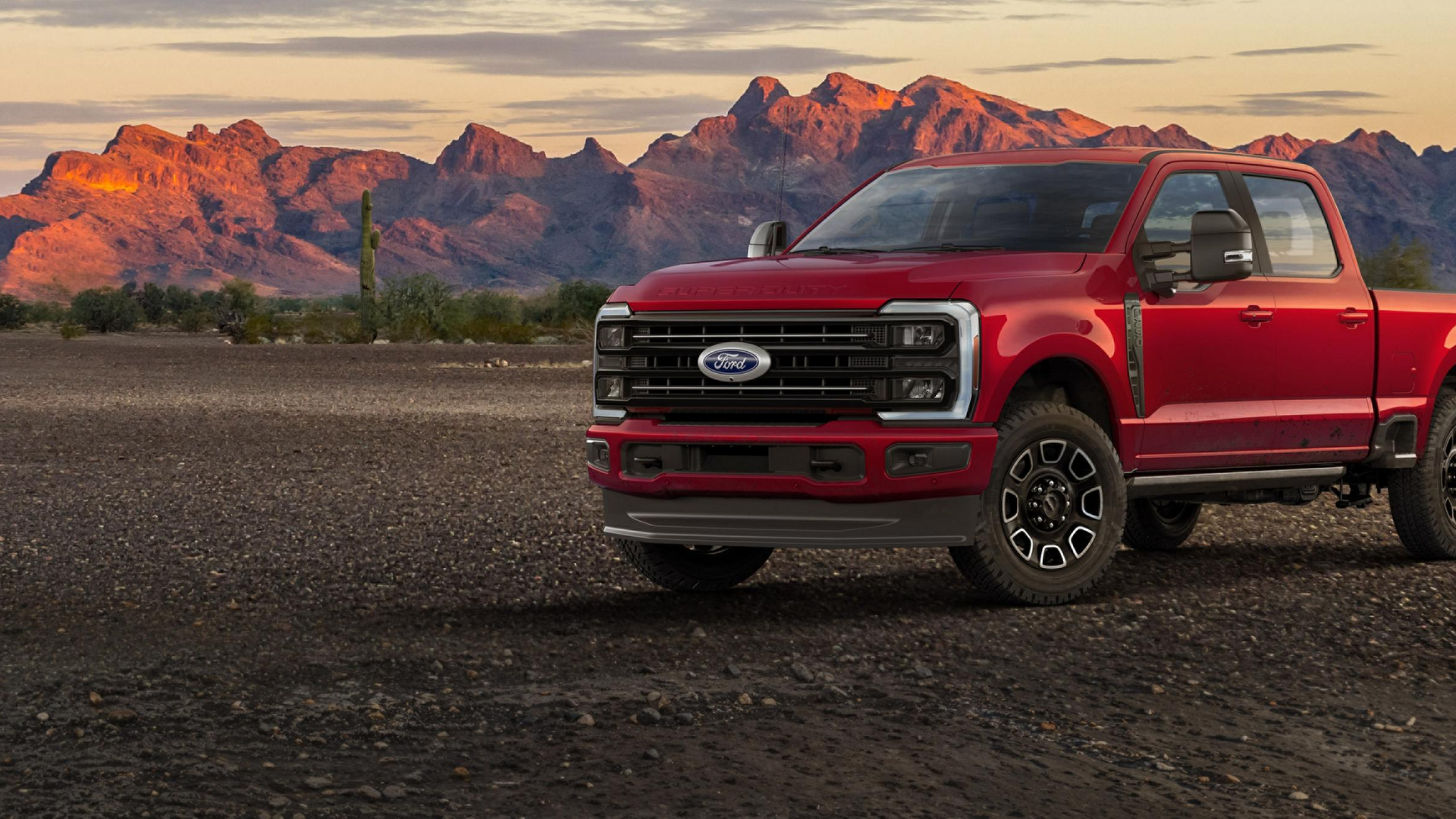
Ford F-250 Super Duty: The Titan of Towing

The Ford F-250 Super Duty is the point where trucks become machines. Separated from the F-150 in 1999 to focus purely on towing capability, the Super Duty line has dominated the commercial and RV sectors for decades. Whether powered by the legendary Power Stroke diesel or the massive Godzilla gas V8, the F-250 is built to move mountains.

Production: 1999-Present
50 Min Read
Ford F-250 Super Duty Exterior Photo

Author

HugeGarage Editor

Published

Updated

50 Min Read

When Half-Ton Isn't Enough

For decades, the heavy duty Ford trucks were just F-150s with stiffer springs and thicker frames. That changed forever in 1999. Ford realized that the F-150 buyer wanted a comfortable daily driver, while the heavy-duty buyer wanted a dedicated towing implement. Thus, the Super Duty brand was born.

When you browse the F-250 listings on Hugegarage, you are looking at a distinct breed of vehicle. Unlike the F-150 (which uses an independent front suspension for ride comfort), the F-250 4x4 utilizes a Solid Front Axle (Dana 60). This layout is ancient, rough riding, and heavy—but it is virtually indestructible under the weight of a snowplow or heavy trailer. This guide will help you navigate the minefield of diesel engines and finding the perfect tow rig.

The Alumiduty: Following the F-150's lead, the Super Duty switched to a military-grade aluminum body in 2017. This saved roughly 350 lbs of body weight, which Ford engineers immediately put back into the frame and axles. The result was a truck that weighed the same but was significantly stronger.

The Diesel Dynasty: Power Stroke History

Buying a used diesel F-250 is high-stakes gambling if you don't know your engine codes. Here is the definitive hierarchy.

1. The Legend: 7.3L Power Stroke (1999–2003.5)

Status: The Holy Grail.
Built by Navistar (International), this V8 is loud, slow, and unrefined. But it is bulletproof. It lacks complex emissions equipment (no DPF, no DEF fluid). A clean 7.3L F-250 with under 150,000 miles is an appreciating asset, often selling for more than it cost new.

2. The Disaster: 6.0L Power Stroke (2003.5–2007)

Status: The Money Pit.
To meet emissions standards, Ford introduced the 6.0L. It was faster but plagued by failures: blown head gaskets, clogged EGR coolers, and failed oil coolers.
Hugegarage Advice: Only buy a 6.0L if it has been Bulletproofed (aftermarket head studs, EGR delete/upgrade, new oil cooler). If stock, walk away.

3. The Heartbreaker: 6.4L Power Stroke (2008–2010)

Status: Do Not Buy.
This engine makes incredible power with a simple tune but is structurally flawed. Pistons crack, radiators leak, and fuel dilution destroys the oil. It is considered a throwaway engine by many mechanics because it is so expensive to repair.

4. The King: 6.7L Scorpion (2011–Present)

Status: The Gold Standard.
Ford stopped using Navistar and built this engine in-house. It solved the reliability issues.
Evolution:
- Gen 1 (2011-2014): Good, but had issues with ceramic turbo bearings.
- Gen 2 (2015-2019): Improved fuel pump and turbo.
- Gen 3 (2020+): Steel pistons and massive power (1,050+ lb-ft torque).
- High Output (2023+): 500 HP / 1,200 lb-ft Torque. It can tow a house.

The Gas Renaissance: Godzilla Returns

For years, gas engines in HD trucks were an afterthought. The 6.8L V10 Triton was reliable but thirsty, and the 6.2L Boss V8 was durable but lacked torque.

In 2020, Ford introduced the 7.3L Godzilla V8.
The Philosophy: Pushrod design (OHV), massive displacement, low stress.
The Result: 430 HP and 475 lb-ft of torque.
Why buy gas? A diesel engine option costs ~$10,000 upfront and requires expensive maintenance (fuel filters, DEF, oil). The Godzilla gas engine can tow 15,000 lbs comfortably and costs pennies to maintain. For fleets and local hauling, it is the smarter choice.

Transmission: The TorqShift Legacy

  • 4R100 (4-Speed): Found behind the 7.3L. Weak link if you tune the engine.
  • 5R110W (5-Speed): Found behind the 6.0L/6.4L. Surprisingly robust.
  • 6R140 (6-Speed): The tank. Found in 2011-2019 models. Handles 1,000+ lb-ft of torque with ease.
  • 10R140 (10-Speed): 2020+ models. Optimized for towing efficiency, keeping the diesel in its narrow powerband.

The Death Wobble Reality

Because the F-250 uses a Solid Front Axle with a track bar (on 4x4 models), it is susceptible to Death Wobble.
Symptoms: Violent shaking of the steering wheel after hitting a bump at highway speeds.
Causes: Worn track bar bushing, ball joints, or steering damper.
The Fix: It is usually a maintenance issue, not a design flaw. Keeping front-end components fresh is mandatory for solid axle trucks.

Towing: Conventional vs. Fifth Wheel

The F-250 is a confusing truck because it sits in a legal gray area.
Payload Limiter: A diesel F-250 is heavy. The engine weighs 1,000 lbs. This eats into the payload capacity (GVWR of 10,000 lbs).
The Trap: You might have the power to pull a 15,000 lb 5th Wheel RV, but the pin weight (tongue weight) of that trailer might exceed the truck's payload rating.
Hugegarage Tip: If you are towing a heavy 5th Wheel, buy an F-350. It is the same truck but with an extra leaf spring and a higher legal weight rating. The F-250 is best suited for heavy bumper-pull trailers or lighter goosenecks.

Trim Levels: From Farm to Country Club

  • XL: Vinyl floors, manual windows (in older years). The fleet special.
  • XLT: Cloth seats, chrome grille. The volume seller.
  • Lariat: Leather, 12-inch screen (newer models). The entry luxury trim.
  • King Ranch: Saddle leather, two-tone paint. The ultimate rancher status symbol.
  • Platinum / Limited: Massaging seats, max towing packages standard, unique grilles. These trucks now push $100,000 MSRP.

Buyer's Guide: What to Look For

1. The CP4 Disaster (2011-2019 Diesel)

The 6.7L diesel used a Bosch CP4 high-pressure fuel pump. In the US, diesel fuel has lower lubricity than in Europe. The CP4 pump can internally disintegrate, sending metal shavings through the entire fuel system.
Cost: $10,000 to replace the entire fuel system (injectors, lines, rails).
Prevention: Use a fuel additive (lubricity formula) at every fill-up, or install a Disaster Prevention Kit that reroutes the contaminated fuel back to the tank instead of into the engine.

2. Cab Rust (1999-2016)

Steel body trucks rust at the cab corners and bed wheel arches. Check the bed support rails underneath; if they are rusted through, the bed can fall off.

3. The 4x4 Vacuum Hubs

Like the F-150, the auto-locking hubs are vacuum-operated. If they fail, you won't have 4WD. Most Super Duty owners manually lock the hubs (get out and turn the dial on the wheel) before off-roading to be safe.

Conclusion: The Tool for the Job

The Ford F-250 Super Duty is not a lifestyle vehicle; it is a piece of industrial equipment that you can drive to church. It is loud, stiff, and massive. But when you need to pull a bulldozer out of the mud or tow a toy hauler across the Rockies, nothing else will do. For the smartest buy, look for a 2015+ 6.7L Diesel or a 2020+ 7.3L Gas model. Explore the full specs and tow ratings below.

Frequently Asked Questions

Which engine is better in the Ford F-250: the 7.3L Godzilla V8 or the 6.7L Power Stroke Diesel?

The ideal engine choice depends entirely on your specific workload and towing frequency.

7.3L Godzilla Gas V8
This massive pushrod V8 is the king of payload. Because it is physically hundreds of pounds lighter than the diesel engine, trucks equipped with the 7.3L have a significantly higher bed payload capacity. It is incredibly reliable, cheaper to maintain, and perfect for plowing snow or hauling heavy slide-in campers.
6.7L Power Stroke Turbo-Diesel V8
This is the ultimate heavy-towing champion. Feel the relentless, earth-moving surge of torque as the turbo spools up, allowing you to drag massive fifth-wheel trailers up steep mountain grades without ever dropping a gear. If you tow over 10,000 pounds daily, the diesel is mandatory.
What is the maximum towing capacity of the Ford F-250 Super Duty?

The maximum towing capacity of the F-250 varies drastically based on the engine, cab configuration, and axle ratio. However, a properly equipped modern F-250 Super Duty featuring the High Output 6.7L Power Stroke diesel engine can achieve a maximum conventional towing capacity of 23,000 pounds. When configured with a gooseneck or fifth-wheel hitch, that number climbs to a staggering 23,000 pounds as well. Always consult the specific compliance sticker on the driver's door jamb to verify the exact limits of your specific truck.

What is the difference between the standard 6.7L Power Stroke and the High Output version?

Starting with the 2023 model year, Ford introduced a completely re-engineered High Output (HO) variant of the legendary 6.7L Power Stroke. The High Output engine features an upgraded, water-jacketed turbocharger to handle extreme heat and highly revised stainless steel exhaust manifolds. While the standard Power Stroke produces an impressive 475 HP and 1,050 lb-ft of torque, the High Output variant shatters industry records by delivering 500 HP and an earth-shattering 1,200 lb-ft of torque straight from the factory.

What does the Ford F-250 Tremor Off-Road Package actually include?

The Tremor package transforms the heavy-duty F-250 into a remarkably capable trail machine without completely sacrificing its towing capabilities. It includes:

  • Massive 35-inch Goodyear Wrangler Duratrac maximum-traction tires on 18-inch wheels.
  • A factory suspension lift featuring custom-tuned 1.7-inch twin-tube dampers for off-road articulation.
  • A Dana electronic-locking rear differential and a limited-slip front differential.
  • Trail Control (cruise control for off-roading) and a specialized Rock Crawl driving mode.
Does the Ford F-250 still suffer from the "Death Wobble" issue?

The term "Death Wobble" refers to a violent steering wheel shake that occurs after hitting a bump at highway speeds. This is not strictly a Ford defect; it is a phenomenon inherent to almost all heavy-duty trucks that utilize a solid front axle design (including Ram and Jeep). Ford has heavily revised the steering damper and track bar brackets on modern Super Duty trucks to mitigate this.

Hugegarage Technical Tip: The wobble is almost always triggered by worn track bar bushings, worn ball joints, or severely unbalanced tires. If you purchase a used F-250, meticulously maintaining the front suspension geometry and immediately replacing the factory steering stabilizer with a high-quality aftermarket unit (like Bilstein or Fox) will permanently prevent this issue.

Why does my F-250 Diesel have a lower payload capacity than the Gas V8 model?

This is one of the most misunderstood concepts in heavy-duty truck purchasing. Payload is calculated by taking the truck's GVWR (Gross Vehicle Weight Rating) and subtracting the truck's actual empty curb weight. The 6.7L Power Stroke diesel engine, along with its complex turbochargers, heavy-duty transmission, and emissions equipment, weighs roughly 800 pounds more than the 7.3L gas V8. Because the diesel engine eats up 800 pounds of the GVWR before you even sit in the driver's seat, the actual weight you can put in the bed is significantly reduced.

Is the Ford F-250 Super Duty comfortable enough to be used as a daily driver?

While upper trim levels like the Platinum and Limited offer genuine luxury-car interiors with massaging leather seats and acoustic glass, you cannot escape the underlying physics of a three-quarter-ton truck. To safely carry massive payloads, the F-250 utilizes stiff rear leaf springs and solid axles. When driven empty (unloaded) over broken city pavement, the ride will be noticeably stiff, harsh, and jittery compared to a half-ton F-150. Furthermore, its massive length and turning radius make navigating tight parking garages extremely difficult.

What kind of fuel economy (MPG) can I expect from the Ford F-250?

Because the F-250 is classified as a heavy-duty commercial vehicle, the EPA does not officially rate its fuel economy. However, based on extensive real-world owner data:

Gas Engines (6.8L or 7.3L V8)
Expect roughly 11 to 14 MPG unloaded, dropping to 7 to 9 MPG when towing heavy loads.
6.7L Power Stroke Diesel
Diesels are significantly more efficient under load. Expect 15 to 19 MPG unloaded on the highway, and roughly 10 to 13 MPG when towing, depending on the aerodynamics of the trailer.
Does the Ford F-250 use the same aluminum body as the F-150?

Yes. Starting with the 2017 model year redesign, Ford transitioned the entire Super Duty lineup to high-strength, military-grade aluminum-alloy body panels. This structural shift shaved hundreds of pounds off the body, which Ford engineers immediately reinvested by upgrading the fully boxed, high-strength steel frame and driveline components to vastly increase towing capacities. A massive secondary benefit of the aluminum body is that it cannot rust, ensuring your cab corners and wheel arches remain pristine even after a decade in the harsh snow belt.

What is the Pro Power Onboard system on the Super Duty?

Introduced to the Super Duty lineup for the 2023 model year, Pro Power Onboard transforms the truck into a mobile electrical generator. It utilizes a 2.0-kilowatt system that provides enough exportable electricity through outlets located directly in the bed and the cabin to run a job site full of heavy-duty power tools, air compressors, or even power an entire tailgate party with televisions and slow cookers, all while the engine quietly idles to maintain the battery charge.