
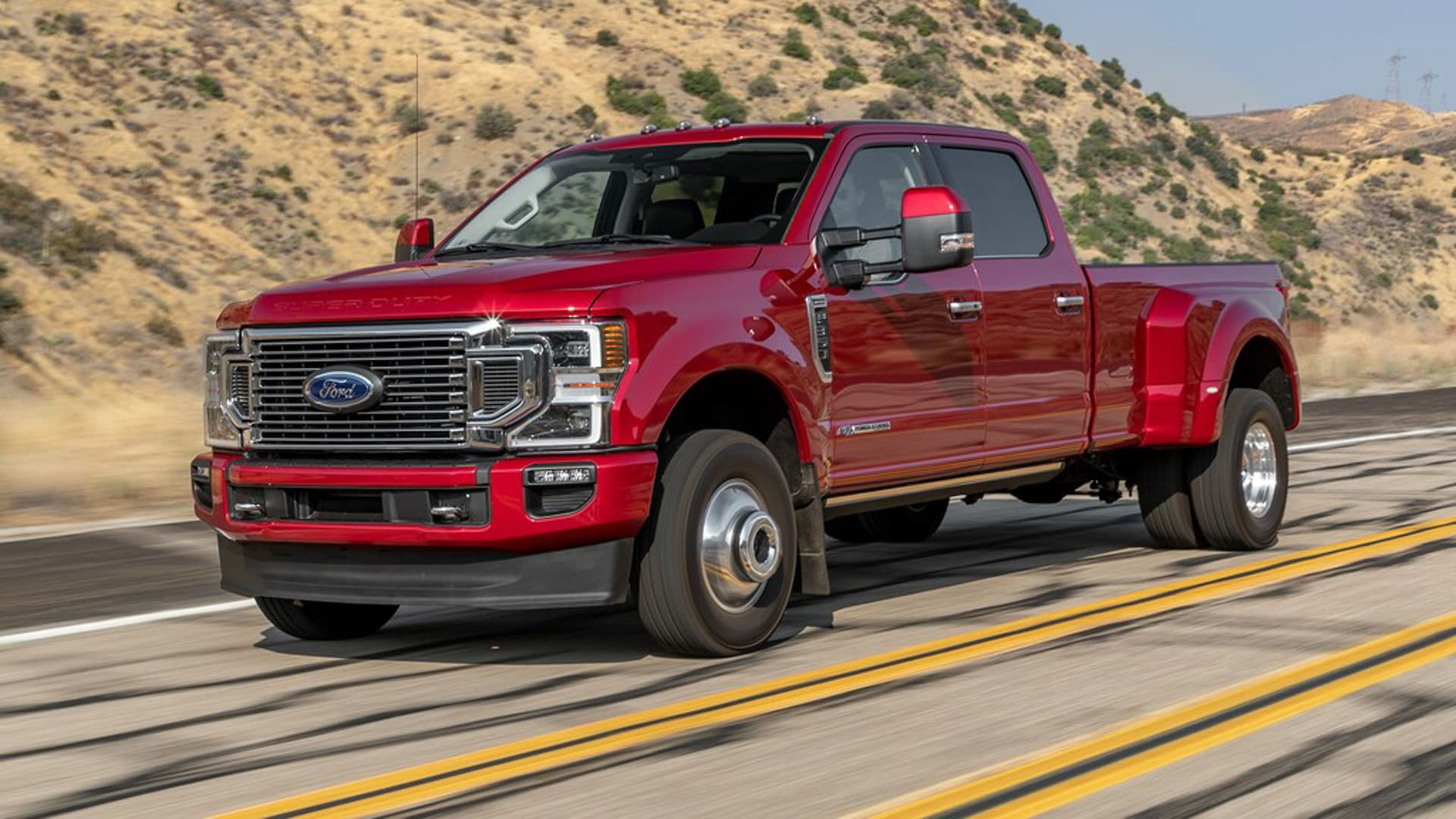
The Threshold of Serious Hauling
In the world of heavy-duty trucks, the F-250 is the generalist, but the Ford F-350 Super Duty is the specialist. It represents the One-Ton class (Class 3), designed specifically for drivers who look at a 15,000-lb trailer and say, Is that all you got? While it shares the same cab and engines as the F-250, the F-350 is reinforced in critical areasâspecifically the rear springs and axleâto handle significantly more vertical weight.
When you browse the F-350 listings on Hugegarage, you are entering a segment dominated by numbers: Payload, Pin Weight, and GCWR. The F-350 is the volume leader in this space because it offers the widest variety of configurations, from a gas-powered single-cab work truck to a $100,000 Platinum Dually that rivals a luxury sedan in comfort while pulling a bulldozer.
The Legal Reality: Owning an F-350, especially a Dually, often pushes you into a new legal category. With GVWRs often exceeding 14,000 lbs, you may be required to stop at weigh stations, carry a DOT medical card, or obtain a commercial license depending on your state and usage. Always check your local commercial vehicle regulations.
SRW vs. DRW: The Critical Decision
The most important box you check when buying an F-350 is the rear wheel configuration. This changes the truck's personality entirely.
- Single Rear Wheel (SRW)
- The Sleeper. From the outside, it looks identical to an F-250. However, it typically features a 4-inch rear block (vs. 2-inch on F-250) for a taller stance and an overload leaf spring pack.
Pros: Fits in drive-throughs, easier to park, better off-road (rear tires track with the fronts).
Cons: Limited tire load capacity. A heavy 5th wheel pin weight can exceed the rating of two tires before it exceeds the truck's axle rating. - Dual Rear Wheel (DRW / Dually)
- The Stable Platform. Four tires on the rear axle distribute the weight and, crucially, resist sway.
Pros: Massive stability in crosswinds, tire redundancy (if one blows, you don't crash), and legal payload ratings often exceeding 6,000 lbs.
Cons: The hips (wide fenders) make parking a nightmare. You cannot take it through automatic car washes. Buying 6 tires at once is expensive.
The Axle Difference: M275 vs. M300
Ford doesn't just slap extra tires on an F-250 axle. The F-350 uses heavier hardware.
- F-250: Typically uses the Sterling 10.5-inch rear axle.
- F-350 SRW: Often uses the massive Dana M275 rear axle (on diesel models) to handle higher torque loads.
- F-350 DRW: Uses the Dana M300, a beast of an axle with massive tubes and ring gears designed for continuous heavy hauling.
Powertrains: The High Output Era
While the F-350 shares the engine lineup with the F-250, the High Output variants make the most sense here due to the chassis capability.
6.7L High Output Power Stroke (2023+)
If you are buying an F-350, this is the engine you want.
Specs: 500 HP / 1,200 lb-ft Torque.
To achieve this, Ford uses a water-cooled turbocharger, upgraded exhaust manifolds, and a unique tune. It allows the F-350 to accelerate up a 6% grade with 30,000 lbs in tow without losing speed.
7.3L Godzilla Gas V8
Don't discount the gas engine in an F-350. For commercial fleets (landscapers, masons) who haul heavy materials but don't tow long distances on the highway, the 7.3L gas Dually is a financial winner. You save $10,000 upfront and never worry about diesel emissions fluid or clogged DPF filters.
Towing: The 30,000 lb Club
The F-350 is designed primarily for Gooseneck and Fifth Wheel towing.
Ford offers a factory-installed 5th Wheel/Gooseneck Prep Package which includes the mounting pucks integrated into the bed floor.
Hugegarage Tip: If buying used, look for this package. Installing an aftermarket hitch requires drilling into the frame and bed, which opens up rust points. The factory system is cleaner and stronger.
Ride Quality: The Empty Truck Bounce
There is no cheating physics. To support 7,000 lbs of payload, the F-350 rear springs are incredibly stiff.
Unloaded: The F-350 will bounce, jitter, and shake over highway expansion joints. It is significantly rougher than an F-150 or even an F-250.
Loaded: As soon as you drop 2,000 lbs in the bed, the ride transforms. The truck settles down and becomes limousine-smooth. This is a truck that needs to work to feel right.
Common Issues & Maintenance
1. The Tire Cost Reality
On a Dually, you have 6 tires. If you run a commercial tread (like Michelin LTX), a set can cost $2,500+. Additionally, rotating tires on a dually is expensive because the inner steel wheels and outer aluminum wheels often have to be dismounted and remounted to rotate properly.
2. Death Wobble (4x4 Models)
Like the F-250, the F-350 4x4 uses a Solid Front Axle. If you experience violent shaking at 60 MPH, check the Track Bar Ball Joint. It is the most common failure point. Many owners install dual steering stabilizers to mask the issue, but replacing the worn parts is the only true fix.
3. DEF System Failures
On the 6.7L Diesel, the Diesel Exhaust Fluid (DEF) heater and pump can fail.
Warning: If you let the truck sit for months, the DEF fluid can crystallize. F-350s need to be driven regularly to keep the emissions systems healthy.
Buyer's Guide: Trim Strategy
- XL Chassis Cab: Often sold without a bed ("Box Delete"). Used for utility bodies or flatbeds. Check for heavy rust on the frame rails if it was a salt spreader.
- Lariat Sport: The "Black Appearance Package" is popular. It removes the chrome (which can pit in winter) and adds body-color bumpers.
- King Ranch: Be careful buying used. The specialized "Saddle Leather" requires specific conditioners. If the previous owner used cheap cleaner, the leather will look dried out and ruined.
- Platinum / Limited: These trims lower the payload! All the luxury features (massage seats, panoramic moonroof) add weight. An F-350 Platinum might have 400 lbs less payload capacity than an F-350 XLT. Check the yellow door sticker.
Conclusion: The Professional's Choice
The Ford F-350 Super Duty is the backbone of American infrastructure. It builds our roads, hauls our horses, and moves our families across the continent in massive RVs. While it is overkill for a trip to the grocery store, it offers a level of capability that provides peace of mind. You never have to worry if your truck can handle the load; with an F-350, the answer is almost always "Yes." Explore the heavy-duty specs below.