
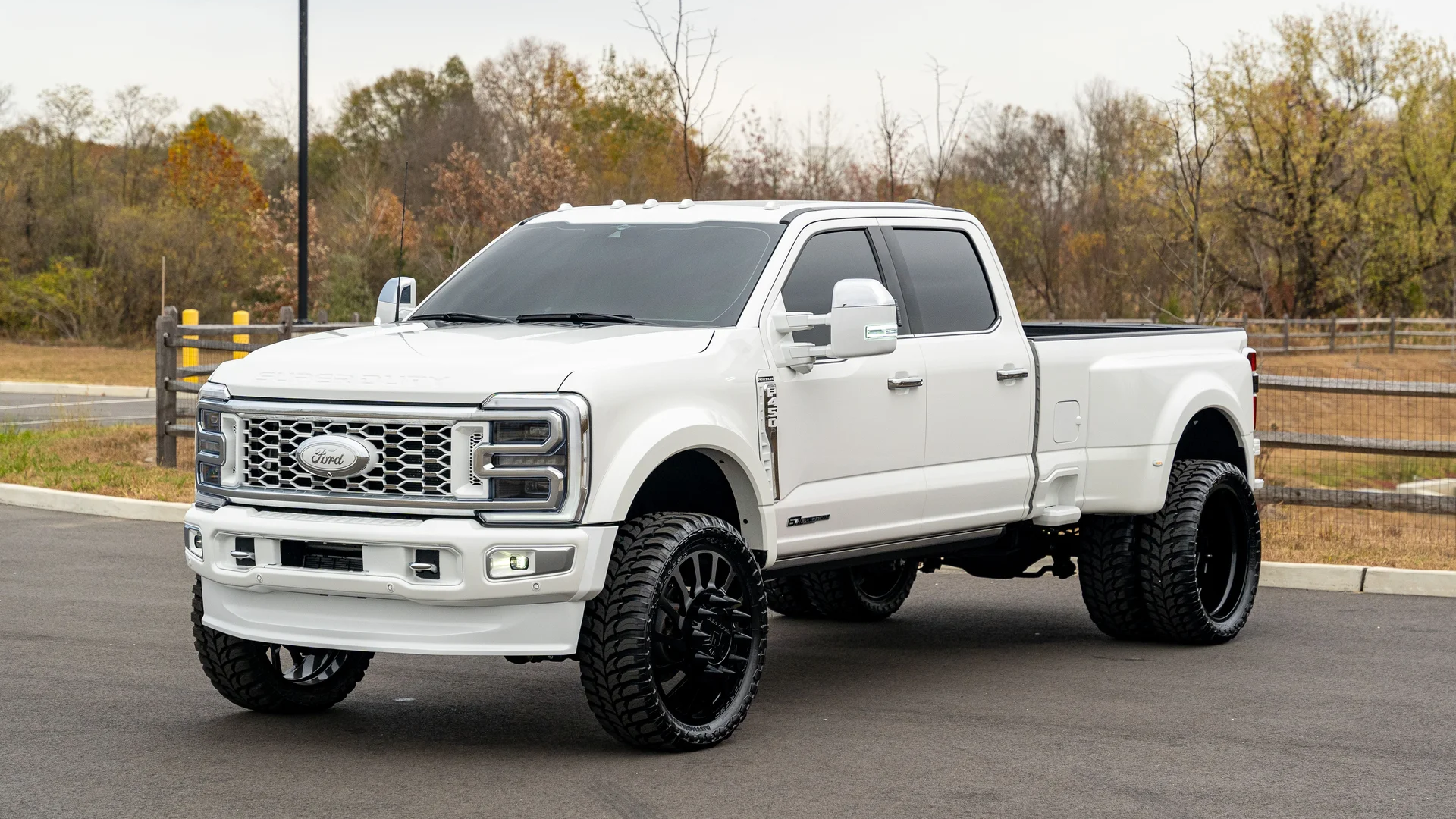
The Blur Between Commercial and Consumer
Most pickup trucks are built from the ground up to be pickups. The Ford F-450 Super Duty is different. It is a commercial chassis cabâdesigned for dump bodies, bucket lifts, and ambulancesâthat Ford decided to fit with a pickup bed and a King Ranch interior. Launched as a consumer pickup in 2008, it created a new category of capability that Chevrolet and Ram have struggled to match.
When you browse the F-450 listings on Hugegarage, you are looking at the only factory-built pickup truck in North America that comes standard with commercial 19.5-inch wheels and tires. This is not just an F-350 with different badges. It has a wider stance, bigger brakes, different gearing, and a suspension geometry designed for loads that would crush a standard truck. It is the nuclear option of towing.
The Turning Radius Magic: The #1 reason to buy an F-450 over an F-350 Dually is not the towing capacity; it is the Wide Track Front Axle. Because the front wheels are pushed further out from the frame, they can cut at a sharper angle (roughly 45 degrees). This gives the massive F-450 a tighter turning circle than many half-ton trucks, making it surprisingly maneuverable in parking lots and RV parks.
F-350 Dually vs. F-450: The Technical Breakdown
This is the most common debate in the heavy-duty world. They look similar, share the same cab, and often share the same engine. But the mechanical differences are profound.
1. The Front Axle (Dana Super 60)
The F-450 uses a specialized Wide Track Dana Super 60 front axle. It is roughly 5 inches wider than the F-350's axle.
Benefit: Massive maneuverability. You can U-turn an F-450 on a standard 4-lane road; an F-350 Dually needs a football field.
2. The Tires and Wheels (19.5-inch)
The F-450 rides on 19.5-inch commercial wheels wrapped in G-Rated tires (usually Continental HSR/HDR).
Pros: Incredible load stability. The sidewalls are steel-reinforced and extremely stiff. They do not squirm or sway under a 6,000-lb pin weight. They last for 50,000+ miles of heavy towing.
Cons: Ride quality. Because the sidewalls don't flex, the F-450 transfers every crack in the road to the driver. Also, these tires are typically speed-rated to 87 MPH (Speed Rating N). You cannot safely cruise at 90 MPH in an F-450.
3. The Brakes
The F-450 uses massive 15.39-inch front rotors and 15.75-inch rear rotors, significantly larger than the F-350. More importantly, it uses 6-piston calipers up front. This braking power is essential when stopping a 40,000-lb Combined Gross Vehicle Weight.
4. Gearing
Almost all F-450 pickups come standard with 4.30:1 Axle Gears.
The F-350 usually comes with 3.55 or 3.73 gears.
Effect: The 4.30 gears give the F-450 incredible acceleration while towing, getting heavy loads moving instantly. The trade-off is higher RPMs on the highway and slightly lower fuel economy (expect 13-15 MPG empty).
The Evolution of the Beast
Generation 1 (2008â2010)
The first consumer F-450.
Engine: 6.4L Power Stroke.
Warning: While capable, the 6.4L engine is a reliability nightmare (see F-250 section). These early models are also unique because they used an 8-lug 19.5-inch wheel pattern that is hard to find aftermarket replacements for.
Generation 2 (2011â2016)
Engine: 6.7L Power Stroke (Gen 1/2).
A Step Back? Strangely, from 2011 to 2014, Ford actually downgraded the F-450 pickup to 17-inch wheels and an 8-lug pattern to save weight and court the Class 3 registration crowd. Enthusiasts revolted.
The Fix: In 2015, Ford brought back the true commercial spec: 19.5-inch wheels, 10-lug axles, and the wide-track front end. If buying used, look for a 2015 or newer model to get the real F-450 hardware.
Generation 3 (2017â2022) Alumiduty
The switch to the aluminum body was a game-changer for the F-450.
Weight Savings: The lighter body allowed Ford to strengthen the frame and hit the magical 30,000 lb+ towing capacity while staying (barely) under the 14,000 lb GVWR limit for insurance reasons.
Generation 4 (2023âPresent)
The modern monster.
Engine: Standard 6.7L High Output Power Stroke (500 HP / 1,200 lb-ft).
Tech: Onboard Scales (measures payload in real-time), 360-degree trailer cameras, and a Heads-Up Display that shows navigation towing instructions on the windshield.
Towing Capability: 40,000 lbs?
Ford markets the F-450 with a maximum gooseneck towing capacity of 40,000 lbs (on specific regular cab configurations).
Real World: For the standard Crew Cab 4x4 configuration most people buy, the rating is typically around 30,000 - 35,000 lbs.
This is overkill for almost every recreational RV (which top out around 20,000 lbs). This headroom means the F-450 is never stressed. It pulls heavy loads with a relaxed confidence that an F-350 at its limit cannot match.
The Insurance and Licensing Maze
Buying an F-450 requires homework.
- Insurance: Many standard auto insurers (Geico, Progressive, etc.) will not insure an F-450 on a personal policy because it is a Class 4 Commercial Vehicle by VIN. You often need a Commercial Personal Auto Policy.
- Registration: In many states, the registration fees are based on weight. An F-450 can cost significantly more to tag than an F-250.
- Driver's License: If your GCWR (Truck + Trailer rating) exceeds 26,001 lbs, many states require a Class A Non-Commercial License. The F-450's GVWR alone is 14,000 lbs. If you hook up a 15,000 lb trailer, you are at 29,000 lbs GCWR. You are in CDL territory unless you have the RV exemption. Check your state laws.
Living with the 19.5s
The wheels are the defining feature, but they come with quirks.
1. Balancing: Commercial tires are hard to balance. Many owners use balancing beads inside the tire rather than wheel weights.
2. Winter Traction: The stock Continental tires are hard rubber designed for highway longevity. They are terrible in snow and mud.
3. Tracking: On rutted highways, the stiff sidewalls tend to tramline (follow the grooves in the road), requiring more steering input than a standard truck.
Buyer's Guide: Trim Levels
The F-450 is a premium product. You cannot buy a stripped F-450 pickup (though you can buy a stripped chassis cab).
- XL: Rare in the pickup configuration.
- XLT: The entry point, but uncommon.
- Lariat: The volume seller.
- King Ranch / Platinum: The most popular trims. F-450 buyers usually want it all. The interiors are identical to the F-150, meaning you get massaging seats, Bang & Olufsen audio, and adaptive cruise control.
- Limited: The $100,000+ status symbol. Unique two-tone leather and numbered plaques.
Conclusion: The Ultimate Machine
The Ford F-450 Super Duty is a flex. It is a statement that you have the biggest, most capable pickup truck money can buy. For the weekend RVer with a 15,000 lb camper, it is arguably unnecessary compared to an F-350. But for the heavy hauler who wants the tightest turning radius, the biggest brakes, and the most stability available without stepping up to a semi-truck, the F-450 has no peer. It is the king of the road. Explore the commercial-grade specs below.