
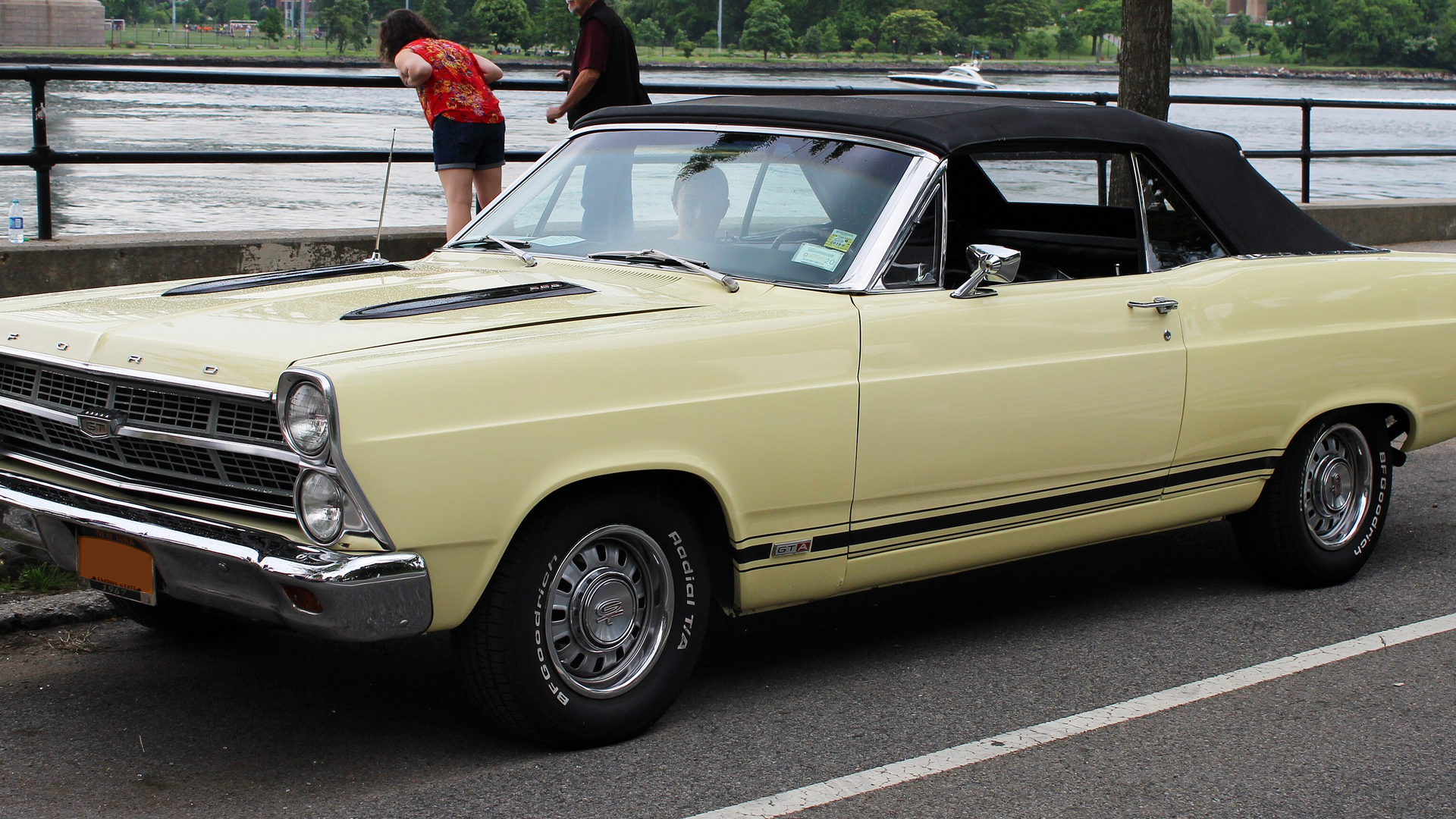
The Goldilocks of the 60s
In the 1950s, Fairlane meant the biggest, fanciest Ford you could buy. But in 1962, Ford did something radical: they shrank it. As the Galaxie took over the full-size duties and the Falcon handled the compact market, the Ford Fairlane was reinvented as the first modern intermediate car. It was bigger than a compact but smaller than a full-size. It was, as it turned out, the perfect size. It fits in a garage easily, yet fits six adults comfortably. This new midsize platform would eventually spawn the Mustang, the Torino, and the Ranchero, making the Fairlane the most important chassis in Ford history.
When you browse the Fairlane listings on Hugegarage, you are looking at the car that started the muscle car wars before the GTO even existed. From the elegant 50s cruisers to the stacked-headlight street machines of 1966-67, the Fairlane offers a sophisticated alternative to the pony car craze.
The Thunderbolt Legend: In 1964, Ford wanted to win the NHRA Super Stock championship. They took 100 Fairlane coupes, stripped out the interiors, replaced the steel fenders/hood/bumpers with fiberglass, and shoehorned the massive 427 High-Riser V8 under the hood. The Fairlane Thunderbolt is arguably the most extreme factory drag racer ever built. It was not street legal, it came with a tow bar, and it ran 11-second quarter miles straight from the dealer.
Generation 1-3: The Full-Size Years (1955â1961)
Originally, the Fairlane was the top trim of the full-size line.
1955-1956 Crown Victoria: The most famous of this era. It featured a unique chrome basket handle B-pillar that arched over the roof. The Skyliner version had a transparent acrylic roof panel (which cooked passengers in the summer).
1957-1959: The Fairlane 500 Skyliner was the retractable hardtop convertible.
Generation 4: The Downsizing (1962â1965)
This is where the Fairlane became its own distinct model.
The Engine: It introduced the lightweight Windsor V8 (221 and 260 cubic inches), which would later power the Mustang.
The K-Code: In 1963, you could order the Hi-Po 289 V8 (271 HP) in a Fairlane. This was a sleeper car that could embarrass Chevy Impalas.
Generation 5: The Muscle Era (1966â1967)
The 1966 redesign is the most popular among muscle car collectors. It featured stacked vertical headlights and cleaner lines.
The GTA: The Fairlane GTA (GT Automatic) was the performance model. It featured the 390 cubic inch V8 (335 HP) and the SportShift automatic transmission, allowing manual shifting.
The 427 R-Code (1967)
To qualify the 427 engine for NASCAR, Ford built 57 special Fairlanes with the 427 Side-Oiler engine (425 HP). These are exceedingly rare and valuable.
Generation 6: The Torino Takeover (1968â1970)
For 1968, the Fairlane was redesigned again with a fastback roofline. Ford introduced a new top trim level called the Torino.
The Transition: Initially, the Torino was just a fancy Fairlane. By 1970, the Torino name had become so popular that Fairlane was relegated to the base model taxi/police trim. In 1971, the Fairlane name was dropped entirely.
The Cobra Jet
In 1968-1969, you could order a Fairlane or Torino with the 428 Cobra Jet V8. Rated conservatively at 335 HP (closer to 400 in reality), these cars were dedicated drag strip warriors, featuring functional hood scoops and heavy-duty suspension.
Common Issues Maintenance
1. Unibody Rust
Unlike the Galaxie (which had a frame), the 1962+ Fairlane was a unibody car. Rust in the torque boxes (where the rear suspension mounts) is critical. If these are rotted, the car is structurally unsafe.
2. Cowl Vents
Like the Mustang, the cowl vents rust out, leaking water onto the floor and ruining the carpets.
3. Front Suspension (Shock Towers)
The shock towers in 1962-1965 models are very narrow. Fitting big-block FE engines or modern 4.6L modular engines is extremely difficult without cutting the shock towers (a Mustang II suspension swap is a common solution).
Conclusion: The Smart Muscle Choice
A 1966 Fairlane GT with a 390 engine costs significantly less than a 1967 Mustang Fastback with the same engine, yet it offers more room, a better ride, and arguably more road presence. It is the sophisticated choice for the Ford enthusiast who wants to stand out from the sea of Mustangs at the local car show. Explore the specs below.