
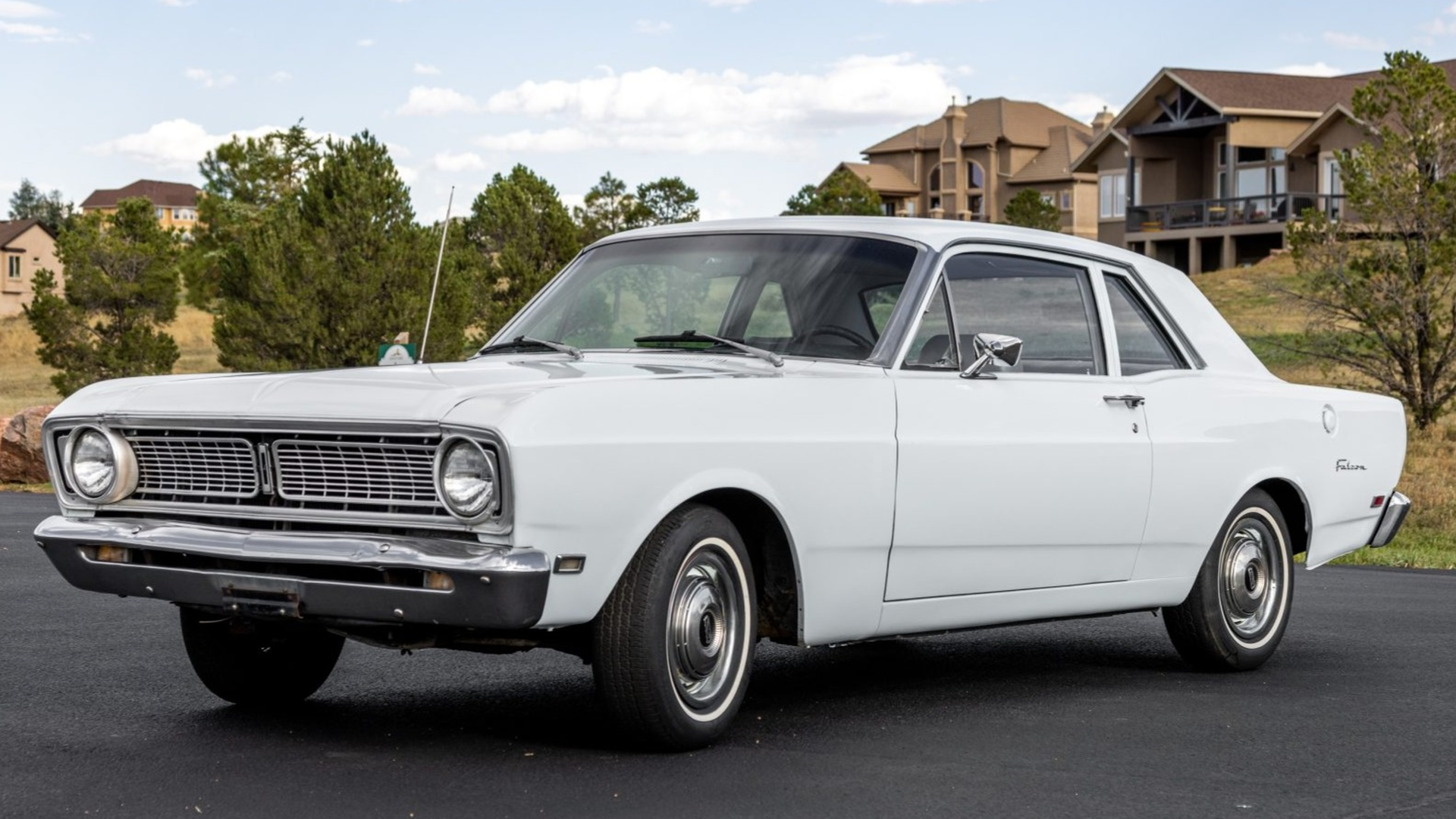
The Bean Counter's Masterpiece
In the late 1950s, Ford executive Robert McNamara (who would later become Secretary of Defense) hated fins, chrome, and excess. He wanted a car that was cheap to build, cheap to buy, and got good gas mileage. The result was the 1960 Ford Falcon. It was boring, simple, and absolutely brilliant. It sold over a million units in its first two years, crushing the radical Chevy Corvair and the Plymouth Valiant.
When you browse the Falcon listings on Hugegarage, you are looking at the most important chassis in Ford history. Why? Because in 1964, Ford took the Falcon chassis, put a sporty body on it, and called it the Mustang. Without the Falcon, there is no Mustang. Today, the Falcon offers all the mechanical simplicity of a Mustang but with unique styling and a much lower entry price.
The Australian Legend: While the US Falcon died in 1970, the Falcon lived on in Australia until 2016. The most famous Falcon of all is the XB GT Coupe from the movie Mad Max. That carâthe last of the V8 Interceptorsâis Australian muscle royalty, but its DNA starts right here with the 1960 US model.
Generation 1: The Round Body (1960â1963)
The early Falcons are cute, round, and extremely light (under 2,500 lbs).
Engine: 144 or 170 cubic inch Thriftpower Inline-6.
Performance: Slow. 0-60 took about 20 seconds.
The Sprint V8 (1963): In 1963, Ford dropped the 260 cubic inch V8 into the Falcon Sprint. This was the testbed for the Mustang powertrain. A 1963 Falcon Sprint convertible is a legitimate performance car.
Generation 2: The Square Body (1964â1965)
To look more modern, the Falcon got squared-off lines and a more aggressive grille.
The 289 V8: You could now get the legendary 289 V8 (200-225 HP) in the Falcon. In a car this light, a 289 Falcon is a rocket.
Generation 3: The Mustang Sibling (1966â1970)
For 1966, the Falcon was redesigned based on the shortened Fairlane chassis. It looks like a scaled-down Fairlane.
The End: By 1970, the Falcon was squeezed out. The Maverick replaced it as the compact economy car, and the Torino replaced it as the midsize offering. The 1970.5 Falcon is a weird half-year model that is essentially a stripped-down Torino.
The Ranchero Connection
The Ford Ranchero (the car-pickup hybrid) was based on the Falcon platform from 1960 to 1966. It was smaller and more nimble than the Chevy El Camino. A Falcon Ranchero is the perfect shop truck for a classic car enthusiast.
Common Issues Maintenance
1. Front Suspension
The early Falcon front suspension (especially the upper control arms) was not designed for modern roads or V8 weight. The Shelby Drop (lowering the upper control arm mounting points 1 inch) is a mandatory modification to improve handling.
2. Vacuum Wipers
Early models used vacuum-powered windshield wipers. When you accelerate (and engine vacuum drops), the wipers stop moving. Upgrading to an electric wiper motor is a safety necessity.
3. Rust (Unibody)
Like the Mustang, check the torque boxes and floor pans. The Falcon is a unibody car; if the structure is rusty, the car will sag.
Conclusion: The Entry-Level Classic
The Ford Falcon is the perfect first classic car. Parts are cheap (because they are shared with the Mustang), it is easy to work on, and it gets more thumbs-up at gas stations than a generic red Mustang. Whether you build a 6-cylinder cruiser or a 400-horsepower V8 restomod, the Falcon is a blank canvas for American car culture. Explore the specs below.