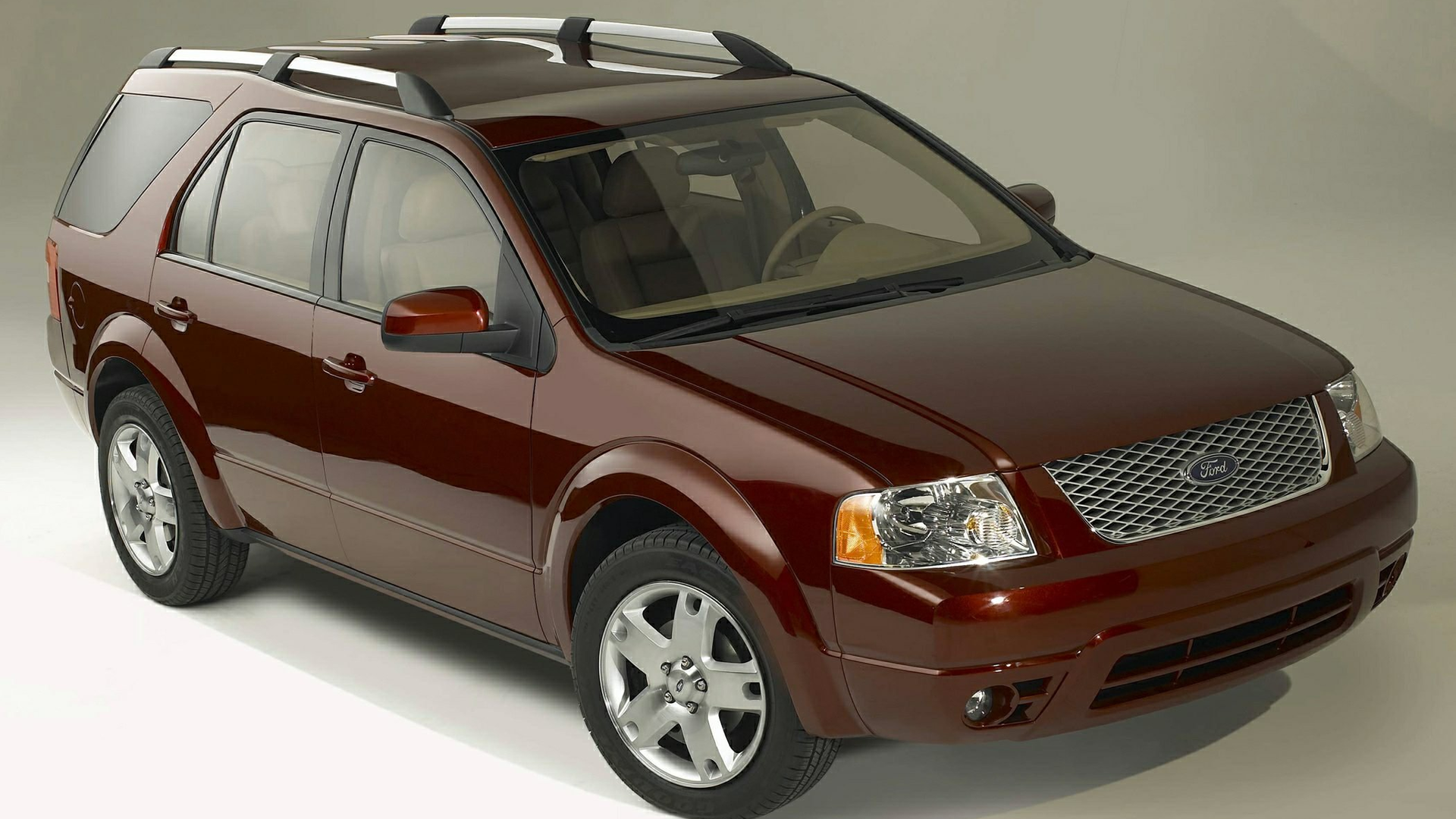
Ford Freestyle: The Crossover That Invented the Future

The Ford Freestyle was a visionary vehicle. Bridging the gap between a wagon and an SUV, it offered three-row seating, Volvo-derived safety, and car-like handling. While often forgotten, it laid the groundwork for the modern crossover boom, providing a safe, spacious, and practical alternative to the truck-based Explorer.

Production: 2005-2007
30 Min Read
Ford Freestyle Exterior Photo

Author

HugeGarage Editor

Published

Updated

30 Min Read

The Right Car at the Wrong Time

In 2005, Americans were still obsessed with body-on-frame SUVs like the Ford Explorer and Chevy Tahoe. They wanted trucks. Ford released the Freestyle into this environment, and the market shrugged. It looked like a tall station wagon. It didn't have a V8. It was sensible. But looking back, the Freestyle was a prophecy. It was the blueprint for the modern three-row crossover (CUV) that now dominates suburban driveways. It offered the interior space of an Explorer with the fuel economy and safety of a sedan.

When you browse the Freestyle listings on Hugegarage, you are finding a hidden gem. Because it lacks the tough truck image, prices are incredibly low. Yet, it sits on the same Volvo P2-derived D3 platform as the XC90 and Ford Five Hundred. This means you get Swedish safety engineering—including a boron steel safety cage—for the price of a used economy car.

The Name Change Confusion: Like the Five Hundred, the Freestyle suffered from Ford's identity crisis. It was sold from 2005-2007. In 2008, it received a new engine and was renamed the Ford Taurus X. Mechanically, the Taurus X is just a Freestyle Gen 2, but the Freestyle nameplate itself is a unique artifact of the mid-2000s.

Engineering: The Volvo Connection

The Freestyle is, under the skin, a long-wheelbase Volvo wagon.
Ride Quality: It uses MacPherson struts up front and a multi-link rear suspension. The ride is firm but compliant, absorbing potholes without the shudder of a truck-based SUV.
AWD System: The available All-Wheel Drive system is the Haldex unit from the Volvo S80. It is a FWD-biased system that sends power rearward only when slip is detected. It is excellent for snow and rain but is not designed for off-roading.

Powertrain: The CVT Experiment

The Freestyle was only available with one powertrain combination, which was its biggest controversy.

3.0L Duratec V6
Specs: 203 HP / 207 lb-ft Torque.
The Reality: This engine was perfectly reliable but underpowered for a 4,000-lb vehicle carrying seven people. Merging onto the freeway requires flooring the pedal.
ZF CFT30 CVT
The Transmission: A Continuously Variable Transmission.
Why? Ford used a CVT to squeeze maximum fuel economy (24 MPG highway) out of the small V6.
Durability: Unlike the fragile CVTs in early Nissans, the Ford/ZF unit uses a chain instead of a belt. It is surprisingly durable if the fluid is changed every 60,000 miles. However, finding a mechanic who knows how to service this specific German-built transmission can be difficult today.

Interior: The Cargo King

The interior of the Freestyle is a masterclass in packaging.
Theater Seating: Each row of seats is mounted slightly higher than the one in front of it. This gives third-row passengers a view out the windshield, reducing motion sickness.
The Magic Fold:
- The third row folds flat into the floor.
- The second row folds flat.
- The front passenger seat folds flat forward.
The Result: You can slide a 10-foot ladder or a stack of 2x4s inside the car and close the trunk. No other SUV in its class could do this.

Trim Levels

  • SE: Cloth seats, plastic trim. Basic but functional.
  • SEL: The volume seller. Added alloy wheels, dual-zone climate control, and nicer upholstery.
  • Limited: Leather seats (heated), 18-inch wheels, and fake wood trim. The Limited AWD is the one to hunt for.

Common Issues Maintenance

1. Throttle Body (Limp Mode)

Like the Five Hundred, the Freestyle eats throttle bodies. If the wrench light comes on and the car loses power, spend the $150 for a new throttle body unit. It is a 20-minute DIY repair.

2. AC Compressor Failure

The AC compressor is known to seize or leak. On the Freestyle, replacing it is expensive because the subframe often interferes with access. Check that the AC blows ice cold before buying.

3. Rear Brake Wear

Because of the Electronic Brake Distribution (EBD) system, the Freestyle uses the rear brakes to stabilize the car under light braking (to prevent nose dive). As a result, rear brake pads often wear out faster than the front pads. This is normal behavior, not a defect.

Conclusion: The Smart Family Choice

The Ford Freestyle is not exciting. It drones when you accelerate, it looks like a hiking boot, and it has zero street cred. But as a tool for moving a family, it is brilliant. It is safer than an Explorer, holds more cargo than a Highlander, and is cheaper than both. If you can live with the modest power and the unique sensation of the CVT, it is arguably the most practical used vehicle Ford has ever made. Explore the dimensions below.

Frequently Asked Questions

What is the difference between the Ford Freestyle and the Ford Explorer?

While both vehicles offer three rows of seating, they are fundamentally different in their engineering. The Ford Explorer (during the 2005-2007 era) was a traditional, body-on-frame SUV with Rear-Wheel Drive (RWD) bias, making it ideal for heavy towing and off-roading. The Ford Freestyle was one of Ford's first true crossovers. It was built on a car-based unibody platform (shared with the Ford Five Hundred sedan), offering a much softer, car-like ride, better fuel economy, and easier passenger access due to its lower step-in height.

What are the most common transmission problems with a used Ford Freestyle?

If you are shopping for a used 2005-2007 Ford Freestyle, you must heavily scrutinize the transmission. Every Freestyle was equipped with a ZF-Batavia Continuously Variable Transmission (CVT).

Hugegarage Technical Tip: This specific CVT is notorious for early failure. When test driving, look for severe surging, lagging off the line, or a loud whining noise at highway speeds. If the internal chain or pulleys are worn, the transmission cannot be easily rebuilt and typically requires a highly expensive complete replacement. Always demand comprehensive maintenance records showing regular CVT fluid changes.

Does the Ford Freestyle have a 3rd row and seating for seven?

Yes, the Freestyle is an exceptional family hauler. Depending on the second-row configuration, it can comfortably seat up to seven passengers (with a second-row bench) or six passengers (if equipped with the highly desirable second-row captain's chairs). Furthermore, Ford engineered a "stadium seating" layout, where the second and third rows are elevated slightly higher than the front seats, giving rear passengers excellent forward visibility and reducing motion sickness on long road trips.

Why did Ford change the name of the Freestyle to the Taurus X?

The name change was purely a corporate branding strategy. In 2008, Ford's CEO Alan Mulally realized that the company had mistakenly abandoned the legendary "Taurus" nameplate. Concurrently, the Freestyle was receiving a major mid-cycle refresh (which included a new 3.5L V6 engine and a traditional 6-speed automatic transmission that finally replaced the problematic CVT). To capitalize on the massive brand recognition of the Taurus name, Ford rebranded the heavily upgraded 2008 Freestyle as the Ford Taurus X.

Is the Ford Freestyle All-Wheel Drive (AWD)?

Yes, it was offered with a highly capable All-Wheel Drive system, though Front-Wheel Drive (FWD) was standard. The AWD system in the Freestyle utilized an advanced Haldex electro-hydraulic clutch (borrowed directly from Volvo). In normal driving conditions, 100% of the power goes to the front wheels to save fuel. Within 50 milliseconds of detecting wheel slip on snow, ice, or loose gravel, the Haldex system instantly transfers torque to the rear wheels, making the Freestyle a phenomenal winter crossover.

Which engine is in the Ford Freestyle, and is it reliable?

Every Ford Freestyle (2005-2007) is powered by Ford's 3.0L Duratec V6 engine, producing 203 HP and 207 lb-ft of torque. The engine block and internals are generally very robust and can easily surpass 200,000 miles. However, this specific engine suffers from a highly documented Electronic Throttle Body failure. Experience sudden, terrifying engine surging or a sudden drop into "Limp Mode" while driving if the internal electronics fail. If buying used, verify if the throttle body has been replaced with an updated unit.

Can the Ford Freestyle tow a trailer?

While it looks like a large SUV, its towing capacity is severely limited by its car-based unibody chassis and its fragile CVT transmission. When properly equipped, the Ford Freestyle has a maximum towing capacity of only 2,000 pounds. This is adequate for pulling a small pop-up camper, a light aluminum utility trailer, or a jet ski, but it cannot safely haul heavy dual-axle boats or car trailers. If you need to tow over 2,000 pounds, you must upgrade to the body-on-frame Ford Explorer or Expedition.

What is the "Command Seating" feature in the Ford Freestyle?

Command Seating was one of the major marketing pillars for the Freestyle. Ford engineers recognized that consumers loved the high, commanding view of the road provided by traditional SUVs, but hated the massive step-in height. By raising the roofline and mounting the interior seats higher off the floorpan than a traditional station wagon, the Freestyle gave drivers that confidence-inspiring, elevated visibility while remaining incredibly easy for young children and elderly passengers to get in and out of.

Is the Ford Freestyle essentially a disguised Volvo station wagon?

Yes, underneath the sheet metal, the Freestyle shares a massive amount of Swedish engineering. It was built on Ford's D3 platform, which was heavily derived from the acclaimed Volvo P2 architecture (the same platform that underpinned the ultra-safe Volvo XC90 SUV and S80 luxury sedan). This partnership granted the Freestyle world-class structural rigidity, a phenomenally smooth ride quality, and top-tier crash test safety ratings that vastly outperformed older American minivans and SUVs.

What kind of gas mileage (MPG) does the Ford Freestyle get?

For a three-row family crossover produced in the mid-2000s, the Freestyle's fuel economy is quite respectable, largely due to the efficiency of the CVT transmission keeping the engine at optimal RPM. A standard Front-Wheel Drive (FWD) model delivers an EPA-estimated 20 MPG in the city and 27 MPG on the highway. If you opt for the heavier All-Wheel Drive (AWD) configuration, expect those numbers to drop slightly to 19 MPG city and 24 MPG highway.