
The 100-Year Grudge
The story of the Ford GT begins with a rejection. In 1963, Henry Ford II tried to buy Ferrari. Enzo Ferrari insulted him and backed out of the deal. Enraged, Ford vowed to build a car that would crush Ferrari at the 24 Hours of Le Mans. That car was the GT40, and it won Le Mans four times in a row (1966-1969).
Decades later, Ford revived the legend not once, but twice. The Ford GT is not just a fast Ford; it is a rolling statement of national pride. It proves that when American engineers are given a blank check and a target, they are unbeatable.
When you browse the Ford GT listings on Hugegarage, you are looking at the blue-chip stocks of the car world. These cars do not depreciate. They are art, history, and violence wrapped in aluminum and carbon fiber.
The Name Game: Why isn't it called the GT40? Because the original car was 40 inches tall. The 2005 revival was 44 inches tall, so GT44 sounded wrong. Plus, Ford didn't own the rights to the name GT40 at the time (a parts company did). So, it became simply the Ford GT.
Generation 1: The Centennial Celebration (2005â2006)
Released to celebrate Ford's 100th anniversary, the 2005 GT was a love letter to the 1960s. It looked almost identical to the original GT40 but was larger and more comfortable.
The Engine: A 5.4L Supercharged Modular V8.
Specs: 550 HP / 500 lb-ft Torque.
The Experience: It is a brute. There is no traction control, no stability control, and a heavy clutch. It is widely considered one of the last great analog supercars. Because the engine is over-engineered, tuners frequently push them to 1,000+ horsepower with stock internals.
The Clamshell Quirk
The doors cut into the roof (like the original race car). This looks cool but makes it impossible to get out of the car in a tight parking spot. If you can't open the door fully, you can't get out.
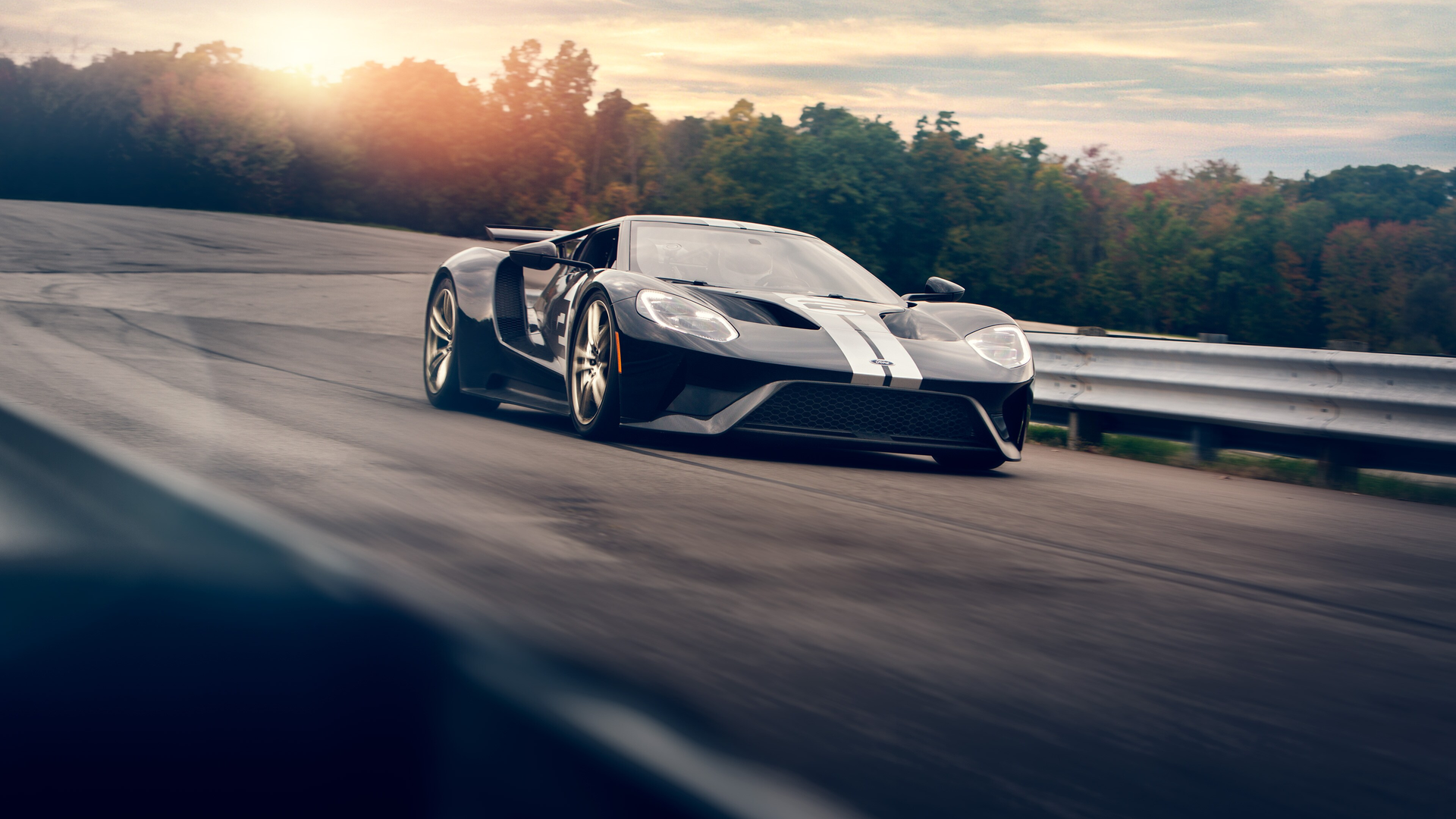
Generation 2: The Le Mans Assassin (2017â2022)
For the 50th anniversary of the 1966 Le Mans win, Ford decided to win again. They secretly developed a radically new Ford GT.
The Design: It is made entirely of carbon fiber. The body features flying buttresses that channel air around the cabin to the rear wing. It looks like a spaceship.
The Controversy: Ford ditched the V8 for a 3.5L Twin-Turbo EcoBoost V6.
The Result: 647-660 HP. Enthusiasts cried foul until the race car version won its class at Le Mans in 2016, beating Ferrari exactly 50 years after the first win.
The Application Process
You couldn't just buy a new Ford GT. You had to apply. Ford hand-picked buyers based on their social media following, brand loyalty, and promise to actually drive the car (not flip it for profit). This created massive demand and controversy in the collector market.
Driving Dynamics: Analog vs. Digital
- 2005 GT: Feels like a muscle car that went to finishing school. It rumbles, shakes, and requires muscle to drive. It is a grand tourer.
- 2017 GT: Feels like a Le Mans prototype with license plates. The suspension is hydraulic and drops the car 2 inches in Track Mode instantly. It is loud, harsh, cramped, and incredibly fast. It is a weapon.
Maintenance and Ownership
1. Fuel Economy (Gen 1)
The 2005 GT is affectionately known for its thirst. It is rated at 12 MPG city, but spirited driving sees single digits. The fuel tank is notoriously small, limiting range.
2. Hydraulic System (Gen 2)
The 2017 GT uses a complex high-pressure hydraulic system for the suspension and active aerodynamics. Maintenance requires specialized Ford GT-certified technicians, of which there are very few.
Conclusion: The King of Detroit
The Ford GT is the halo car that casts a shadow over the entire industry. The 2005 model is the accessible classic, a V8 icon that is surprisingly reliable. The 2017 model is a piece of unobtainium, a carbon-fiber marvel that represents the absolute limit of what a road car can be. Owning either one is not just owning a Ford; it is owning a victory. Explore the specs below.