
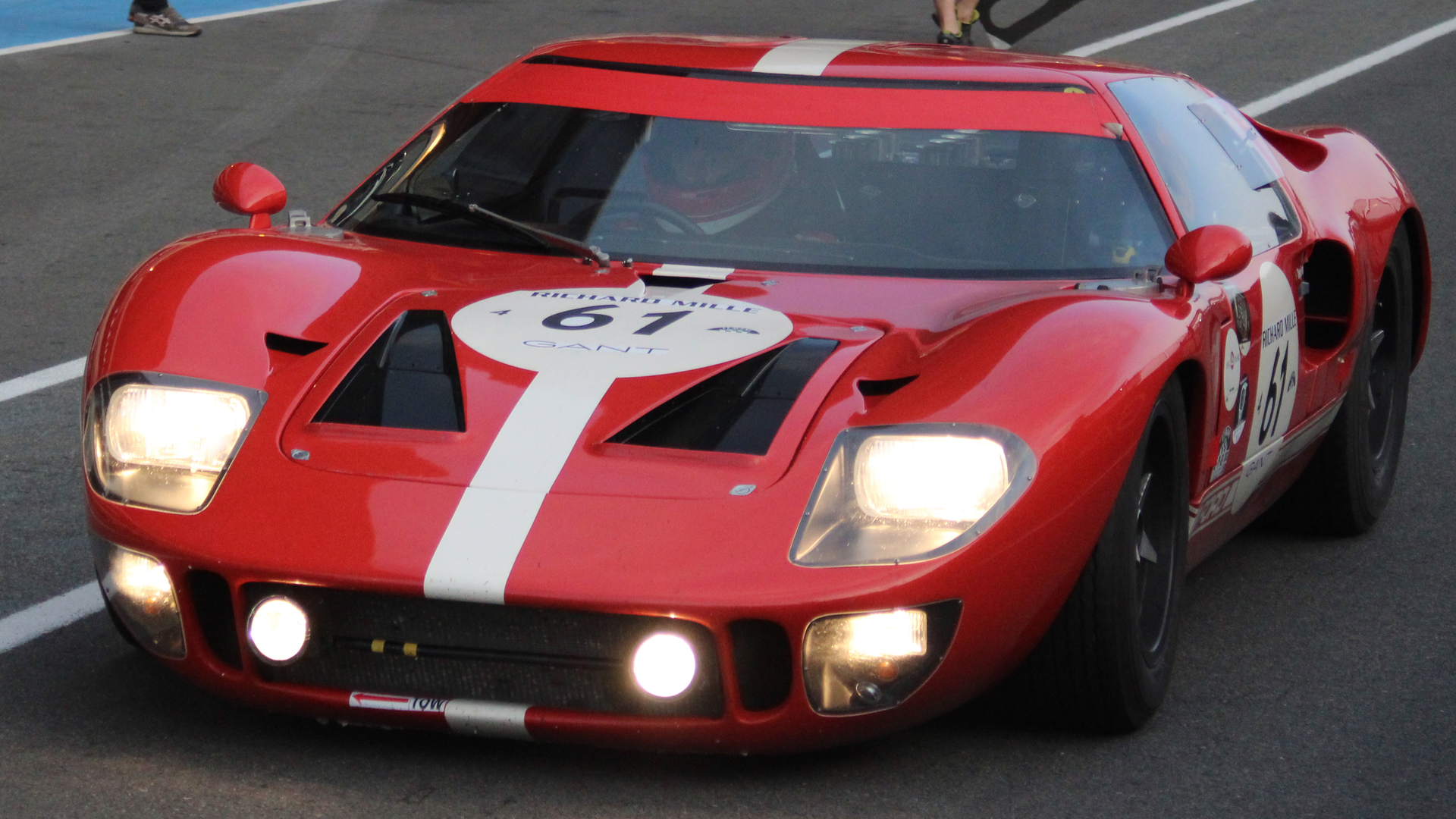
"Go Like Hell"
In 1963, Enzo Ferrari abruptly walked away from a deal to sell his company to Ford, insulting Henry Ford II in the process. The Deuce (as Ford was known) returned to Detroit with a vendetta. He gathered his best engineers and issued a simple command: Build a car that will beat Ferrari at Le Mans. The result was the Ford GT40. Standing just 40 inches tall, powered by American V8 muscle, and honed by legends like Carroll Shelby and Ken Miles, it didn't just beat Ferrari; it annihilated them.
When you browse the GT40 history on Hugegarage, you are reading the bible of American racing. This car represents the moment the United States proved it could build a sports car superior to the Europeans on their own turf. It is a story of failure, tragedy, and ultimate triumph.
The Name: The GT stands for Grand Touring. The 40 refers to its overall height of 40 inches (measured at the windshield), which was the maximum allowed height for the class. Ironically, the car was never officially badged as the GT40 by the factoryâmostly just Ford GT but the nickname stuck instantly.
The Evolution of a Champion
The GT40 program evolved rapidly through several iterations, each designed to solve specific problems.
Mk I (1964-1965)
The original. Powered by a 289 cubic inch (4.7L) small-block V8. It was fast but unreliable. In 1964, all three cars retired from Le Mans. It was an aerodynamic disaster initially, generating lift at high speeds that terrified drivers.
Mk II (1966)
The game changer. Carroll Shelby and Ken Miles stuffed the massive 427 cubic inch (7.0L) V8 from the Galaxie into the back. They redesigned the suspension and aerodynamics.
The Result: It dominated the 1966 24 Hours of Le Mans, finishing 1-2-3 in a controversial photo finish.
Mk III (1967)
A rare road-going version. Only 7 were built. It had four headlights, a softer suspension, and a luggage box. It is the least loved of the bunch because it looked awkward.
Mk IV (1967)
The all-American hero. While the Mk I and II were built in England (by Lola/Ford Advanced Vehicles), the Mk IV was built entirely in the USA. It featured an aluminum honeycomb chassis (revolutionary at the time) and a more aerodynamic long tail body. Driven by Dan Gurney and A.J. Foyt, it won Le Mans in 1967, beating the Ferrari 330 P4.
The "Gulf" Era (1968-1969)
For 1968, rules changed, banning the 7.0L engines. Ford returned to the Mk I chassis with the 4.9L V8, painted in the iconic Gulf Oil livery (Light Blue and Orange). Amazingly, the same exact chassis (P/1075) won Le Mans in both 1968 and 1969, a feat never repeated.
The Gurney Bubble
Driver Dan Gurney was too tall (6'4) to fit in the car with a helmet on. Engineers had to cut a hole in the roof and mold a fiberglass bubble over his head so the door would close. This feature is now iconic on the Mk IV.
Authenticity vs. Recreation
A real, race-verified Ford GT40 is worth tens of millions of dollars. As a result, a massive industry of continuation and replica cars exists.
Superformance: They build a GT40 so accurate that 90% of the parts are interchangeable with the original, and it even carries a Shelby chassis number.
Conclusion: The Greatest American Race Car
The Ford GT40 is the mechanical embodiment of determination. It is loud, hot, claustrophobic, and terrifyingly fast. It didn't just win races; it broke the spirit of Ferrari and cemented Ford's legacy as a performance brand. Whether you are looking at a priceless original or a high-quality recreation, the silhouette of the GT40 is the most recognizable shape in motorsport history. Explore the specs below.