
The Heartbeat of America
April 17, 1964. The New York World's Fair. Ford executive Lee Iacocca unveiled a car that didn't just change Ford; it changed the world. The Ford Mustang was compact, stylish, and affordable, but most importantly, it was a blank canvas. It could be a secretary's economical commuter with an inline-6, or it could be a fire-breathing drag racer with a 428 Cobra Jet V8. It created the Pony Car segment overnight, selling over 400,000 units in its first year and 1 million within two years.
When you browse the Mustang listings on Hugegarage, you are navigating the most diverse lineage in automotive history. You will find the agile Fox Bodies of the 80s, the retro-futuristic S197s of the 2000s, and the world-class sports cars of the modern S550/S650 eras. The Mustang is the only American muscle car to remain in continuous production for over 60 years, surviving oil crises, emissions regulations, and the SUV boom without ever losing its soul.
The 1964 1/2 Myth: Technically, all early Mustangs are 1965 models by VIN. However, enthusiasts refer to the cars built between April and August 1964 as 1964.5 models. These early cars feature unique characteristics, such as a generator instead of an alternator and a 170ci inline-6 instead of the later 200ci.
Generation 1: The Golden Era (1964.5â1973)
The first generation grew larger and more powerful with every redesign.
1965-1966: The Pure Pony
Small, light, and beautiful. The K-Code 289ci V8 High Performance (271 HP) is the collector's choice. Carroll Shelby took these cars and created the legendary GT350, stripping out the rear seats and turning them into SCCA race winners.
1967-1968: The Muscle Growth
The body grew wider to accept big-block engines. This era gave us the 390 FE V8 (famously driven by Steve McQueen in Bullitt) and the 428 Cobra Jet. The 1967 Shelby GT500 Eleanor remains one of the most recognizable cars in film history.
1969-1970: Peak Performance
Ford went all-in on performance variants.
Boss 302: Built for Trans-Am racing. High-revving small block.
Boss 429: Built to homologate the hemi-head engine for NASCAR.
Mach 1: The street brawler with the Shaker hood scoop.
1971-1973: The Big Horse
The Mustang grew massive, sharing DNA with the mid-size Torino. While powerful (the 351 Cleveland is a gem), these cars suffered from weight bloat and looming emissions restrictions.
Generation 2: The Mustang II (1974â1978)
History judges this car harshly, but it was the right car for the time. Based on the subcompact Pinto, it was small, slow, and fuel-efficient during the 1973 Oil Embargo.
Why it matters: It sold incredibly well. Without the sales success of the Mustang II, the Mustang nameplate would have been cancelled. It kept the lights on.
Generation 3: The Fox Body (1979â1993)
Built on the ubiquitous Fox platform, this generation returned the Mustang to performance relevance.
The 5.0L Legend: The 1987-1993 models, featuring the 5.0L High Output V8 (225 HP) and fuel injection, sparked the modern aftermarket industry. They were cheap, lightweight (3,000 lbs), and incredibly easy to modify. To this day, the Fox Body is the preferred chassis for drag racers.
Generation 4: SN95 New Edge (1994â2004)
Ford updated the Fox chassis with modern styling and safety.
The Modular Engine Switch (1996)
In 1996, Ford killed the pushrod 5.0L and introduced the 4.6L Modular V8.
2-Valve (GT): Reliable but underpowered (215-260 HP).
4-Valve (Cobra): High-revving and exotic. The 1996-2001 Cobras are undervalued gems.
The Terminator Cobra (2003-2004)
The SVT Cobra Terminator is a legend. It featured a factory-supercharged 4.6L 4-Valve V8 with a cast-iron block and forged internals. Rated at 390 HP (underrated), it could handle 700+ HP with just a pulley swap and a tune. It earned the nickname The Man's Engine.
Generation 5: The Retro S197 (2005â2014)
Ford tapped into boomer nostalgia with a design that mimicked the 1969 fastback. This generation had two distinct eras.
The 3-Valve Era (2005-2010)
Powered by a 4.6L 3-Valve V8 (300 HP). Great sound, decent torque, but struggled to keep up with the new Chevy Camaro SS in 2010.
The Coyote Revolution (2011-2014)
In 2011, Ford dropped the bomb: the 5.0L Coyote V8.
The Tech: Twin Independent Variable Cam Timing (Ti-VCT), 4 valves per cylinder, high compression.
The Result: 412+ HP. Finally, the Mustang GT was a world-class sprinter. The Boss 302 (2012-2013) refined this package into one of the best track cars ever made with a solid rear axle.
Generation 6: The S550 (2015â2023)
For the 50th anniversary, Ford finally ditched the solid rear axle for Independent Rear Suspension (IRS) across all trims. This transformed the Mustang from a drag strip hero into a corner-carving sports car.
Engine Lineup
- 2.3L EcoBoost: Replaced the V6. 310 HP. Lighter nose weight makes it surprisingly agile.
- 5.0L Coyote (Gen 2/3): Refined with Port and Direct Injection (Gen 3) for 460 HP.
- 5.2L Voodoo (GT350): A flat-plane crank V8 that revs to 8,250 RPM. It sounds like a Ferrari mixed with a chainsaw. It is one of the most special engines ever produced by an American manufacturer.
- 5.2L Predator (GT500): Supercharged cross-plane crank. 760 HP. The most powerful street-legal Ford ever.
Generation 7: The S650 (2024âPresent)
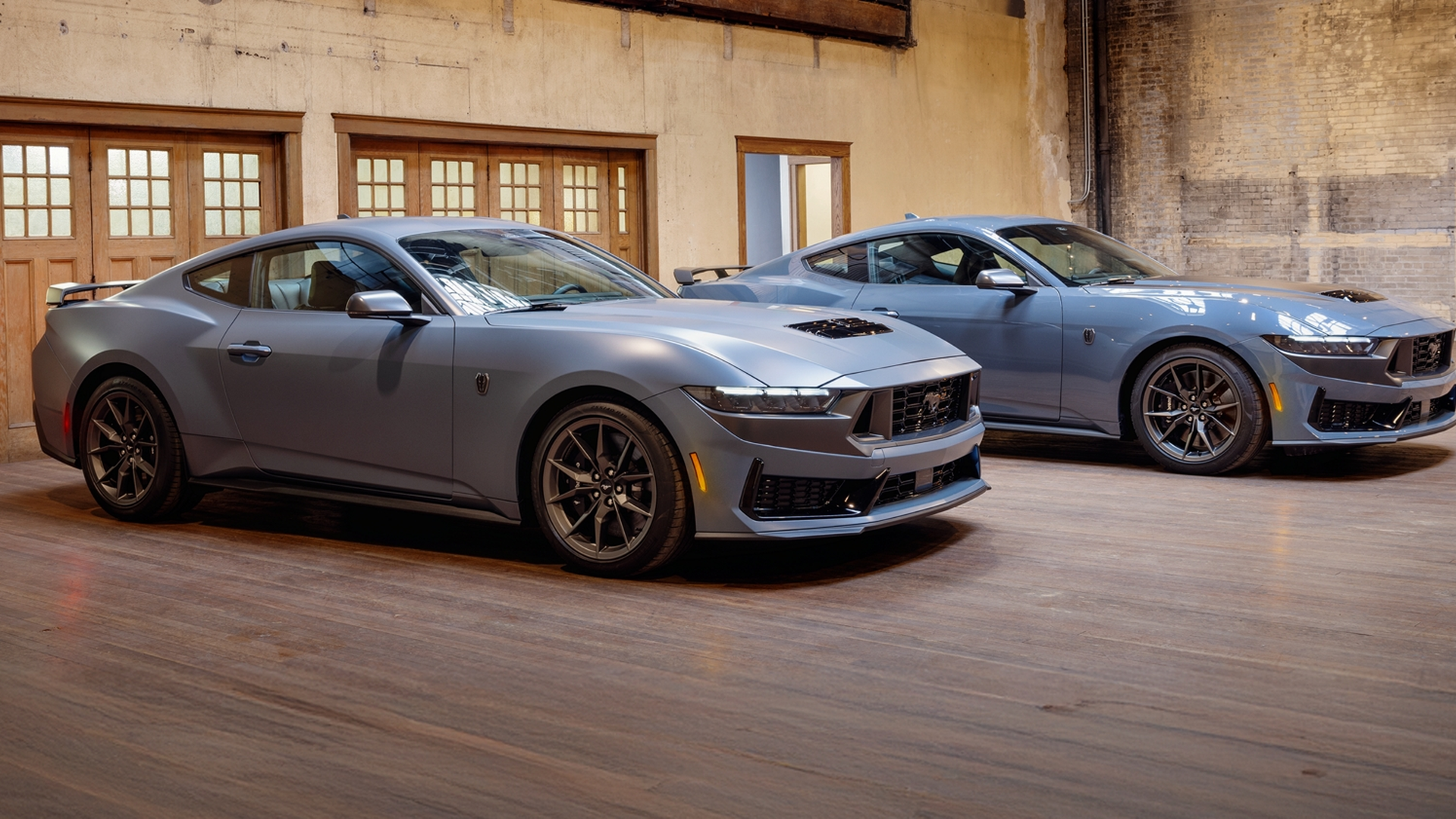
The S650 carries the torch as the last V8 muscle car standing (with the Camaro and Challenger discontinued). It features a digital-heavy interior (screens replacing gauges) and the Dark Horse performance trim.
The Dark Horse
Essentially a street-legal race car.
Engine: Coyote Gen 4 (500 HP).
Transmission: Tremec TR-3160 Manual (superior to the standard GT's Getrag).
Tech: Remote Rev allows you to rev the engine from the key fob to show off.
Technical Deep Dive: The Coyote V8 Evolution
Understanding the Coyote generations is critical for buyers and tuners.
- Gen 1 (2011-2014)
- Found in S197. Strong block, but weaker oil pump gears. 412-420 HP.
- Gen 2 (2015-2017)
- Found in early S550. Added Charge Motion Control Valves (CMCV) for better torque. Sintered iron connecting rods. 435 HP.
- Gen 3 (2018-2023)
- The big leap. Added Dual Fuel Injection (Port + Direct) to support high RPM and compression (12:1). Spray-in cylinder liners (increased displacement to 5.035L). 460 HP. This is the tuner's favorite.
Manual Transmission Wars: MT82 vs. Tremec
Not all Mustang manuals are created equal.
- Getrag MT82 (6-Speed): Standard on Mustang GTs since 2011. It has a reputation for being fragile, with remote shifter lockout issues and weak shift forks. Enthusiasts often install aftermarket shifters (like Barton) to fix the feel.
- Tremec TR-3160 (6-Speed): Found in GT350 and Dark Horse. Significantly smoother and stronger.
- Tremec TR-6060 (6-Speed): Found in the GT500 (2007-2014). Bulletproof.
Common Issues Maintenance
1. The Typewriter Tick
Coyote engines often make a rhythmic ticking noise at idle. Ford states this is normal functionality of the high-pressure fuel pump and variable cam timing. It is annoying but typically harmless.
2. A/C Evaporator Leaks (S550)
A very common failure on 2015-2017 models. The evaporator core inside the dash leaks refrigerant. Fixing it requires removing the entire dashboard, a labor-intensive job.
3. Oil Pump Gears (OPG)
If you plan to supercharge a Coyote engine, you must replace the stock powdered-metal oil pump gears with billet steel gears. The stock gears can shatter under the vibration of a supercharger or bouncing off the rev limiter, causing instant engine failure.
Buyer's Guide: The Sweet Spots
The Budget Drag Racer
2011-2014 Mustang GT (S197). The solid rear axle launches hard, the Gen 1 Coyote loves boost, and the car is lighter than the S550.
The Daily Driver
2018+ Mustang GT with 10-Speed Auto (10R80). The 10-speed transmission keeps the Gen 3 Coyote in its powerband perfectly. It is faster than the manual and comfortable in traffic.
The Collector
Shelby GT350 (2016-2020). The Voodoo engine will likely never be made again. Its unique sound and high-revving character make it a future blue-chip collectible. Look for 2019+ models which have the updated Gen 2 Voodoo engine block.
Conclusion: The Icon
The Ford Mustang is more than specs; it is an emotion. It is the sound of a V8 echoing off a canyon wall; it is the smell of tire smoke at a drag strip; it is the feeling of connection to a 60-year legacy of American engineering. While competitors have come and gone, the Mustang endures because it evolves. It offers a perfect entry point for every enthusiast, from the eco-conscious commuter to the hardcore track rat. Long live the pony. Explore the detailed specs and history below.