
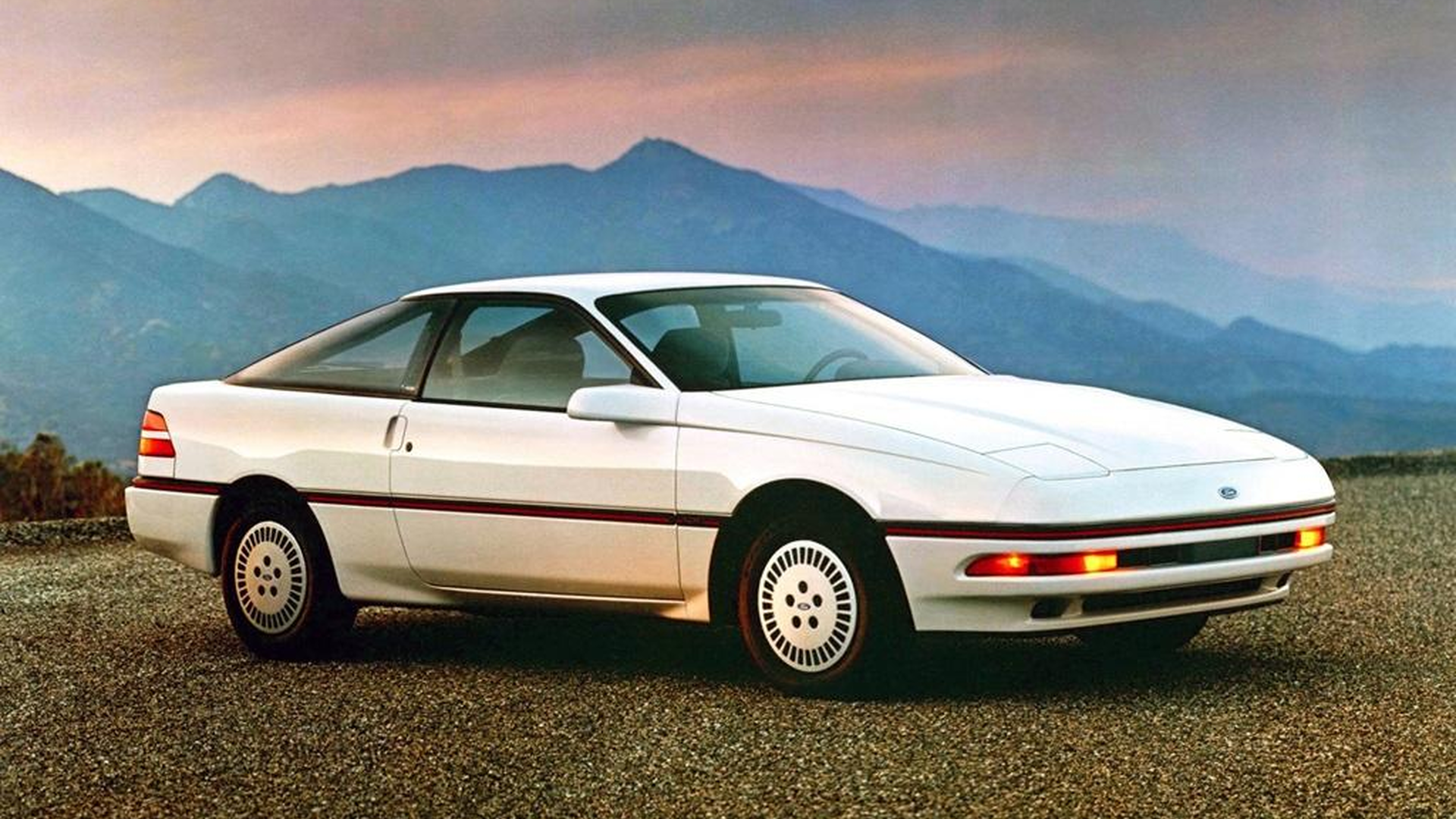
The Great Mustang Mutiny
In the mid-1980s, Ford executives looked at rising gas prices and the success of the Honda Prelude and Toyota Celica. They decided the future was front-wheel drive. They engaged their partner, Mazda, to engineer a new sports coupe on the 626 platform to replace the aging Fox-body Mustang. When AutoWeek leaked the plans in 1987, the American public exploded in anger. Tens of thousands of letters flooded Ford headquarters. The message was clear: A Mustang must be rear-wheel drive. Ford listened, granting the Fox-body a stay of execution. But they had already spent millions developing the new car. So, in 1989, they released it as the Ford Probe.
When you browse the Probe listings on Hugegarage, you are looking at one of the best sport compacts of the 1990s. Because it was essentially a Mazda MX-6 with Ford styling, it possessed a level of engineering refinement and handling precision that the Mustang of the same era simply lacked. It was the import fighter that actually had import DNA.
The Aerodynamic Benchmark: The Probe was named after Ford's series of aerodynamic concept cars from the early 80s. True to its name, the production Probe Gen 1 had a drag coefficient of 0.30, making it one of the slipperiest cars on the road. The pop-up headlights weren't just for style; they were essential for that low nose profile.
Generation 1: The Turbo Wedge (1989â1992)
The first-generation Probe is an 80s icon. It is angular, features aggressive pop-up headlights, and has a dashboard filled with digital gauges and buttons.
The Trims:
- GL/LX: Powered by a Mazda 2.2L naturally aspirated 4-cylinder (110 HP). Reliable but slow.
- GT: The legend. It used the 2.2L F2T Turbo engine.
The Probe GT Turbo
The Gen 1 GT is famous for one thing: Torque.
Specs: 145 HP / 190 lb-ft Torque.
The Drive: The horsepower number sounds low today, but the torque hit low in the rev range (3,500 RPM). It was a traffic light monster. However, putting 190 lb-ft through the front tires in 1989 resulted in massive torque steer. The steering wheel would tug violently in your hands under hard acceleration, an erratic behavior that owners affectionately learned to manage.
Generation 2: The Bio-Design Curve (1993â1997)
For 1993, the Probe grew up. The styling shifted to the bio design trendâorganic curves, feline headlights (still pop-ups), and a smoother silhouette. It was longer, wider, and handled significantly better.
The Engine Shift: From Turbo to V6
Ford and Mazda dropped the coarse turbo 4-cylinder in favor of a sophisticated V6.
- 2.0L Mazda FS I4 (Base/SE)
- Specs: 118 HP.
Verdict: A solid, efficient commuter engine. Not exciting, but durable. - 2.5L Mazda KL-DE V6 (GT)
- Specs: 164 HP / 160 lb-ft Torque.
The Magic: This all-aluminum V6 is a masterpiece. It features a Variable Resonance Induction System (VRIS) that changes the intake runner length to optimize airflow. It revs to 7,000 RPM with a silky smoothness that BMW would envy. It made the Probe GT a legitimate competitor to the Acura Integra GS-R and Honda Prelude VTEC.
Handling Dynamics
The Probe GT was widely praised by magazines like Car and Driver for its chassis balance. It used independent MacPherson struts all around and specially tuned sway bars. On a canyon road, a Probe GT could easily run away from a V8 Mustang GT of the same year, simply because it could carry so much more speed through corners.
Common Issues Maintenance
1. Distributor Failure (Gen 2 V6)
The Mazda KL engine uses a distributor that is prone to internal seal failure. Oil leaks into the electronics, causing misfires or a no-start condition. It is known as the HEI mod in the community to retrofit a GM ignition module, or simply replace the distributor with a quality OEM unit.
2. Timing Belt Tensioner
On the V6, the hydraulic timing belt tensioner is known to fail, causing a rattling noise (often mistaken for rod knock). The KL engine is non-interference, so a belt snap won't destroy the engine, but it will leave you stranded.
3. Pop-Up Headlight Motors
Like all cars with pop-ups, the nylon gears inside the motors strip over time, leaving one eye lazy or stuck shut. Brass gear replacement kits are available.
Why Was It Cancelled?
By 1997, the sport compact coupe market was shrinking. SUVs were rising. Sales of the Probe plummeted (from 119,000 in 1993 to under 20,000 in 1997). Ford replaced the Probe with the Mercury Cougar (1999-2002), which was based on the Ford Contour/Mondeo chassis, marking the end of the Mazda partnership for Ford's sport coupes.
Conclusion: The Underrated Import Fighter
The Ford Probe is a car caught between worlds. Domestic muscle fans hated it for threatening the Mustang; import fans ignored it because of the Ford badge. Today, that makes it a bargain. A 1993-1997 Probe GT with a 5-speed manual is a fantastic driving experienceâpure 90s analog feedback with a glorious V6 soundtrack. It stands as a testament to what Ford and Mazda could achieve when they worked together. Explore the detailed specs below.