
"More Than a Car! More Than a Truck!"
In 1957, Ford launched a vehicle that defied categorization. The Ford Ranchero was built on a station wagon chassis but featured a pickup bed integrated into the body. The marketing slogan was brilliant: For the man who needs a truck but wants a car. It was a sensation, selling enough units to force Chevrolet to rush the El Camino into production two years later. For 22 years, the Ranchero followed the evolution of Ford's car lineup, shifting from full-size to compact to mid-size, always offering a unique solution for the rancher who wanted to drive to church in style.
When you browse the Ranchero listings on Hugegarage, you are looking at the most versatile classic car you can buy. It has the ride quality of a sedan, the parts availability of a Mustang (for many years), and the ability to haul a motorcycle or a load of mulch. It is the ultimate expression of having your cake and eating it too.
The Identity Crisis: Unlike the El Camino, which was almost always based on the Chevelle, the Ranchero changed platforms three times.
- 1957-59: Based on the full-size Fairlane/Galaxie.
- 1960-66: Based on the compact Falcon.
- 1967-79: Based on the mid-size Fairlane/Torino/LTD II.
Generation 1: The Full-Size Pioneer (1957â1959)
The original Ranchero was big. Based on the 1957 Ford Custom, it could carry an 1,100-lb payloadâmore than many half-ton pickups of the day. It featured the same tailfins and two-tone paint as the cars, making it a hit with gentleman farmers.
Generation 2: The Compact Falcon Era (1960â1966)
In 1960, Ford downsized the Ranchero to the new Falcon platform.
The Logic: Buyers wanted economy. The smaller Ranchero was cheap, light, and sipped fuel with its inline-6 engine.
The V8 Arrival: In 1963, the 260 V8 became available, followed by the 289 V8 in 1965. A 1965 Ranchero with a 289 and a 4-speed is a nimble, fun little truck.
Generation 3: The Muscle Era (1967â1971)
This is the golden age. In 1967, the Ranchero moved to the Fairlane chassis. It grew larger and gained muscle car styling.
1968-1969: Now based on the Torino. You could order a Ranchero GT with a 390 or even the 428 Cobra Jet.
1970-1971: The wildest styling. The Coke bottle curves of the Torino made for arguably the best-looking Ranchero ever. The Ranchero Squire trim added woodgrain siding, creating a bizarre mix of muscle car and country club wagon.
The 429 Cobra Jet Ranchero
In 1970-71, you could order the Ranchero with the 429 Super Cobra Jet engine. With 375+ horsepower and a functional shaker hood, this was a pickup truck that could run 13-second quarter miles. It is exceedingly rare.
Generation 4: The Heavyweight (1972â1976)
Following the Torino, the Ranchero switched to a body-on-frame design in 1972. It became huge, heavy, and extremely comfortable. The fishmouth grille gave it an aggressive look. These models are popular for towing vintage campers.
Generation 5: The Final Years (1977â1979)
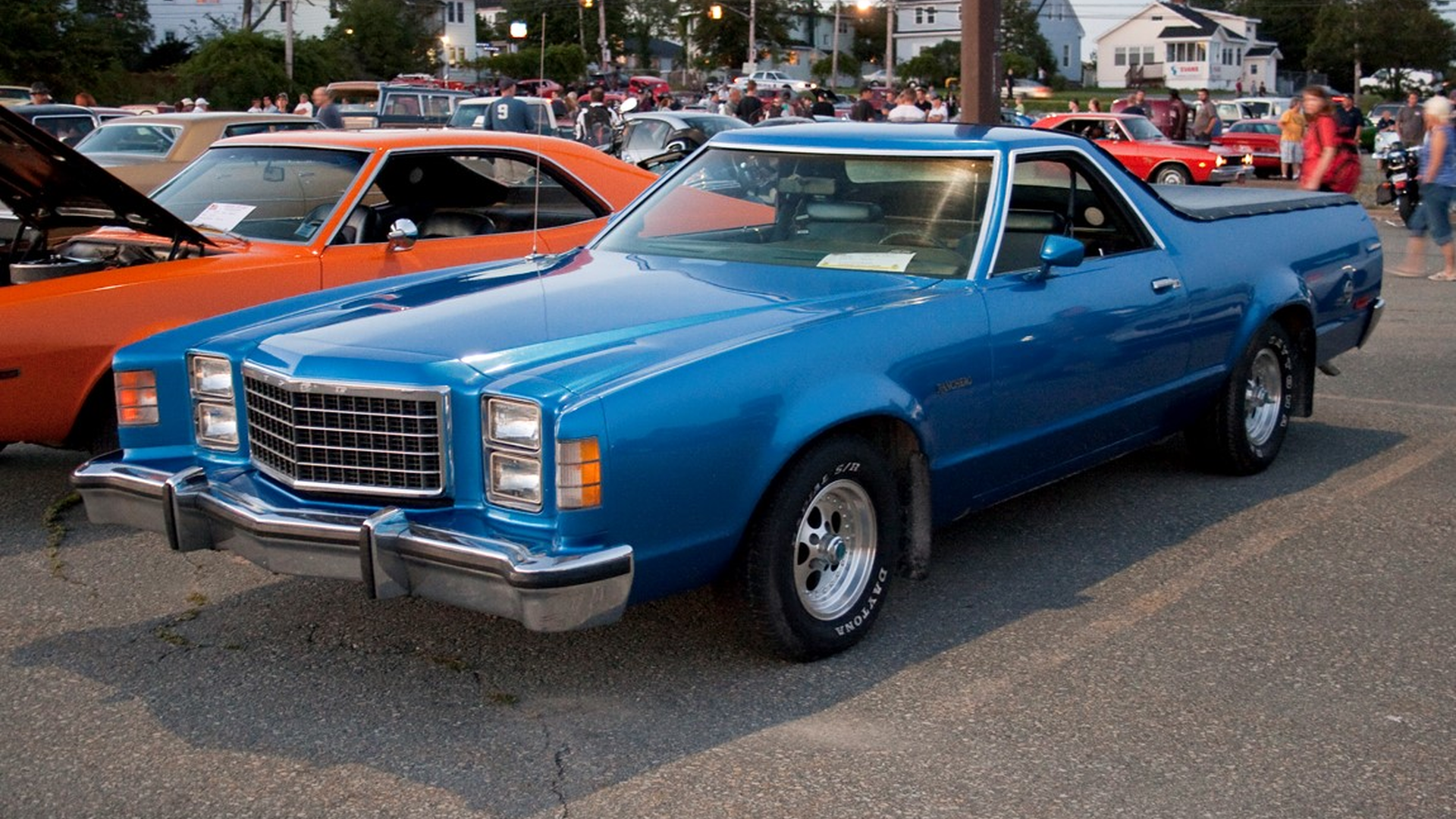
For the final run, the Ranchero was based on the LTD II (a restyled Torino). It featured stacked headlights and a sharp, angular nose. By 1979, the compact truck market (Ford Courier/Ranger) was exploding, and the car-based pickup no longer made sense. The Ranchero was discontinued to make room for the 1980 F-150 and Ranger.
Common Issues Maintenance
1. Rust in the Bed Floor
The bed floor is part of the unibody structure on 1960-1971 models. If the bed floor rusts out, the car loses structural integrity. Check under the bed mat carefully.
2. Smugglers Box
Many Rancheros have a storage compartment behind the seats (under the bed floor) called the smuggler's box. The drains clog, and it fills with water, rusting out the floor pans from behind.
3. Tailgate Rust
The double-walled tailgate traps moisture at the bottom seam. Finding a rust-free tailgate is difficult and expensive.
Conclusion: The Practical Classic
The Ford Ranchero is the perfect solution for the classic car enthusiast who still needs to make runs to the hardware store. It offers all the performance options of a Mustang or Torino but with a lower price tag and more utility. Whether you want a frugal Falcon Ranchero or a fire-breathing 429 GT, you are buying a vehicle that represents a unique moment in automotive history when cars were tough enough to do a day's work. Explore the specs below.