
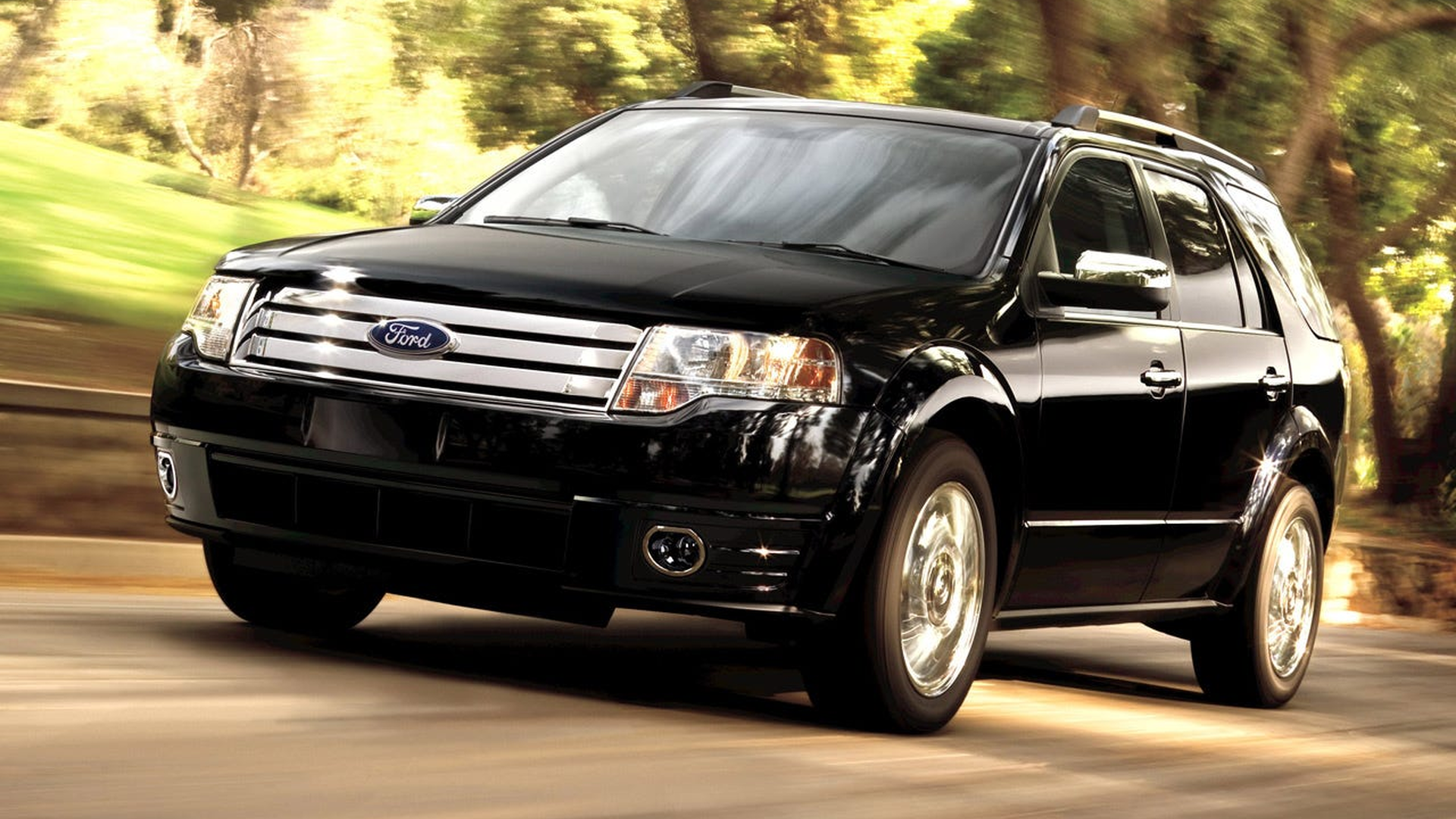
The Phoenix of the Crossover World
In the automotive industry, second chances are rare. The Ford Freestyle, launched in 2005, was a brilliant concept let down by a lackluster powertrain. Ford listened. In 2008, they didn't just Facelift the car; they gave it a heart transplant and a new name: the Ford Taurus X. It was designed to align with the rebranding of the Five Hundred sedan into the Taurus, creating a family of "bull-market" vehicles.
When you browse the Taurus X listings on Hugegarage, you are looking at what is essentially a "Freestyle 2.0." While it looks similar to its predecessor, the driving experience is night-and-day different. Gone is the rubber-band feel of the CVT. Gone is the struggle to merge onto the highway. The Taurus X is punchy, refined, and exceptionally quiet. It served as the immediate predecessor to the modern unibody Ford Explorer, proving that a car-based chassis could handle the duties of a family hauler better than a truck.
The "One-Touch" Magic: One of the Taurus X's standout features was the available power-folding second-row seats. With the press of a single button in the cargo area (or on the pillar), the second-row captain's chairs would tumble forward, granting easy access to the third row. In 2008, this was cutting-edge convenience that rivaled luxury minivans.
Engineering: The D3 Platform Perfection
Like the Freestyle, the Taurus X rides on the Ford D3 Platform. This architecture was derived from the Volvo P2 Platform (used on the Volvo S80 and XC90).
Why is this important? Safety. The chassis utilizes a high-strength boron steel safety cage and energy-absorbing crumple zones designed by Swedish engineers. For a used car buyer today, getting Volvo-level safety ratings for the price of a domestic crossover is an incredible value proposition.
The Heart Transplant: Duratec 35
The single biggest reason to buy a Taurus X over a Freestyle is the engine.
- 3.5L Duratec V6 (Cyclone)
- Specs: 263 HP / 249 lb-ft Torque.
The Upgrade: This engine produced 60 more horsepower than the old 3.0L. It turned the car from "slow" to "surprisingly quick." It uses variable cam timing (iVCT) on the intake cams to broaden the torque curve. - 6F50 6-Speed Automatic
- The Transmission: Ford partnered with GM to develop this transmission. It replaced the CVT.
The Benefit: It offers real, crisp shifts. It has a significantly higher torque capacity, allowing the Taurus X to tow up to 2,000 lbs (Class I) with confidence. It is a sealed unit but generally robust if fluid is changed.
Interior Versatility: The "Swiss Army Knife"
The interior packaging of the Taurus X remains a benchmark for efficiency.
Stadium Seating
Ford employed "Stadium Seating" (also known as Theater Seating).
- Row 1: Lowest position.
- Row 2: Mounted roughly 2 inches higher.
- Row 3: Mounted even higher.
This arrangement allows rear passengers to see over the heads of those in front, significantly reducing motion sickness for children on long road trips.
Cargo Dimensions
- Behind 3rd Row: 15.8 cubic feet. (Enough for groceries).
- Behind 2nd Row: 47.2 cubic feet.
- Max Cargo: 85.5 cubic feet.
- The Secret Weapon: The front passenger seat folds flat forward. This allows you to load items up to 9 feet long (like a surfboard, ladder, or rolled carpet) entirely inside the vehicle with the hatch closed.
Trim Levels: The Return of Eddie Bauer
The Taurus X marked one of the final appearances of a legendary Ford trim level.
SEL
The base model, but well-equipped. It featured alloy wheels, the leather-wrapped steering wheel, and the full safety suite (Safety Canopy airbags). Usually found with cloth seats.
Eddie Bauer Edition
A nod to the 90s Explorer heritage.
Visuals: Distinguished by the signature Pueblo Gold two-tone lower cladding and bumpers.
Interior: Pecan-colored leather seats, unique wood-grain trim, and Eddie Bauer badging. It gave the crossover a rugged, outdoorsy aesthetic that the standard Limited trim lacked.
Limited
The top-tier luxury model. Monochromatic exterior paint (no gold cladding), 18-inch chrome wheels, perforated leather seats, and the premium Audiophile sound system with a subwoofer.
Mechanical Watchlist: What Breaks?
While the Taurus X is robust, the 3.5L Cyclone engine introduced a specific maintenance nightmare that owners MUST be aware of.
1. Internal Water Pump Failure
The Design: The water pump is driven by the timing chain and sits inside the engine front cover.
The Risk: If the pump's weep hole gets clogged or the seal fails catastrophically, coolant will dump directly into the oil pan.
The Result: Coolant mixes with oil, creating a milky sludge that destroys the main bearings. The engine can seize in minutes.
The Fix: Replacement is expensive ($1,500+) because the entire timing chain assembly must be removed.
Hugegarage Tip: If the car has over 120,000 miles and the pump hasn't been done, negotiate the price down significantly.
2. PTU Fluid (AWD Models)
The Power Transfer Unit (PTU) sends power to the rear wheels. It sits right next to the scorching hot catalytic converter. The modest amount of gear oil inside cooks over time, turning into a thick tar.
Recommendation: Suction out the old fluid and refill with high-quality synthetic gear oil every 30,000 miles. Do not trust "lifetime fluid" claims.
3. Rear Subframe Bushings
Clunks from the rear end usually indicate worn subframe bushings. Because the Taurus X is heavy (over 4,000 lbs), it chews through rubber suspension components faster than a sedan.
The SYNC Revolution
The 2008 Taurus X was among the first batch of Ford vehicles to feature the Microsoft-developed SYNC system. While primitive by today's standards (small dot-matrix display), it introduced voice-activated music and hands-free calling via Bluetooth, a feature that was revolutionary in the non-luxury segment at the time.
Why Was It Cancelled?
The Taurus X was squeezed out by its own siblings.
The Ford Flex (2009): Offered the same powertrain and platform but with much cooler, retro styling and more third-row legroom.
The Ford Explorer (2011): Ford moved the Explorer to the D4 platform (an evolution of the D3), effectively creating a "Taurus X with rugged styling." The Explorer nameplate was too valuable, so the Taurus X was quietly retired to make way for the new unibody Explorer.
Conclusion: The Smartest Money in the Used Market
The Ford Taurus X is a victim of marketing, not engineering. It is mechanically superior to the Freestyle and functionally identical to a 2011 Explorer, yet it sells for thousands less because nobody remembers the name. For the buyer who values utility, safety, and highway power over rugged looks, the Taurus Xâespecially in Eddie Bauer trimâis arguably the best bargain 3-row hauler on the used market today. Just check that water pump. Explore the detailed specifications below.