
The Anti-Corvette: Luxury Over Lap Times
In 1953, Chevrolet launched the Corvette. It was raw, uncomfortable, and fiberglass. Ford watched, waited, and in 1955, they launched the Ford Thunderbird. But unlike Chevy, Ford didn't build a sports car. They built a Personal Luxury Car. It had a V8 (standard), roll-up windows (standard), and a steel body. It wasn't designed for the racetrack; it was designed for the boulevard. And it outsold the Corvette 23-to-1 in its first year.
When you browse the Thunderbird listings on Hugegarage, you are looking at the evolution of American taste. The T-Bird has been a two-seater, a four-seater, a land yacht, a Fox-body coupe, and a supercharged muscle car. It is the most schizophrenic nameplate in history, yet every generation has a distinct charm.
The Square Bird Genius: In 1958, Ford added a back seat. Enthusiasts cried foul, saying it ruined the sporty image. The result? Sales exploded. The 1958-1960 Square Bird proved that Americans wanted style and practicality. It defined the T-Bird formula for the next 40 years.
Generation 1: The Classics (1955â1957)
These are the icons. The Baby Birds.
1955: Pure, clean styling.
1956: Added the famous Continental Kit (spare tire on the rear bumper) to increase trunk space and the porthole window in the hardtop.
1957: Added tailfins and more power (up to 300 HP with a supercharger). These are the most valuable T-Birds today.
The Jet Age: Bullet Birds Flair Birds (1961â1966)
The 1961-1963 Bullet Birds are masterpieces of design. They look like rockets, with a sharp nose and afterburner taillights. They introduced the Swing-Away Steering Wheel, which slid 10 inches to the right when the car was in Park to help the driver exit.
The 1964-1966 Flair Birds introduced the sequential turn signals (still used on Mustangs today) and a more formal, squared-off look.
The MN12 Era: The Super Coupe (1989â1997)
After a dark period in the 70s and 80s (where the T-Bird became a bloated luxury barge and then a boring Fox-body), Ford got serious in 1989. They built a dedicated chassis (MN12) with Independent Rear Suspension (IRS)âsomething the Mustang wouldn't get for another 26 years.
The Thunderbird Super Coupe (SC)
This is the one to buy.
Engine: 3.8L Supercharged V6.
Specs: 210-230 HP / 315-330 lb-ft Torque.
Tech: Electronic adjustable suspension (firm/soft ride), limited-slip differential, and 4-wheel disc brakes. It was faster than the V8 Mustang GT of the same era and handled better.
Hugegarage Tip: The head gaskets on the 3.8L SC are a weak point. Ensure they have been replaced with multi-layered steel (MLS) gaskets.
The Retro Revival (2002â2005)
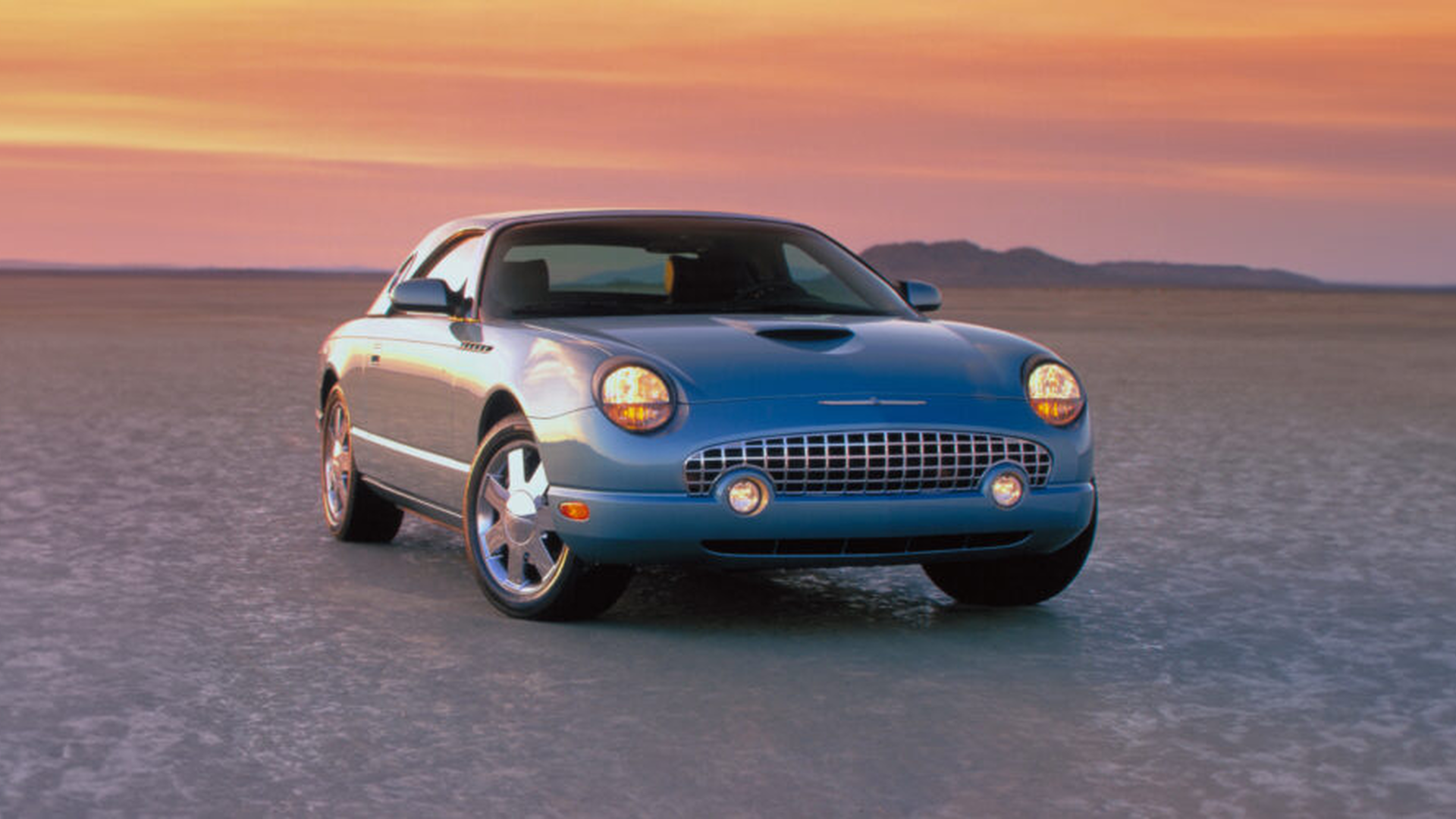
After a 5-year hiatus, the Thunderbird returned as a two-seater convertible on the Lincoln LS platform.
The Look: A direct homage to the 1955 original, complete with the porthole hardtop and turquoise paint options.
The Engine: 3.9L V8 (borrowed from Jaguar).
The Verdict: It was a beautiful cruiser but not a sports car. The suspension was soft, and the interior was too similar to the cheap Lincoln LS. However, as a future classic, prices are rising for clean examples.
Why Was It Cancelled?
The 11th generation (Retro Bird) was a niche product. Sales started strong but plummeted as the novelty wore off. It was expensive to build and didn't share enough parts with high-volume Fords to justify its existence. The final Thunderbird rolled off the line on July 1, 2005.
Conclusion: An American Icon
The Ford Thunderbird is not just a car; it is a cultural artifact. Whether you want the 50s rock-and-roll style, the 60s jet-age cool, or the 90s supercharged performance, there is a T-Bird for you. It represents a time when Ford was willing to take risks and build cars simply because they were cool. Explore the specs below.