
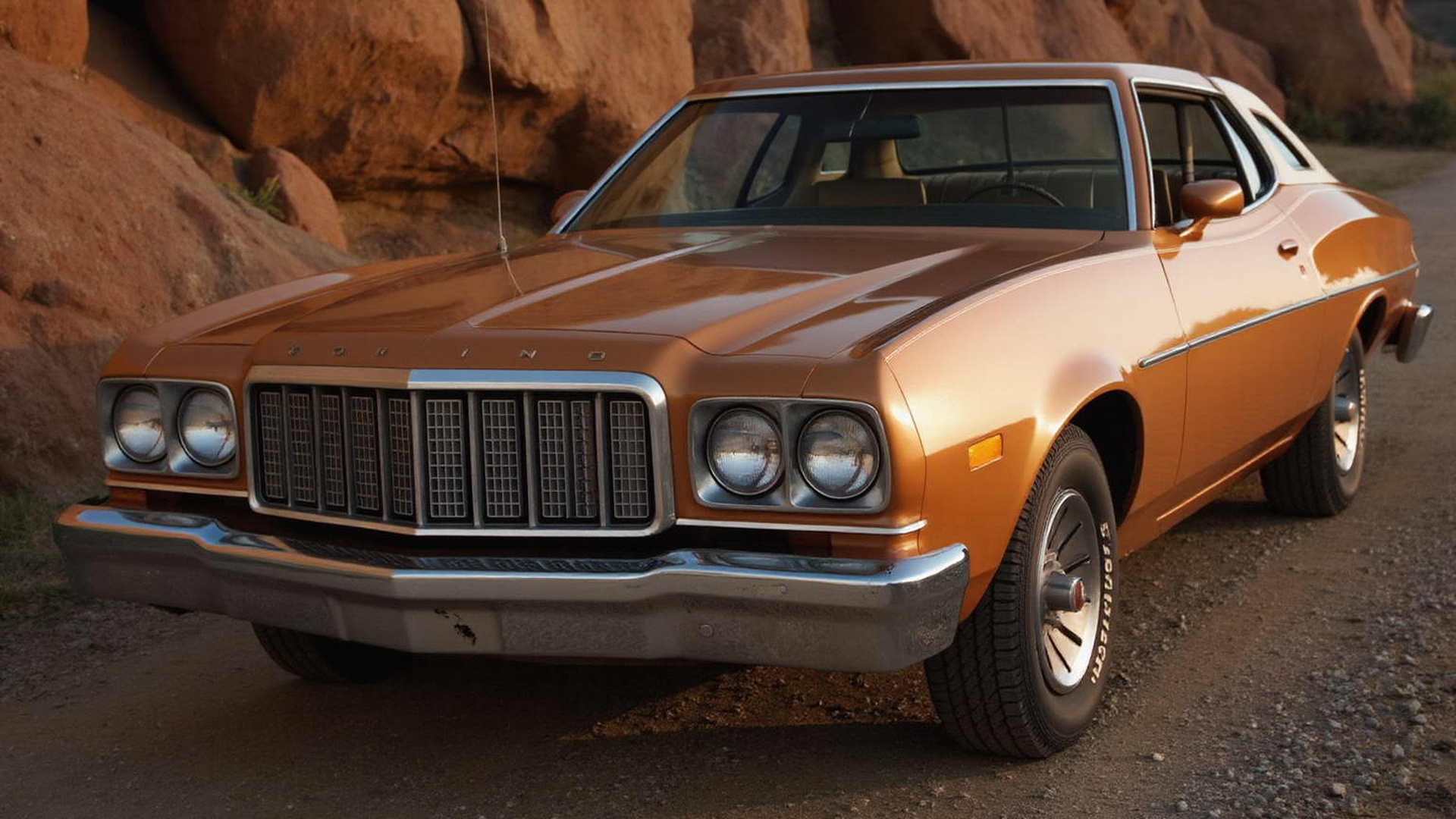
The Muscle Car That Did It All
In 1968, Ford decided the Fairlane needed a glamorous big brother. Named after the Detroit of Italy (Turin), the Ford Torino started as a luxury trim but quickly evolved into the most versatile intermediate car of the muscle era. It could be ordered as a grocery-getter station wagon, a plush luxury coupe (the Brougham), or a fire-breathing drag strip warrior (the Cobra). While the Mustang gets the glory, the Torino did the heavy lifting, winning NASCAR championships and starring in one of the most famous cop shows of the 70s.
When you browse the Torino listings on Hugegarage, you are seeing the evolution of the American mid-size car. The early models (1968-1969) are sleek and aerodynamic unibody machines. The middle years (1970-1971) feature the wildest styling with Coke-bottle curves. The final years (1972-1976) morphed into body-on-frame heavyweights that prioritized comfort over speed. Each generation has a distinct personality, but all share the blue-collar toughness that defines Ford.
The Aero Warrior: The Talladega
In 1969, NASCAR was an aerodynamics war. The standard Torino fastback had a recessed grille that trapped air, slowing it down at 200 MPH. To fix this, Ford built roughly 750 units of the Torino Talladega. They extended the nose, flush-mounted the grille, and famously chopped and re-welded the rocker panels to lower the car's center of gravity legally. It dominated the 1969 NASCAR season, forcing Dodge to build the Charger Daytona in retaliation.
Generation 1: The Fastback Era (1968â1969)
The Torino launched with a distinct SportsRoof fastback body style that mimicked the Mustang but with more rear seat room.
1968 GT: The debut performance model. Standard with a 302 V8, but savvy buyers optioned the 390 FE.
The 428 Cobra Jet Arrives
In mid-1968, Ford dropped the 428 Cobra Jet (CJ) into the Torino. Rated at 335 HP (underrated), it turned the Torino into a legitimate street sweeper. In 1969, Ford introduced the Torino Cobra, a budget muscle car designed to fight the Plymouth Road Runner. It came standard with the 428 CJ, a 4-speed manual, and virtually no sound insulation.
Generation 2: The Coke Bottle (1970â1971)
For 1970, the Torino was completely redesigned. It became lower, wider, and curvier, winning the Motor Trend Car of the Year award. The styling was aggressive, with a shaker hood scoop available on high-performance models.
The Engine Summit: 429 SCJ
This generation represents the peak of performance.
- 429 Thunder Jet
- 360 HP. The standard big block.
- 429 Cobra Jet (CJ)
- 370 HP. Larger valves, Rochester carburetor.
- 429 Super Cobra Jet (SCJ)
- 375 HP (Conservative). This was a dedicated race engine with 4-bolt mains, forged pistons, a solid lifter cam, and an oil cooler. It was part of the Drag Pack option. A 1970 Torino Cobra with the 429 SCJ is the holy grail of Torino collecting.
Generation 3: The Gran Torino (1972â1976)
Everything changed in 1972.
The Chassis Swap: Ford abandoned the unibody construction used since the Fairlane days and switched to a body-on-frame perimeter chassis (similar to the LTD).
The Result: The car became heavier, quieter, and isolated from the road. Handling suffered, but ride quality improved. The styling featured a massive fishmouth grille.
Starsky Hutch
The 1974-1976 Gran Torino is immortal thanks to the TV show Starsky Hutch. The bright red car with the white vector stripe is one of the most recognizable vehicles in history. Ford actually produced a limited run of 1,000 replica Starsky Hutch editions in 1976. These cars usually featured the 351 Windsor or 400 V8âby then, smog regulations had strangled horsepower (the 460 V8 made barely 200 HP), but the look was iconic.
The Cleveland Connection
While the big blocks get the fame, the 351 Cleveland V8 (introduced in 1970) was the workhorse of the Torino line.
351C-4V: With huge intake ports and canted valves, the 4-barrel Cleveland loved to rev. It is widely considered one of the best small-block Ford engines ever made.
Common Issues Maintenance
1. Rust (The Unibody Killer)
On 1968-1971 models, check the rear frame rails and torque boxes. These unibody cars rot from the inside out.
On 1972+ models, check the body mounts where the shell sits on the frame.
2. Cowl Leaks
Like the Mustang and Galaxie, leaves trap moisture in the cowl vents, rotting the metal and flooding the floor.
3. The Police Suspension
1972+ models often have worn-out control arm bushings. The heavy front end destroys rubber components. Upgrading to polyurethane bushings is highly recommended.
Conclusion: The Underrated Muscle Car
For a long time, the Torino lived in the shadow of the Mustang and the Chevelle. That has changed. Collectors now recognize the 1970-71 Torino GT and Cobra as some of the best-styled cars of the era. Even the later malaise era Gran Torinos are skyrocketing in value due to 70s nostalgia. Whether you want a 429 SCJ drag racer or a comfortable red-and-white cruiser to slide across the hood of, the Torino delivers pure American presence. Explore the detailed specs below.