Jaguar: The Art of Performance and Rebellious Elegance

Jaguar is the wild cat of the automotive world—beautiful, agile, and occasionally unpredictable. From the curves of the legendary E-Type to the roar of the modern F-TYPE V8, these British machines are built for drivers who value soul over statistics. Now pivoting to an all-electric future, Jaguar remains a symbol of distinct, athletic luxury.

Jaguar Hero Vehicle

Model Lineup

Explore the current production vehicles.

F-PACE

The quintessential performance SUV with the soul of a sports car. The F-PACE combines Jaguar's seductive styling and agile handling with everyday practicality. The SVR version, with its supercharged V8, is a thunderous expression of raw power.

Production 2016-Present

E-PACE

The compact performance SUV with the look and feel of a Jaguar sports car. The E-PACE is a dynamic and agile crossover, blending a driver-focused cockpit with distinctive, athletic styling for a thrilling and practical daily drive.

Production 2018-Present

I-PACE

The revolutionary all-electric performance SUV that shocked the world. With its stunning cab-forward design and silent, instant acceleration, the I-PACE is a bold, award-winning vision of Jaguar's electrified future. A true game-changer.

Production 2018-Present

F-TYPE

The spiritual successor to the legendary E-Type and the heart of the modern Jaguar brand. The F-TYPE is a pure, two-seat sports car that delivers a visceral experience with its breathtaking design and the glorious symphony of its supercharged V8 engine.

Production 2014-2024

XF

The sophisticated and dynamic luxury sport sedan. The XF has always been the driver's choice, blending a beautifully crafted interior with agile, rear-wheel-drive dynamics that deliver on the brand's promise of 'The Art of Performance'.

Production 2009-Present

E-Type

Enzo Ferrari called it 'the most beautiful car ever made.' The E-Type is a global icon, a masterpiece of automotive design and engineering that defined the swinging 60s. It is the undisputed soul of the Jaguar legend and a true work of art.

Production 1961-1975

XJ

The flagship of British luxury for over 50 years. The XJ has always been the definitive blend of 'grace, space, and pace,' a long, low, and beautiful sedan with the cat-like reflexes of a much smaller car. The benchmark for executive transport.

Production 1968-2019

XK

The elegant and powerful grand touring coupe and convertible. The XK (XK8/XKR) heralded Jaguar's modern design renaissance, offering a classic long-hood, short-deck silhouette and the effortless performance of a supercharged V8 in the R models.

Production 1997-2014

XE

The agile and lightweight sport sedan built to take on the German giants. With its advanced aluminum architecture and brilliant rear-wheel-drive chassis, the XE was a true driver's car, praised for its sharp handling and connected feel.

Production 2015-2023

Mark II

The original sport sedan. The Mark II combined a beautiful, curvaceous body with a powerful inline-six engine and agile handling, creating the template for all future performance sedans. An icon of 60s British style and performance.

Production 1959-1967

XJ220

The impossibly low, wide, and brutally fast supercar of the 90s. The XJ220 was a twin-turbocharged, 217-mph monster that held the record for the world's fastest production car. A rare and legendary piece of hypercar history.

Production 1992-1994

D-Type / XKSS

A Le Mans-winning legend. The D-Type was a revolutionary, aerodynamic race car that dominated the track. The ultra-rare XKSS was its road-going version, famously driven by Steve McQueen, making it one of the most desirable cars in the world.

Production 1954-1957

S-Type

The retro-styled executive sedan that paid homage to the classic Jaguars of the 60s. With its distinctive quad headlamps and curvaceous lines, the S-Type offered a unique blend of classic British charm and modern performance, especially in the supercharged R model.

Production 1999-2007

Author

HugeGarage Editor

Published

Updated

9 Min Read

The Villain’s Choice: Why We Love Jaguar

There is a reason why Hollywood movie villains drive Jaguars. They are sleek, sophisticated, and hint at a dangerous edge. Unlike the clinical precision of a German sedan or the brash loudness of an American muscle car, a Jaguar operates on charm. It is the automotive equivalent of a well-tailored suit worn with unbuttoned cuffs.

For the American driver, Jaguar represents an alternative to the "default" luxury choices. You don't buy a Jaguar because you compared spreadsheets and reliability charts. You buy one because you walked away from it in a parking lot, looked back, and felt your heart rate spike. It is a brand defined by the ethos of "Grace, Pace, and Space," offering a driving experience that is fluid, communicative, and deeply emotional.

From Swallow Sidecars to the E-Type

The company began in 1922 as the Swallow Sidecar Company, founded by Sir William Lyons. They didn't make cars; they made motorcycle sidecars. But Lyons had an eye for style. After WWII, they dropped the "SS" name for obvious political reasons and became Jaguar.

In 1961, Jaguar dropped a bombshell that changed the world: the E-Type. It was capable of 150 mph when most family cars struggled to hit 60. It was shockingly affordable compared to its rivals. And it was so devastatingly beautiful that even Enzo Ferrari—a man with an ego the size of Italy—conceded it was "the most beautiful car ever made." That legacy of design-first engineering is still the North Star for the brand today.

The Ian Callum Revolution

For decades, Jaguar was stuck in the past, churning out cars that looked like old English pubs on wheels—lots of wood, chrome, and nostalgia. Then came Ian Callum, the design director who dragged the brand into the 21st century. He killed the retro look and introduced the sharp, aggressive lines we see today. He proved that a Jaguar could look modern without losing its British soul.

The Modern Lineup: Grace and Pace

Today's Jaguar lineup is a mix of traditional sports cars and necessary SUVs, all underpinned by lightweight aluminum architecture.

The F-TYPE: The Torchbearer

If you want to understand Jaguar, start here. The F-TYPE is the spiritual successor to the E-Type. Available as a coupe or convertible, it is famous for one thing above all else: noise. The Supercharged V8 models don't just have an exhaust; they have a musical instrument. The cracks, pops, and bangs on the overrun sound like distant artillery fire. It is arguably the best-sounding car on the market today.

The F-PACE: The Savior

Purists cried when Jaguar announced an SUV. Then they drove it. The F-PACE became the brand's best-selling model immediately. It handles like a sports sedan but hauls families like a crossover. The F-PACE SVR is the high-performance variant, stuffing that massive 550-hp V8 into a family hauler. It is absurd, wonderful, and very American in spirit.

The I-PACE: The Electric Pioneer

Jaguar beat Audi, Mercedes, and BMW to the punch with the first credible Tesla fighter. The I-PACE is an all-electric SUV that looks like a spaceship. It won World Car of the Year in 2019. It proved that electric cars could still handle like Jaguars—agile, planted, and fun.

The Sedans (XF)

While the XE has bowed out of the US market, the XF remains. It is a lonely warrior in a world of SUVs. It drives beautifully, offering a ride quality that balances comfort and sportiness better than almost anything in its class. It is the connoisseur's choice.

Reliability and the "British Tax"

We have to talk about it. The joke used to be, "Buy two Jaguars: one to drive and one for parts." While the days of Lucas Electronics (" The Prince of Darkness") are long gone, Jaguar still struggles to match the bulletproof reliability of Lexus. Electronic glitches with infotainment screens and sensors are not uncommon.

However, under Tata Motors' ownership (since 2008), quality control has improved significantly. They offer one of the best warranties in the business (EliteCare) to combat this perception, often covering scheduled maintenance for the first few years. It is a gesture of confidence that prospective buyers should take seriously.

Buying Advice: The Depreciation Hero

Here is the secret to buying a Jaguar: Let someone else take the first hit.

Jaguars depreciate faster than almost any other luxury brand. This is painful for the first owner, but it makes them the absolute bargain of the century on the used market. You can pick up a 3-year-old F-TYPE or XJ for a fraction of its original MSRP. You get a car that looks like a million bucks for the price of a Toyota Camry.

If you are willing to keep up with the maintenance and accept the occasional quirk, a Jaguar rewards you with a driving experience that feels alive. It is a car you turn back to look at every time you park it. And in a world of boring appliances, that counts for everything.

Frequently Asked Questions

What is the meaning of the Jaguar "Leaper" and "Growler" logos?

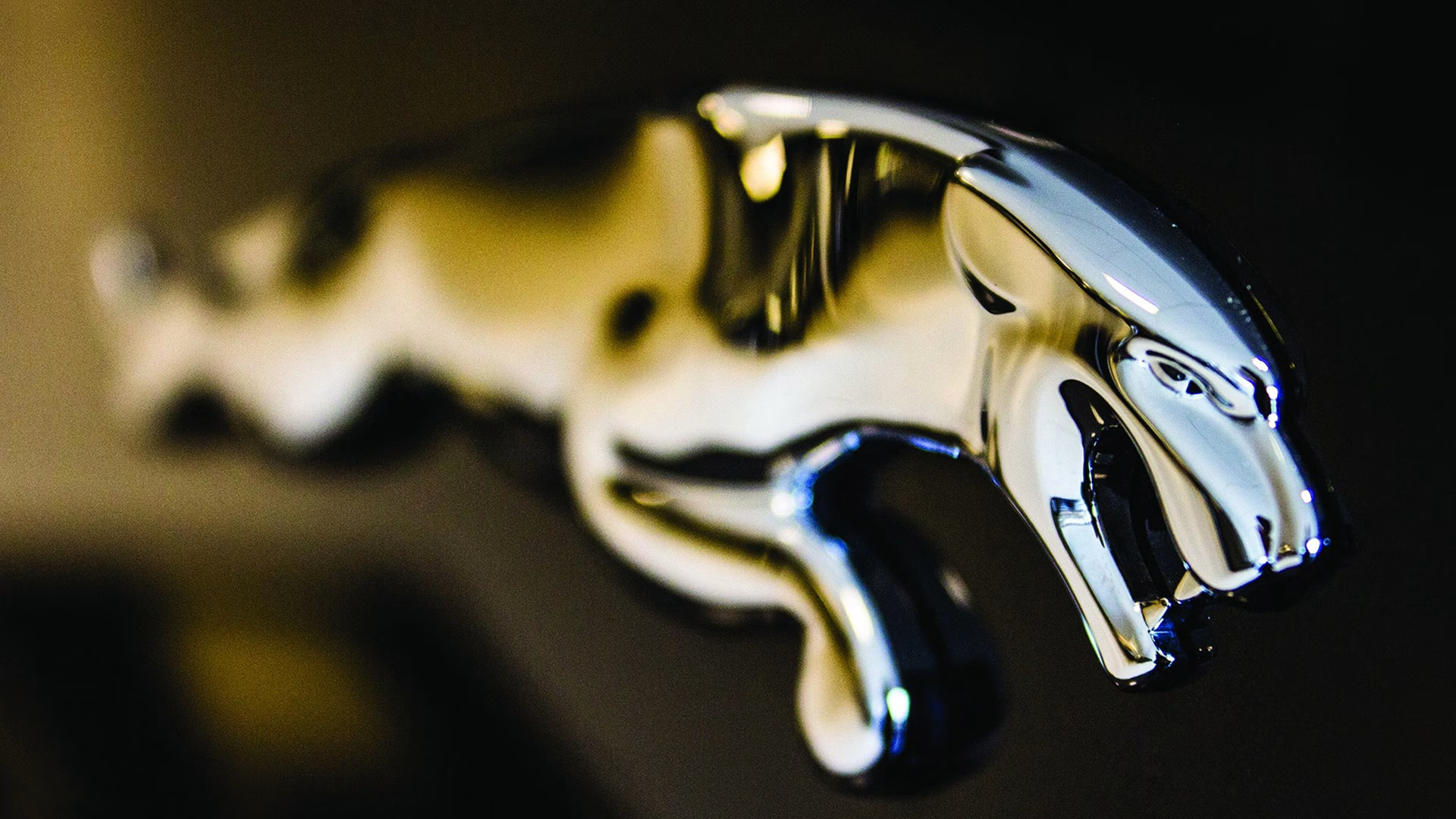
Jaguar uses two primary symbols: the "Leaper" is the iconic silver jaguar pouncing forward, representing power and speed. The "Growler" is the face of a roaring jaguar typically found on the grille and steering wheel.

Due to pedestrian safety regulations, the physical 3D Leaper hood ornament was phased out on modern models, replaced by a flat emblem or a retractable version on select classics.

What is the difference between Jaguar XE, XF, and XJ?

These represent Jaguar's core sedan (saloon) hierarchy based on size and luxury level:

  • XE: The compact executive sedan, rivaling the BMW 3 Series.
  • XF: The mid-size business sedan, known for balancing sportiness with comfort.
  • XJ: The flagship full-size luxury sedan, traditionally featuring a long wheelbase and the highest level of craftsmanship.
What are Jaguar Ingenium engines?

Ingenium is the name of Jaguar Land Rover’s (JLR) modular engine family. Designed in-house, these 2.0-liter and 3.0-liter gasoline and diesel engines feature all-aluminum construction.

They are equipped with twin-scroll turbochargers and variable valve timing to maximize low-end torque and improve fuel efficiency while reducing CO2 emissions across the F-PACE, E-PACE, and sedan ranges.

Is the Jaguar I-PACE a fully electric vehicle?

Yes, the Jaguar I-PACE was the brand's first all-electric performance SUV. Launched in 2018, it won the World Car of the Year award.

It features two electric motors providing AWD (All-Wheel Drive) and a 90kWh battery. It is designed to offer the "instant torque" feel of a sports car while maintaining the practical ride height of a crossover.

What is the Jaguar F-TYPE known for?

The F-TYPE is the spiritual successor to the legendary E-Type. It is famous for its emotive exhaust note, particularly the Supercharged V8 models which feature an active exhaust system that produces a distinct "crackle and pop" on overrun.

It is available in both Coupé and Convertible body styles, utilizing a lightweight aluminum structure to enhance agility.

What is the "J-Gate" shifter in older Jaguars?

The J-Gate is a classic Jaguar gear selector design used in the 1980s through the early 2000s. It features a J-shaped path for the lever.

The left side of the "J" allows the driver to manually select gears in an automatic transmission, while the right side operates as a standard automatic. It was a signature interior element before the brand transitioned to Rotary Shifters and modern electronic toggles.

Why did Jaguar stop using the Inline-6 and then bring it back?

Jaguar became legendary for its XK Inline-6 engine in the 1950s. They later moved to V6 configurations for packaging reasons under Ford ownership. However, in 2020, Jaguar returned to the Straight-Six layout within the Ingenium family.

Modern Straight-Six engines are inherently balanced and smoother than V6 engines, and they now utilize Mild Hybrid (MHEV) technology and electric superchargers to eliminate turbo lag.

What is Jaguar's "All Surface Progress Control" (ASPC)?

ASPC is essentially a low-speed cruise control for slippery surfaces. It helps the driver pull away smoothly on snow, ice, or wet grass.

Once activated, the driver sets a speed between 3.6 km/h and 30 km/h, and the car manages the brakes and throttle to maintain traction, allowing the driver to focus entirely on steering through difficult terrain.

What is the Jaguar SVR division?

SVR (Special Vehicle Operations) is Jaguar's high-performance halo division. Vehicles like the F-PACE SVR represent the peak of Jaguar performance.

These models are tuned for maximum speed and track capability, often featuring 5.0L Supercharged V8 engines, bespoke suspension setups, and larger air intakes for improved cooling under extreme driving conditions.

Is Jaguar moving to an all-electric future?

Yes, Jaguar has announced a radical "Reimagine" strategy. The brand intends to become a pure-electric luxury brand from 2025 onwards.

This transition involves moving Jaguar into a more exclusive "modern luxury" tier, focusing on unique design and sustainable electric architectures to compete with the highest level of luxury manufacturers.