Jeep: The Universal Symbol of Freedom

Born in the heat of battle in 1941, Jeep is more than an automaker; it is a global icon of resilience and adventure. From the beaches of Normandy to the boulders of Moab, the seven-slot grille represents the ability to go anywhere and do anything. It is the creator of the SUV and the keeper of the 4x4 flame.

Jeep Hero Vehicle

Model Lineup

Explore the current production vehicles.

Wrangler

The undisputed icon of off-road freedom. The Wrangler is the direct descendant of the original WWII hero, offering legendary capability with its removable doors and roof. From the Rubicon trail to the city streets, it's the ultimate adventure machine.

Production 1987-Present

Gladiator

The world's only open-air pickup truck. The Gladiator uniquely combines the legendary 4x4 capability and freedom of a Wrangler with the utility of a 5-foot cargo bed. It's the most versatile and adventure-ready truck on the planet.

Production 2020-Present

Grand Cherokee

The original luxury 4x4, perfected for the modern era. The Grand Cherokee and 3-row Grand Cherokee L masterfully blend legendary off-road capability with premium comfort and cutting-edge technology. It's the award-winning SUV that does it all, in style.

Production 1993-Present

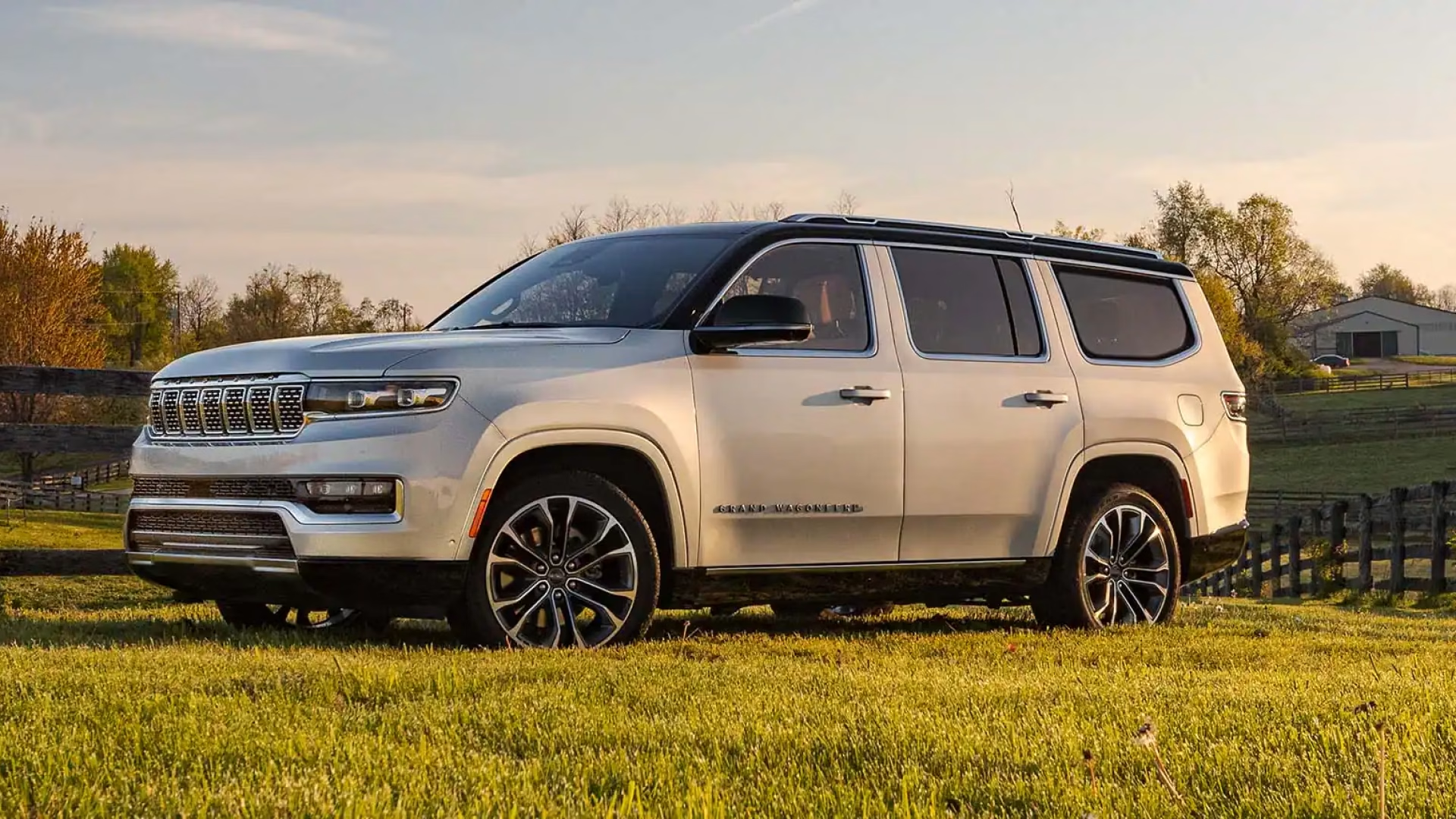
Wagoneer & Grand Wagoneer

The return of an American icon. The Wagoneer and ultra-luxurious Grand Wagoneer redefine the full-size premium SUV, offering an incredible amount of space, sophisticated technology, and powerful capability. It’s a new standard of American luxury.

Production 2022-Present

Compass

The stylish and capable compact SUV. The Compass offers a sophisticated design and a tech-forward interior, backed by the confidence of available Jeep 4x4 systems. The Trailhawk model proves that you don't need a large SUV for serious trail-rated fun.

Production 2007-Present

Renegade

The fun-loving and adventurous subcompact SUV with a huge personality. The Renegade packs clever features and unmistakable Jeep styling into a city-friendly size. With its best-in-class Trailhawk off-road capability, it's the small SUV that can.

Production 2015-Present

Cherokee

The modern and capable mid-size crossover carrying a legendary name. The modern Cherokee (KL) offered a smooth, comfortable ride for daily duties, while the Trailhawk trim provided best-in-class off-road prowess, making it a truly versatile performer.

Production 2014-2023

Patriot

The affordable and classic-looking compact SUV that brought the Jeep brand to the masses. The Patriot offered traditional, boxy styling and available Freedom Drive 4x4 systems, providing a budget-friendly entry into the world of adventure.

Production 2007-2017

Liberty

The rugged and capable successor to the original Cherokee. The Liberty was known for its true truck-based toughness and independent front suspension, a first for Jeep. It offered a classic, no-nonsense approach to off-road-ready utility.

Production 2002-2012

Willys MB

The original. The hero. The vehicle that started it all. The Willys MB was the workhorse of the Allied forces in WWII, forging a reputation for toughness and versatility that became the foundation for the entire Jeep brand and its go-anywhere ethos.

Production 1941-1945

CJ (Civilian Jeep)

The direct link between the military hero and the modern Wrangler. The CJ series brought the rugged capability of the Willys to the public, creating a new world of off-road recreation. It is the quintessential classic, open-top adventure vehicle.

Production 1945-1986

Cherokee (XJ)

The revolutionary SUV that changed the automotive world. The Cherokee XJ's lightweight unibody design created the template for the modern compact SUV. Its legendary reliability and off-road capability have made it a beloved and timeless cult classic.

Production 1984-2001

Grand Wagoneer (SJ)

The original luxury 4x4. The Grand Wagoneer (SJ) pioneered the concept of a premium, go-anywhere family vehicle. With its iconic woodgrain paneling and plush interior, it remains an enduring symbol of classic American style and adventure.

Production 1963-1991

Jeepster Commando

A unique and stylish blend of a sports car and an off-roader. The Jeepster Commando was designed for fun and adventure, available in convertible, pickup, and wagon body styles. It's a quirky and highly collectible piece of Jeep's diverse history.

Production 1966-1973

Comanche (MJ)

A true pickup truck with the heart of a legend. Based on the iconic Cherokee XJ platform, the Comanche was a tough, capable, and highly regarded compact truck. Its rarity and connection to the XJ make it an incredibly sought-after classic today.

Production 1986-1992

Author

HugeGarage Editor

Published

Updated

13 Min Read

General George Marshall famously called the original Jeep "America’s greatest contribution to modern warfare." He wasn't exaggerating. But what started as a military necessity in 1941 evolved into something far more powerful: a civilian religion. Jeep is the only brand where owners wave to each other in traffic. It is the only brand where scratches are worn like badges of honor. It is the definitive word for "off-road."

The Origin: Forged by Fire (1941)

The story begins with the Willys MB. No doors, no roof, just a flat windshield, four-wheel drive, and an indestructible "Go Devil" engine. It didn't just transport soldiers; it liberated continents. That DNA is still present in every Wrangler sold today. The seven-slot grille, the round headlights, and the trapezoidal wheel arches aren't retro styling cues; they are copyright-protected heritage that says, "I was there."

The Cult of the Seven Slots

Owning a Jeep—specifically a Wrangler or Gladiator—is joining a club. You need to know the rules.

  • The Jeep Wave: If you drive a Wrangler or Gladiator and you pass another one, you wave. Two fingers up off the steering wheel. It’s mandatory. It’s a silent acknowledgment of shared misery (wind noise) and shared joy (top-down freedom).
  • Duck Duck Jeep: In recent years, a massive phenomenon took over. If you see a cool Jeep, you leave a rubber duck on the door handle. It sounds silly, but it’s a nationwide movement of kindness that defines the community.
  • Trail Rated: That little badge on the fender isn't marketing fluff. It means the vehicle has passed grueling tests in traction, water fording, maneuverability, articulation, and ground clearance, usually on the Rubicon Trail in California.

The Icons of the Trail

1. The Wrangler: The Anchor

The Wrangler (generations YJ, TJ, JK, JL) is the direct descendant of the war hero. It defies modern automotive logic. It still uses solid axles front and rear (for articulation). You can still take the doors off. You can still fold the windshield down. You can wash the interior with a hose (literally, there are drain plugs in the floor).

The Rubicon trim is the gold standard for factory off-roaders: locking front and rear differentials, an electronic sway-bar disconnect, and a 4:1 transfer case low range that allows it to crawl up a vertical wall at idle speed.

2. The Grand Cherokee: The Civilized Savage

In 1992, Jeep crashed a Grand Cherokee through a plate-glass window at the Detroit Auto Show. It invented the premium SUV segment. Before the Grand Cherokee, if you wanted 4x4 capability, you drove a tractor. Jeep proved you could have unibody construction, leather seats, and still cross a river. The modern Grand Cherokee (WL) continues this duality, offering McIntosh audio systems and massaging seats while retaining legitimate trail capability.

3. The Gladiator: The Toy Hauler

Jeep fans begged for a pickup truck for decades. In 2019, they got the Gladiator. It is essentially a Wrangler with a bed. It has the longest wheelbase in its class, making it a stable towing platform, but its real party trick is being the only convertible truck on the market. Taking the roof off a pickup truck while towing a boat is a uniquely American experience.

4. The Wagoneer: The Return of the King

Jeep was absent from the massive, three-row luxury SUV market for too long. The return of the Wagoneer and Grand Wagoneer changed that. These are land yachts designed to fight the Cadillac Escalade. They are opulent, massive, and packed with screens. They represent Jeep moving upmarket, proving they can do "white-glove luxury" just as well as "mud-caked adventure."

Engineering the Outdoors: 4x4 Systems

Jeep doesn't just have "AWD." They have a dictionary of systems. Understanding them is key.

  • Command-Trac: The classic part-time system. You pull a lever (or push a button) to engage 4WD. Good for snow and dirt.
  • Selec-Terrain: A dial that tells the computer what you are driving on (Snow, Sand, Mud, Rock). It adjusts the throttle, transmission, and traction control instantly.
  • Rock-Trac: The heavy artillery found on Rubicons. Extreme low-range gearing for technical rock crawling.

The Green Revolution: 4xe and Beyond

Jeep found the cheat code for survival in the 2020s: 4xe (pronounced "Four-by-E").

The Wrangler 4xe became the best-selling Plug-in Hybrid (PHEV) in America almost overnight. Why? Because electric torque is perfect for off-roading. It’s instant and silent. You can crawl through nature in "Electric Mode" without the noise of an engine, hearing only the gravel crunching under your tires. It combines 20+ miles of silent EV range with a turbo engine for long trips.

And now, the Wagoneer S leads the charge into full BEV (Battery Electric Vehicle) territory. 600 horsepower, 0-60 in 3.4 seconds. It proves that an electric Jeep isn't just green; it's mean.

The End of the Hemi Era

We are in a transition period. The beloved 5.7L and 6.4L Hemi V8s are retiring. Replacing them is the Hurricane Twin-Turbo Inline-6. Like Ram, Jeep is betting on this engine to deliver V8 power with better efficiency. While we mourn the V8 rumble, the Hurricane’s performance numbers in the Wagoneer and Grand Cherokee are undeniable.

Why Jeep Matters to You

A Jeep is an antidote to a boring life. It is a vehicle that whispers (or sometimes shouts) promises of adventure every time you get in. Even if you never take it off-road, knowing that you could creates a psychological shift. It handles blizzards with contempt. It handles potholes like they don't exist.

There is also the resale value. Wranglers hold their value better than almost any other vehicle on the road. You aren't just buying a car; you are parking cash in your driveway.

The Hugegarage Verdict

Jeep is not for everyone. The Wrangler’s steering can be vague, and the wind noise on the highway is real. But for millions, these are features, not bugs. If you want a vehicle that connects you to the outdoors, offers the largest aftermarket customization ecosystem in the world, and makes you part of a global family, "There’s Only One."

Frequently Asked Questions

What does the "Trail Rated" badge actually mean on a Jeep?

The Trail Rated® badge is not just a marketing sticker; it signifies that the vehicle has passed a series of grueling off-road tests at the Nevada Automotive Test Center (NATC). To earn this badge, a Jeep must prove its capability in five key categories:

  • Traction: Climbing slip-prone surfaces.
  • Water Fording: Traversing deep water without stalling.
  • Maneuverability: Navigating tight trails.
  • Articulation: Keeping tires on the ground on uneven terrain.
  • Ground Clearance: Clearing logs and rocks.
What is the difference between the Jeep Wrangler Sahara and Rubicon?

This is the classic "Comfort vs. Capability" choice. The Sahara is designed for a balance of daily driving comfort and off-road ability, often featuring body-color fenders, side steps, and 18-inch wheels for the street.

The Rubicon is built for extreme off-roading. It comes factory-equipped with the Rock-Trac® 4x4 System, electronic locking front and rear differentials ("lockers"), an electronic sway bar disconnect for maximum articulation, and 33-inch (or larger) all-terrain tires. If you plan to rock crawl, buy the Rubicon.

How does the Jeep Wrangler 4xe hybrid system work?

The Jeep Wrangler 4xe is a Plug-in Hybrid Electric Vehicle (PHEV) that pairs a 2.0L Turbo engine with two electric motors. It is the best of both worlds:

  • Electric Mode: You can drive roughly 21 miles on pure electricity (near silent off-roading).
  • Hybrid Mode: The system automatically blends gas and electric power for maximum efficiency.
  • E-Save: You can save the battery charge to use later on the trail.

It delivers 375 horsepower and 470 lb-ft of torque, making it one of the most powerful Wranglers ever.

Is it legal to drive a Jeep Wrangler or Gladiator without doors?

Yes, it is generally legal in most US states to drive without doors, which is a key part of the open-air Jeep experience. However, you must have side mirrors to be street legal in most jurisdictions.

Since the factory mirrors are attached to the doors, when you remove the doors, you remove the mirrors. To stay legal and safe, you need to purchase aftermarket "trail mirrors" that mount directly to the vehicle's A-pillar or door hinge.

What is the difference between the Jeep Wagoneer and Grand Wagoneer?

While they look similar, the distinction lies in the level of luxury and engine power:

  • Wagoneer: A premium full-size SUV competing with the Chevy Tahoe/Suburban. Standard engines are powerful but efficient.
  • Grand Wagoneer: The ultra-luxury flagship. It competes with the Cadillac Escalade and Lincoln Navigator. It features the high-output Hurricane Twin-Turbo engine, significantly more premium materials (American walnut wood, Palermo leather), and more screens (including a passenger screen).
Can the Jeep Gladiator actually tow heavy loads?

Surprisingly, yes. The Jeep Gladiator offers Best-in-Class gas towing capacity for mid-size trucks. When properly equipped with the Max Tow Package, it can pull up to 7,700 lbs.

This is more than enough for most travel trailers, boat trailers, or flatbeds with ATVs. Because it uses the rear suspension geometry from the Ram 1500 (modified for the Jeep), it handles tongue weight much better than a standard Wrangler.

What are "Easter Eggs" on Jeep vehicles?

Since the late 1990s, Jeep designers have hidden small graphics and design elements, known as "Easter Eggs," throughout their vehicles. It started with a small grille icon on the 1997 Wrangler.

Today, you can find them on almost every model: a tiny vintage Willys Jeep climbing the windshield glass, a map of Moab in the center console, or a lizard molded into the cowl. It is a fun tradition that rewards owners for paying attention to detail.

Is the Jeep Grand Cherokee L just a bigger Grand Cherokee?

Essentially, yes, but with a critical addition: a third row. The "L" stands for Long.

The Grand Cherokee L was introduced to fix a gap in the Jeep lineup. It has a longer wheelbase than the standard 2-row Grand Cherokee, providing a usable third row for children or smaller adults. Despite the extra length, it maintains impressive off-road capability with available Quadra-Lift® air suspension.

What is the "Jeep Wave"?

The Jeep Wave is an unwritten rule of the road and a sign of camaraderie among Jeep owners (specifically CJ, Wrangler, and Gladiator drivers).

When you pass another Jeep, you raise two or four fingers from the steering wheel to acknowledge the other driver. It signals membership in a unique community of enthusiasts. While not mandatory, failing to return the wave is often considered a breach of etiquette in the Jeep world!

Are Jeeps expensive to maintain?

Maintenance costs for Jeeps can be slightly higher than the industry average, primarily due to the specialized 4x4 components (differentials, transfer cases) that require fluid changes and upkeep.

However, the Wrangler specifically holds its value (resale value) better than almost any other vehicle in America. While you might pay a bit more for gas and maintenance, the vehicle deprecates very slowly, lowering the total cost of ownership over time.