
Smashing the Glass Ceiling: The ZJ Generation
The Jeep Grand Cherokee did not arrive quietly. It literally shattered expectations when automotive executive Bob Lutz drove a bright red ZJ model through a plate-glass window at the 1992 North American International Auto Show. This visceral, unscripted debut signaled a ruthless intent: Jeep was targeting the premium SUV market, and they were bringing heavy artillery. The ZJ generation (1993-1998) introduced a sophisticated unibody chassis, abandoning the traditional body-on-frame truck architecture. This decision drastically reduced weight, lowered the center of gravity, and provided car-like handling dynamics without sacrificing the legendary ground clearance required to earn the Jeep badge.
Engineers retained solid front and rear axles for the ZJ, utilizing a Quadra-Coil suspension layout to maximize articulation over jagged rocks. Under the hood, buyers could select the venerable 4.0L inline-six, but the true paradigm shift came with the availability of V8 power. The 5.2L Magnum V8 delivered effortless highway merging power and substantial towing capacity. By 1998, Jeep unleashed the 5.9 Limited, featuring a massive 360 cubic-inch V8 that transformed the Grand Cherokee into the fastest sport utility vehicle on the planet at the time, complete with functional hood louvers and a high-flow exhaust system.
The 1998 Jeep Grand Cherokee 5.9 Limited clocked a 0-60 mph time of 6.8 seconds, an engineering anomaly for the 1990s that laid the foundational blueprint for the high-performance SUV segment.
The WJ Era: Elevating Refinement and Traction
Faced with mounting competition from foreign luxury automakers, Jeep launched the completely redesigned WJ generation (1999-2004). Engineers stiffened the unibody structure significantly by working alongside Porsche Engineering, resulting in vastly improved crash safety and a drastic reduction in noise, vibration, and harshness (NVH). The exterior styling traded the boxy ZJ lines for a swept-back, aerodynamic profile that cut through the wind to eliminate cabin noise during high-speed interstate cruising.
The WJ marked the debut of the legendary 4.7L PowerTech V8. This modern overhead-cam engine shed significant weight compared to the cast-iron Magnum blocks, delivering 235 horsepower and a smooth, linear torque curve. More importantly, the WJ introduced the Quadra-Drive 4WD system. Utilizing a New Venture Gear NV247 transfer case paired with Vari-Lok gerotor progressive front and rear axles, this mechanical masterpiece could seamlessly transfer nearly 100 percent of available torque to a single wheel with traction, pulling the heavy SUV through deep snow or slick mud with zero driver intervention.
WJ Technical Specifications (4.7L V8)
- Displacement
- 4701 cm3
- Engine Architecture
- Cast Iron Block, Aluminum Alloy Heads, SOHC
- Horsepower
- 235 hp @ 4,800 RPM
- Peak Torque
- 295 lb-ft @ 3,200 RPM
- Transfer Case
- NV247 Full-Time On-Demand
- Max Towing Capacity
- 6,500 lbs
The WK Generation: Independent Suspension and HEMI Power
The WK generation (2005-2010) represented a massive structural pivot. Jeep engineers finally retired the solid front axle, implementing an IFS geometry featuring short and long arms. This modernization transformed the steering rack into a precise instrument, allowing the Grand Cherokee to carve through canyon roads with the agility of a premium European sedan. The rear retained a solid axle but was heavily updated to manage immense payload forces.
Propulsion entered a golden age with the return of the iconic HEMI nameplate. The 5.7L HEMI V8 generated 330 horsepower, utilizing a multi-displacement system to shut down four cylinders during highway cruising, conserving fuel. Jeep shattered the performance ceiling again with the introduction of the SRT8. Stuffed with a 6.1L HEMI generating 420 horsepower, the SRT8 featured massive Brembo brakes, an aggressive lower stance, and a reinforced drivetrain that sent the SUV sprinting to 60 mph in under five seconds, embarrassing dedicated sports cars at the drag strip.
The WK2 Generation: Global Architecture and The Hellcat
Built upon a highly advanced global architecture shared heavily with the Mercedes-Benz ML-Class during the DaimlerChrysler era, the WK2 generation (2011-2021) brought world-class structural rigidity and four-wheel independent suspension to the Jeep lineup. The WK2 featured the Quadra-Lift air suspension system, allowing drivers to push a button and raise the chassis for 10.4 inches of rock-clearing ground clearance or drop it into an aerodynamic "Aero Mode" to maximize MPG at highway speeds.
Engineers offered a staggering array of powertrains, from the efficient 3.6L Pentastar V6 to the torque-rich 3.0L EcoDiesel. The ultimate execution of internal combustion madness arrived with the Grand Cherokee Trackhawk. By dropping the supercharged 6.2L Hellcat V8 into the engine bay, Jeep created a 707-horsepower leviathan capable of twisting out 645 lb-ft of torque. The Trackhawk required reinforced driveline components, forged pistons, and a high-capacity cooling system just to manage the violent thermal output of its supercharger.
The Jeep Grand Cherokee Trackhawk holds the distinction of being one of the most powerful internal combustion SUVs ever produced, utilizing a specialized Torque Reserve launch control system to achieve a quarter-mile time of 11.6 seconds directly off the showroom floor.
The WL Generation: Ultra-Luxury and Electrification
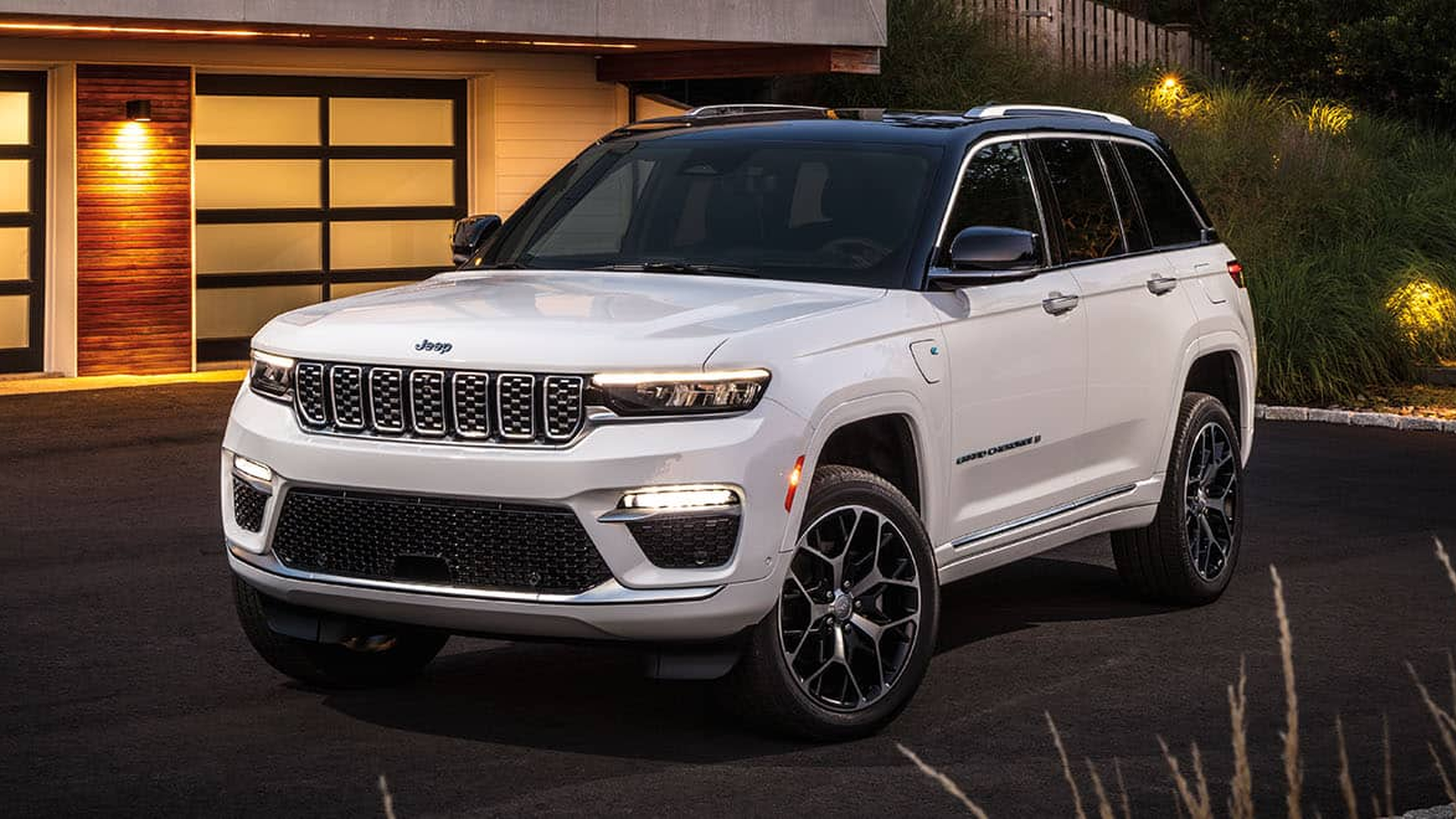
The current WL generation (2022-Present) moves the Grand Cherokee firmly into the ultra-luxury stratosphere. Jeep expanded the lineup by introducing the Grand Cherokee L, featuring a stretched wheelbase to accommodate a much-demanded third row of seating. The exterior styling returns to a sharper, more chiseled aesthetic, paying subtle homage to the original Wagoneer while integrating advanced LED matrix lighting technology.
Inside the cabin, the WL leaves its utilitarian roots far behind. Top-tier Summit Reserve models surround occupants with hand-wrapped Palermo leather, open-pore waxed walnut wood, and an exclusive 19-speaker McIntosh premium audio system. The dashboard is a digital command center, dominated by the Uconnect 5 interface and a dedicated interactive display for the front passenger.
WL Powertrain Evolution
- Standard Power
- 3.6L Pentastar V6 (293 hp, 260 lb-ft)
- V8 Performance (Discontinued Post-2023)
- 5.7L HEMI V8 (357 hp, 390 lb-ft)
- 4xe Plug-in Hybrid
- 2.0L Turbocharged I4 + Dual Electric Motors
- 4xe Total System Output
- 375 hp, 470 lb-ft torque
- Max Towing Capacity
- 7,200 lbs (with 5.7L V8)
Mastering the Trail: The 4xe Revolution
The most crucial engineering advancement of the WL generation is the 4xe powertrain. By pairing a 2.0-liter turbocharged four-cylinder with a 17-kWh battery pack and electric motors integrated directly into the 8-speed automatic transmission, Jeep created a vehicle that delivers massive low-end rock-crawling torque while radically reducing tailpipe CO2 emissions. The 4xe allows for up to 25 miles of pure electric driving, transforming the daily commute into a silent, zero-emission experience.
Mechanically, the 4xe does not compromise. It utilizes the Quadra-Trac II or Quadra-Drive II OEM transfer cases, maintaining true low-range gearing. The Selec-Terrain traction management system coordinates the ECU, transmission shift mapping, and electronic limited-slip differential to maintain forward momentum on ice, deep sand, or jagged granite. Experience the surreal sensation of conquering severe off-road trails in absolute silence, listening only to the tires crushing the dirt beneath you.
From the glass-shattering ZJ to the electrified WL, the Jeep Grand Cherokee consistently dictates the trajectory of the modern sport utility vehicle. It is an engineering marvel that confidently tows heavy boats to the lake, dominates the Rubicon Trail, and delivers occupants to high-end restaurants enveloped in absolute comfort. It remains the undeniable benchmark of the American luxury 4x4.