
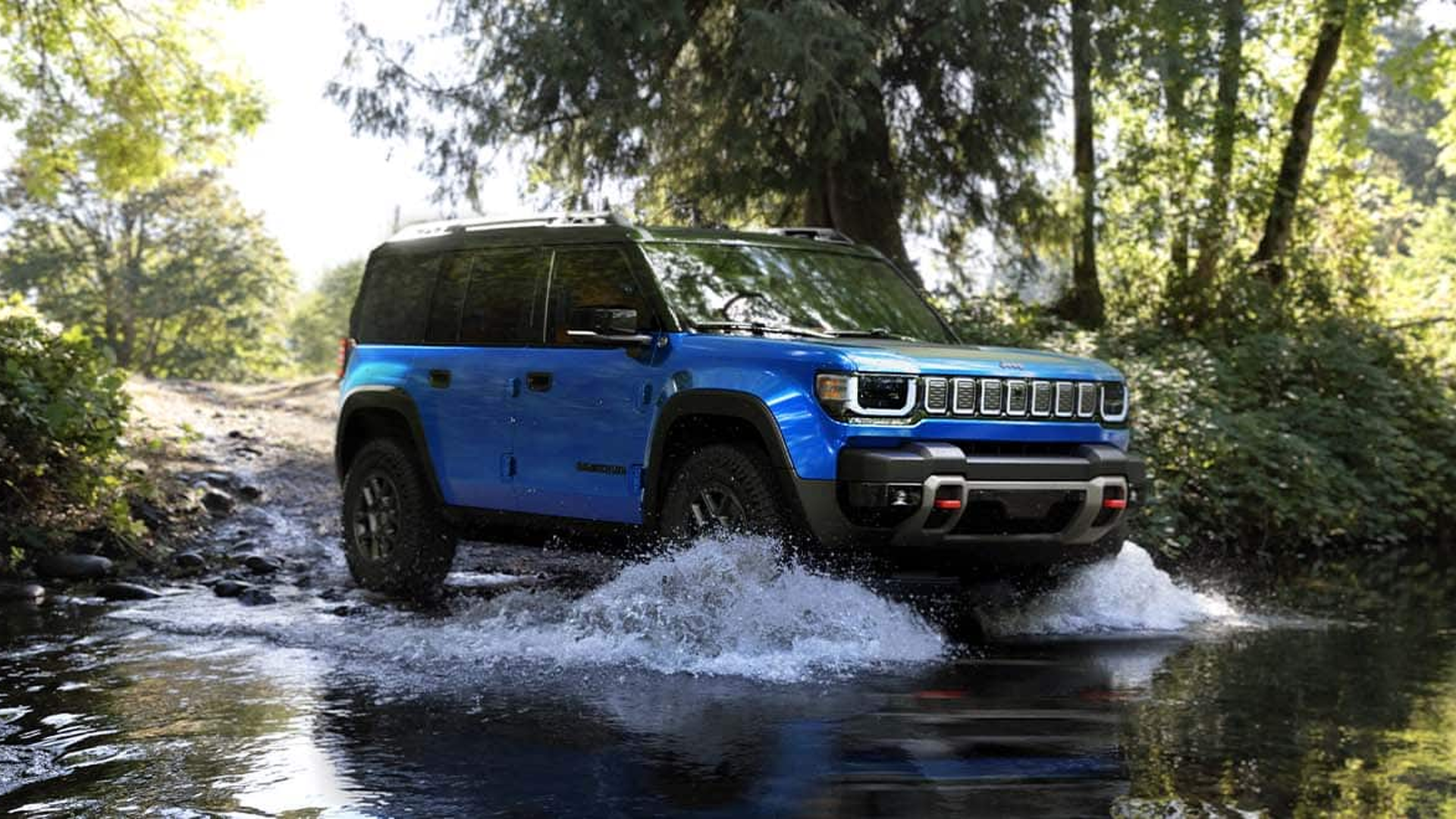
Shattering the Internal Combustion Paradigm
The Jeep Recon fundamentally rewrites the rules of backcountry exploration. It discards heavy mechanical transfer cases, spinning driveshafts, and the reliance on refined petroleum, stepping into the wilderness with a sophisticated BEV architecture. Pushing the accelerator pedal unleashes a massive surge of instantaneous torque, rocketing the heavy sport utility vehicle over jagged granite and through deep mud bogs with zero hesitation. The Recon achieves this without generating a single decibel of exhaust noise, allowing drivers to conquer the legendary Rubicon Trail while listening strictly to the sound of tires crushing dirt and the ambient noise of the forest.
Engineers approached this clean-sheet design by completely abandoning traditional body-on-frame truck constraints. The vehicle utilizes the STLA Large platform, an advanced native electric architecture. This chassis represents a masterclass in structural metallurgy and packaging efficiency. The massive high-voltage battery casing integrates directly into the floorpan as a stressed structural member. This strategic fusion of energy storage and frame dynamics dramatically increases the overall torsional rigidity of the unibody shell. When the Recon drops a tire into a deep rut, suspending the opposite wheel entirely in the air, the stiffened skeletal structure refuses to twist, ensuring the doors and tailgate open flawlessly despite the extreme mechanical binding forces applied to the chassis.
The Jeep Recon achieves the coveted Trail Rated badge not by mimicking legacy mechanical hardware, but by leveraging microsecond software calibrations to deliver exact torque outputs to individual wheels, completely reinventing how a vehicle finds traction.
Dual Electric Drive Modules: The New Heartbeat
Propulsion inside the Recon changes the definition of off-road power delivery. It utilizes two independent 3-in-1 EDM units mounted directly to the front and rear axles. Each EDM seamlessly houses the high-speed electric motor, the reduction gearing, and the power inverter inside a single, highly compact aluminum casting. This dense packaging saves critical physical space while radically reducing high-voltage wire lengths, improving overall electrical efficiency and protecting sensitive components from trail damage.
The system operates on a robust electrical architecture, processing direct current from the battery pack into the alternating current required to spin the motors. Advanced silicon carbide inverters mitigate thermal resistance, minimizing switching losses during heavy, low-speed crawling where constant throttle modulation generates massive heat. Rather than waiting for an internal combustion engine to reach an optimal RPM band, the electric motors generate maximum rotational force the absolute millisecond the driver demands it. You experience zero transmission downshifts, zero torque converter slip, and zero turbo lag. The vehicle simply claws forward with relentless authority.
Core Propulsion Specifications
- Propulsion Architecture
- Dual 3-in-1 Electric Drive Modules (Front/Rear AWD)
- Traction Management
- Selec-Terrain with Dedicated Off-Road Calibrations
- Axle Technology
- Electronic Locking Differentials (e-Locker)
- Underbody Protection
- High-Strength Steel Skid Plates
- Energy Storage
- High-Capacity Lithium-Ion Battery Pack
E-Locker Technology and Instantaneous Grip
Four-wheel-drive dynamics shift completely in the electric era. The Recon discards passive slip-and-grip systems, relying instead on pure software and electronic locking differentials to manage traction. The Selec-Terrain system networks directly with the front and rear EDMs, adjusting torque output at a microsecond level based on steering angle, wheel speed, and suspension compression.
When navigating slick, off-camber rock faces, traditional mechanical lockers often induce severe driveline binding, forcing the tires to scrub and slide. The Recon utilizes advanced e-locker technology. The ECU instantly detects wheel slip and digitally locks the axles, forcing both wheels on that axle to spin at the exact same velocity. Because there is no mechanical linkage transferring power from a central gearbox to the axles, the computer can actively vector torque, sending massive amperage exclusively to the tires maintaining physical friction against the earth. This allows the heavy SUV to drag itself out of deep sand or snow without ever digging itself into a deeper hole.
Thermal Management and High-Voltage Armor
Buried securely between the reinforced frame rails lies the massive lithium-ion battery pack. Jeep engineers selected a highly stable chemistry, balancing intense energy density with the rapid discharge capabilities required to pull the vehicle over steep vertical ledges. Dragging thousands of pounds of steel up a mountain generates extreme electrical draw, which in turn generates extreme heat. The battery utilizes an aggressive liquid thermal management loop. Specialized coolant snakes through micro-channels woven directly between the battery cells, pulling heat away from the core to prevent thermal degradation during sustained low-speed crawling or rapid direct-current fast charging sessions.
Armor plating is absolutely critical for a battery-electric off-roader. A punctured oil pan on a gasoline vehicle ends the day; a punctured high-voltage battery casing creates a catastrophic hazard. Engineers fitted the Recon with heavy-gauge, high-strength steel skid plates that run the entire length of the belly pan. This completely flat underbody not only protects the sensitive electrical architecture from jagged rock strikes but also vastly improves the vehicle's aerodynamic efficiency on the highway, ensuring the Recon slices through the slipstream to maximize its driving range while completely eliminating its tailpipe CO2 footprint.
Open-Air DNA: Stripping Away the Armor
A true Jeep requires open-air freedom. The Recon embraces the legendary modularity of the Wrangler brand while injecting a heavy dose of modern convenience. Drivers can effortlessly strip the vehicle down to its skeleton. The heavy reinforced doors unbolt and remove completely, providing unparalleled visibility when leaning out to inspect the exact placement of the front tires on a technical trail. The quarter-panel glass removes with simple latches, transforming the rear cargo area into an open-air bed.
Instead of wrestling with heavy fiberglass hardtop panels or complex canvas soft tops, the Recon features a massive, one-touch power-folding roof. A single press of a button retracts the durable fabric top the entire length of the cabin, exposing all occupants directly to the sky. Experiencing a remote alpine trail with no doors, no roof, and absolutely zero engine noise provides a sensory experience totally unique to the electric off-road segment.
Stripping away the doors and glass while navigating the wilderness in total silence reconnects the driver with the environment, perfectly mirroring the raw, unfiltered experience of the original 1941 Willys MB military vehicle.
Suspension Articulation and Trail Geometry
Earning the Trail Rated badge requires severe geometric clearances. The Recon sits tall, featuring aggressive approach, breakover, and departure angles specifically designed to prevent the vehicle from getting high-centered on sharp crests. The front and rear fascias are sculpted tightly against the chassis, amputating any unnecessary plastic overhangs that would otherwise smash into boulders.
Unlike legacy solid-axle vehicles, the STLA Large platform utilizes a fully independent suspension system. This architectural pivot provides a remarkably smooth, car-like ride on paved interstates, completely isolating the cabin from harsh expansion joints. To ensure this independent setup survives the trail, engineers utilized heavy-duty cast aluminum control arms and long-travel shock absorbers. The suspension geometry forces the massive, aggressive off-road tires downward into deep ruts, maintaining the crucial contact patch required to keep the heavy EV moving forward.
The Digital Trailhead: Uconnect 5 and Topographical Mapping
The interior of the Recon aggressively rejects delicate luxury, favoring rugged, waterproof functionality. The cabin architecture is brutalist and precise, utilizing highly durable, easy-to-clean synthetic seating surfaces and heavy-duty rubberized flooring designed to be washed out after a weekend in the mud. Chunky, tactile grab handles provide stability for passengers when the trail angles become violent.
The dashboard centers entirely around the Uconnect 5 digital ecosystem. The massive central touchscreen operates with the processing speed of a premium tablet, rendering crisp graphics and instantaneous menu responses. Jeep recognizes that EVs require strategic trip planning, especially when traveling far off the grid. The navigation system includes detailed, pre-loaded topographical trail guides, covering the most famous off-road routes in North America.
The software actively calculates the remaining battery state of charge against the severe elevation changes and energy demands of the specific trail. The system drops digital breadcrumbs via GPS to ensure drivers can always find their way back to the trailhead, and it specifically maps the location of remote high-speed charging stations. The Recon proves that transitioning to battery-electric propulsion does not require abandoning the visceral thrill of off-road exploration; it simply provides a superior, silent tool to conquer the earth.