
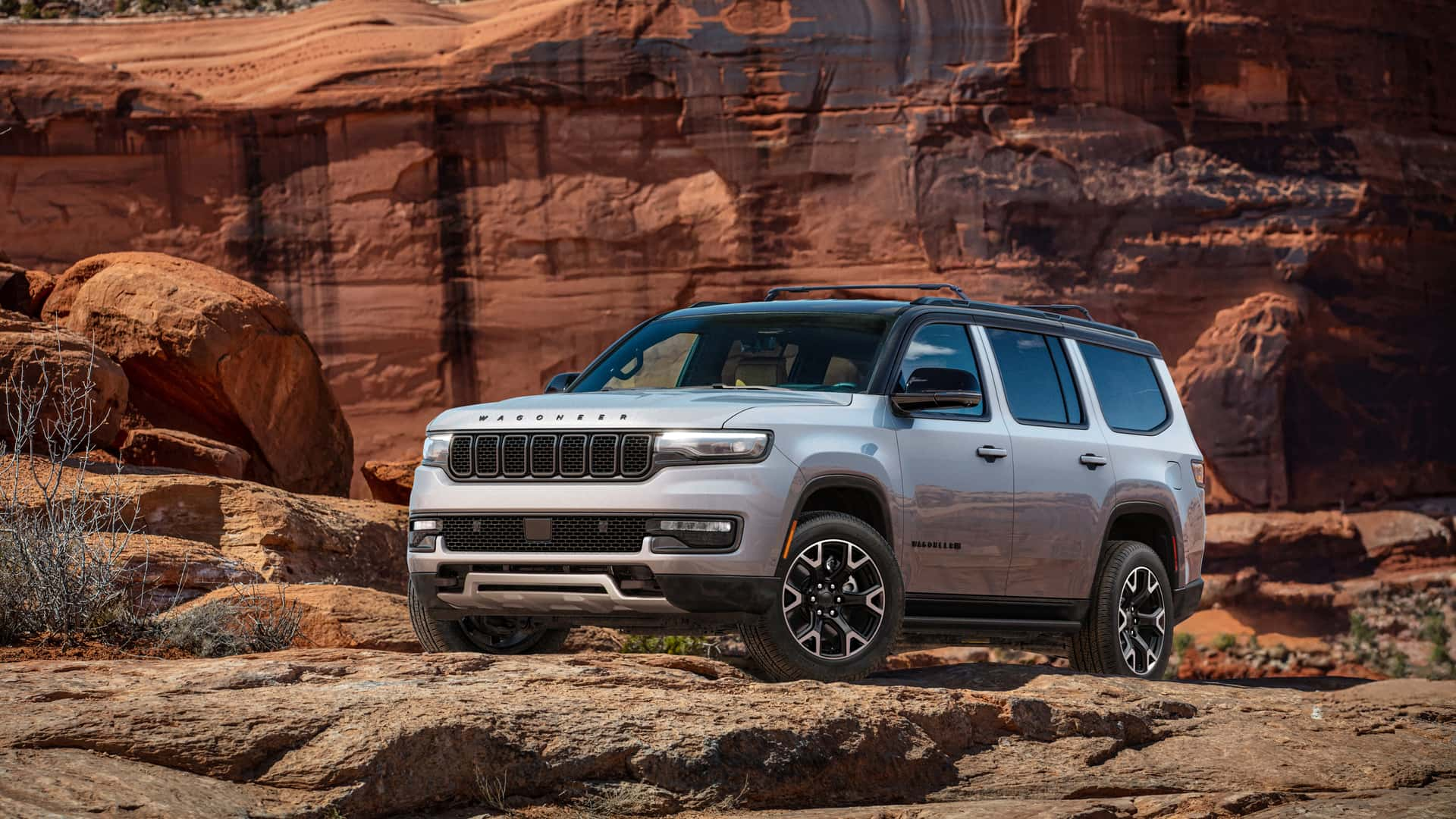
Forging the Premium 4x4 Segment
Industrial designer Brooks Stevens shattered the utilitarian confines of the automotive landscape in 1963. Tasked with replacing the archaic Willys Station Wagon, Stevens conceptualized a machine that married the rugged, body-on-frame architecture of a truck with the refined passenger cabin of a premium station wagon. The resulting Jeep Wagoneer (SJ generation) effectively invented the luxury sport utility vehicle category decades before European marques recognized the market's existence. It offered factory air conditioning, power steering, and an automatic transmission paired directly to a four-wheel-drive system-an engineering configuration previously considered impossible for a civilian utility vehicle.
The original Wagoneer utilized a bespoke chassis that sat remarkably low compared to competing trucks of the era. This low stance allowed passengers to step directly into the cabin rather than climbing up into it, dramatically broadening its appeal to suburban families. Early models featured an optional IFS setup utilizing torsion bars, a radical departure from the punishing solid front axles dominating the 1960s 4x4 market. While Jeep eventually reverted to a solid Dana 44 front axle to satisfy heavy-duty durability requirements, the initial IFS experiment proved the brand's relentless pursuit of passenger comfort.
The 1963 Jeep Wagoneer stood alone in the automotive market, offering a factory automatic transmission paired with four-wheel drive exactly seven years before the British introduced the original Range Rover.
The SJ Era Powertrain Evolution
Propulsion during the SJ era transitioned from overhead-cam ingenuity to massive American displacement. The Wagoneer launched with the Tornado OHC inline-six, a highly advanced powerplant for its time that suffered from complex maintenance requirements. Following the acquisition by American Motors Corporation (AMC), engineers stuffed the engine bay with torque-rich V8 engines to handle heavy steel trailers and high-speed interstate cruising.
- 1963 Tornado OHC Inline-Six
- Displacement: 3770 cm3, 140 horsepower
- AMC 327 "Vigilante" V8
- Introduced in 1965, generating 250 horsepower
- AMC 360 V8
- The legendary 5.9L block, the backbone of the Grand Wagoneer era
- AMC 401 V8
- Massive 6.6L block providing uncompromising low-end torque
The Quadra-Trac Revolution
Prior to 1973, engaging four-wheel drive required the driver to stop the vehicle, exit the cabin, manually lock the front wheel hubs, and violently pull a heavy mechanical floor lever. Jeep eradicated this primitive ritual by introducing Quadra-Trac, the first fully automatic, full-time four-wheel-drive system available in a mass-produced SUV. Engineered by BorgWarner, the aluminum-cased transfer case utilized a unique chain-drive system and a limited-slip center differential equipped with cone clutches.
This mechanical brain constantly monitored driveshaft speeds. When the rear wheels lost traction on snow or ice, the cone clutches locked, instantly transferring torque to the front axle without any driver intervention. Quadra-Trac transformed winter driving dynamics, providing absolute confidence on slick asphalt while retaining immense off-road capability. The system proved so effective that modifying an OEM Wagoneer with a heavy-duty locking differential became a mandatory upgrade for serious off-road racers in the 1970s.
The WS Generation: Resurrecting the Titan
Following the retirement of the Grand Wagoneer in 1991, Jeep abandoned the full-size luxury segment for thirty years. The brand resurrected the legendary nameplate for the 2022 model year with the WS generation. Engineers refused to compromise on capability, rejecting a car-based crossover platform. They developed a heavily modified body-on-frame architecture derived from the Ram 1500 (DT platform). This fully boxed ladder frame utilizes 98 percent high-strength steel, maximizing torsional rigidity to prevent the massive vehicle from flexing under extreme tow loads or violent trail impacts.
The exterior dimensions command immediate respect. Measuring over 214 inches in length and 83 inches in width, the modern Wagoneer physically dominates the highway. The design language pays subtle homage to the SJ generation with its upright A-pillars, forward-leaning seven-slot grille, and large, trapezoidal wheel arches. Extensive aerodynamic optimization, including active grille shutters and a sweeping roofline, mitigates the immense drag coefficient inherent to a vehicle of this magnitude.
Hurricane Twin-Turbo Propulsion
Jeep launched the WS Wagoneer with the legendary 5.7L HEMI V8, fortified by the eTorque mild-hybrid system. The eTorque architecture replaced the traditional alternator with a belt-driven motor generator unit, providing a seamless 130 lb-ft burst of supplemental torque during initial acceleration to smooth out transmission shifts and improve low-speed drivability.
However, the true engineering marvel arrived shortly after launch: the 3.0L Hurricane Twin-Turbo Inline-Six. This completely modern powerplant replaces massive displacement with highly pressurized forced induction. Engineers utilized Plasma Transfer Wire Arc (PTWA) cylinder coating technology, melting steel wire at 35,000 degrees Fahrenheit to spray a micro-thin, ultra-hard friction surface directly onto the aluminum cylinder walls. This eliminates heavy iron sleeves, reducing the engine's physical weight while radically improving thermal efficiency.
Dual low-inertia turbochargers spool instantly, forcing pressurized oxygen into a dedicated water-to-air charge cooler. This drops the intake air temperature dramatically before it enters the combustion chamber, allowing for aggressive ignition timing without detonation. The result is a mechanical leviathan that produces V8-destroying power while minimizing tailpipe CO2 emissions.
Standard Output (SO) Hurricane Specifications
- Engine Architecture
- 3.0L Twin-Turbocharged Inline-Six, Aluminum Block
- Fuel Delivery
- High-Pressure Direct Injection (5,075 psi)
- Peak Horsepower
- 420 hp @ 5,200 RPM
- Peak Torque
- 468 lb-ft @ 3,000 RPM
- Transmission
- TorqueFlite 8HP75 8-Speed Automatic
Independent Rear Suspension and Spatial Geometry
The most critical chassis modification differentiating the Wagoneer from its pickup truck siblings is the adoption of an independent rear suspension. Replacing a solid rear axle with a complex multilink setup fundamentally changes the vehicle's geometry. A solid axle requires significant vertical space beneath the cargo floor to travel up and down over bumps. By utilizing an independent layout, engineers dropped the rear floor pan substantially.
This dimensional shift creates best-in-class third-row legroom. Adults can comfortably inhabit the rear seats during cross-country road trips without their knees pushed into their chests. Furthermore, the independent articulation isolates severe impacts to the specific wheel encountering the obstacle, preventing lateral head-toss and ensuring the heavy SUV tracks perfectly straight over washboard dirt roads.
Quadra-Lift and Advanced 4x4 Mechanics
Premium trims ditch standard steel coil springs for the Quadra-Lift air suspension system. Utilizing heavy-duty pneumatic bladders, the onboard compressor automatically drops the chassis 0.6 inches at highway speeds to slice through the wind and improve fuel economy. When the pavement ends, the driver can manually raise the vehicle, securing up to 10.0 inches of ground clearance to clear jagged boulders and submerged logs.
Traction management relies on three available four-wheel-drive systems. Quadra-Trac I provides a seamless, active single-speed experience. Quadra-Trac II introduces a two-speed transfer case featuring a dedicated 2.72:1 low-range gear ratio for extreme rock crawling. The pinnacle is Quadra-Drive II, which incorporates an electronic limited-slip differential (eLSD) in the rear axle. This system instantly detects wheel slip and can route up to 100 percent of available engine torque to a single rear wheel, dragging the 6,000-pound SUV out of deep mud or slick ice patches with zero hesitation.
Equipped with the Quadra-Lift air suspension, the modern Jeep Wagoneer safely navigates water crossings up to 24 inches deep, utilizing specialized breathers to protect the axles and transmission from catastrophic fluid contamination.
Heavy-Duty Towing and Thermal Management
The Wagoneer is engineered to haul massive loads, boasting a best-in-class maximum towing capacity of 10,000 pounds when properly equipped. Achieving this metric requires severe structural and thermal reinforcements. The Class IV hitch receiver is integrated directly into the high-strength steel frame during the welding process, preventing the mounting points from tearing under immense tongue weight.
Pulling five tons up a steep mountain grade generates extreme heat. The Heavy-Duty Trailer Tow Package includes an upgraded engine cooling system, an active air dam to direct airflow across the massive radiator, and a dedicated transmission fluid cooler. The Uconnect 5 system integrates specific trailering applications, allowing the driver to monitor trailer tire pressure and adjust the integrated electronic trailer brake controller directly from the central touchscreen.
Acoustic Isolation and the Digital Cockpit
The cabin of the WS Wagoneer rivals premium European luxury sedans in its absolute silence. Engineers aggressively attacked Noise, Vibration, and Harshness (NVH) by utilizing acoustic laminated windshield and front-door glass, active noise cancellation technology routed through the audio system, and massive liquid-filled engine mounts to absorb powertrain vibrations before they penetrate the firewall.
This silent environment serves as the perfect acoustic canvas for the available 19-speaker McIntosh MX950 Entertainment System. Pumping 950 watts through a 17-channel amplifier, the system utilizes patented Power Guard technology to prevent speaker clipping at maximum volume, delivering audiophile-grade clarity. The dashboard is a fully digital command center. The driver utilizes a 10.25-inch frameless digital instrument cluster, while the center stack houses a 10.1-inch high-definition Uconnect 5 touchscreen. A dedicated 10.25-inch passenger display even allows the co-pilot to monitor navigation data, view exterior camera feeds, and manage media without distracting the driver.
The Jeep Wagoneer refuses to compromise. It honors the groundbreaking luxury of the 1963 original by surrounding occupants in absolute premium comfort, yet it utilizes a massive high-strength steel frame, twin-turbocharged thrust, and true low-range gearing to ensure it can still conquer the most hostile terrain on the planet. It remains the ultimate expression of American full-size utility.