
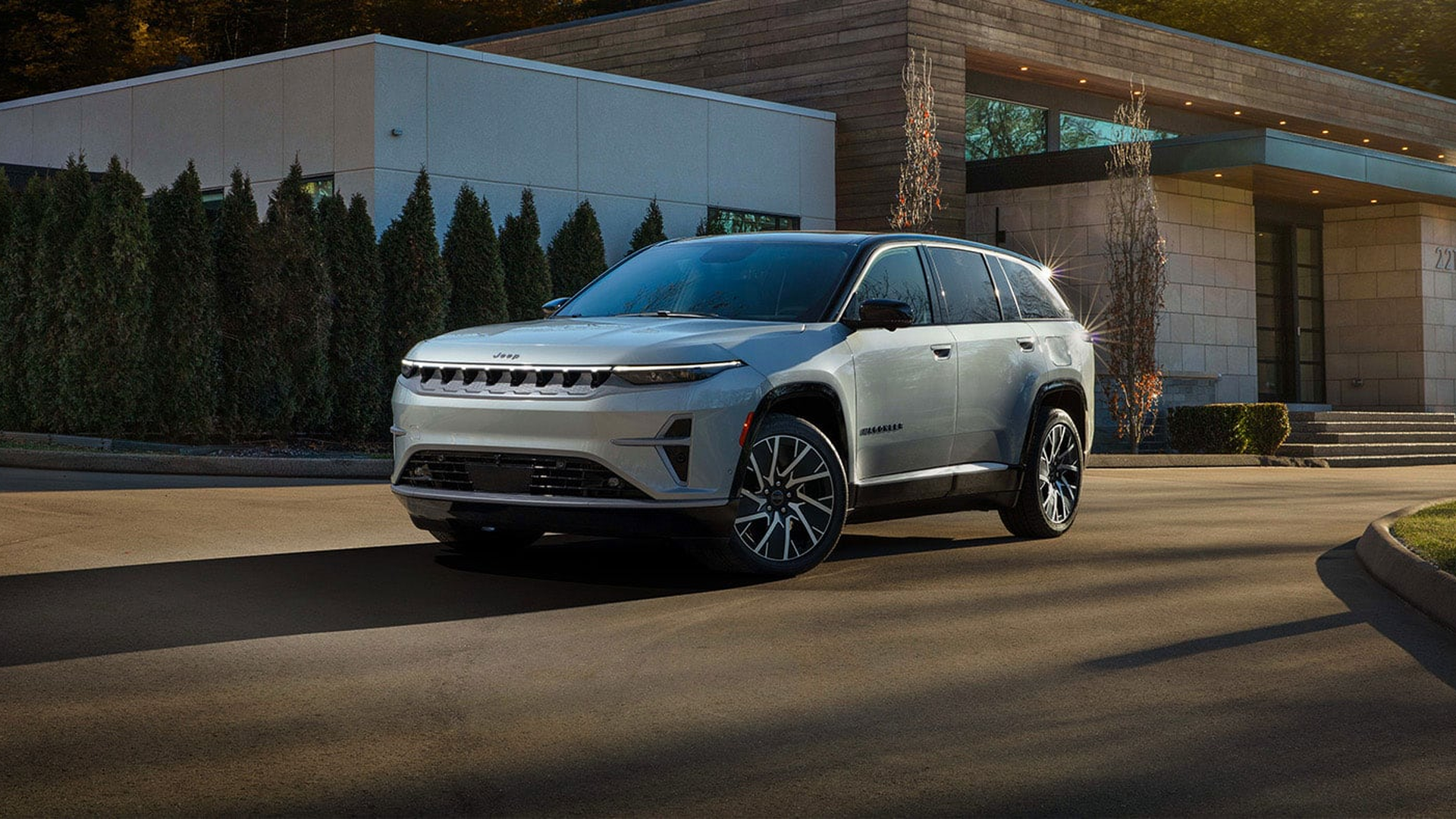
Shattering the Combustion Paradigm
The Jeep Wagoneer S executes a ruthless assault on the premium electric utility segment. It abandons over eighty years of internal combustion reliance, stepping into the battery-electric arena with staggering performance metrics. Pushing the accelerator pedal to the floor unleashes 600 horsepower, rocketing the heavy sport utility vehicle from a dead stop to 60 mph in a blistering 3.4 seconds. This acceleration rivals dedicated European sports cars, yet the Wagoneer S retains the commanding ride height and unyielding all-weather capability demanded by the Jeep badge.
Engineers approached this clean-sheet design by discarding traditional heavy-duty ladder frames. The vehicle rides on the highly advanced STLA Large platform, a native BEV architecture. This chassis represents a masterclass in structural metallurgy. The high-voltage battery casing integrates directly into the vehicle floor as a stressed structural member. This fusion of battery and frame dramatically increases the overall torsional rigidity of the unibody shell by 35 percent compared to previous mid-size ICE platforms. A stiffer chassis provides the perfect foundation for the independent suspension system to process violent road imperfections without transferring the shock energy into the passenger cabin.
The Wagoneer S achieves a 0-60 mph sprint in 3.4 seconds, making it the fastest accelerating production vehicle in the brand's history, completely eclipsing the supercharged V8 Trackhawk of the previous generation.
Dual Electric Drive Modules: Precision Torque
Propulsion fundamentally changes when you replace a central spinning crankshaft with localized magnetic fields. The Wagoneer S utilizes two independent 3-in-1 EDM units mounted directly to the front and rear axles. Each EDM seamlessly houses the electric motor, the reduction gearing, and the power inverter inside a single, highly compact aluminum casting. This dense packaging saves critical physical space while radically reducing high-voltage wire lengths, improving overall electrical efficiency.
The system operates on a robust 400-volt architecture. Silicon carbide inverters process the direct current from the battery into the alternating current required by the motors. Silicon carbide represents a massive leap over traditional silicon semiconductors, offering significantly less thermal resistance and minimizing switching losses during heavy acceleration. Producing a combined 617 lb-ft of instantaneous torque, the motors generate maximum rotational force the millisecond the driver demands it. You experience zero transmission downshifts, zero turbo lag, and zero hesitation. The vehicle simply warps forward.
Efficiency dictates range. To maximize highway touring distances, the front EDM features a sophisticated mechanical disconnect system. When the onboard computers detect steady-state cruising on dry asphalt, a physical clutch inside the front reduction gear disengages the electric motor from the front axle. The front wheels spin freely, completely eliminating the parasitic magnetic drag of the inactive motor and actively extending the remaining driving range.
Core Powertrain and Battery Specifications
- Propulsion Architecture
- Dual 3-in-1 Electric Drive Modules (AWD)
- Peak Horsepower
- 600 hp
- Peak Torque
- 617 lb-ft
- High-Voltage Battery Capacity
- 100 kWh Lithium-Ion
- Target Aerodynamic Drag
- 0.29 Cd
Thermal Management and High-Voltage Storage
Buried securely between the frame rails lies the massive 100-kWh lithium-ion battery pack. Jeep engineers selected a highly stable nickel-manganese-cobalt chemistry, balancing intense energy density with the rapid discharge capabilities required to feed two 300-horsepower motors simultaneously. Extreme electrical draw generates extreme heat. The battery utilizes an aggressive liquid thermal management loop. Coolant snakes through micro-channels woven directly between the battery cells, pulling heat away from the core to prevent thermal degradation during sustained high-speed driving or rapid direct-current fast charging sessions.
During cold weather operations, the system reverses. The thermal management loop utilizes waste heat scavenged from the electric motors and inverters, pumping it back into the battery pack to raise the core temperature. A warm battery accepts charge faster and discharges energy more efficiently, mitigating the severe range loss typically experienced by electric vehicles in freezing northern climates. This complex thermoregulation effectively zeroes out the tailpipe CO2 footprint while maintaining reliable cross-country touring capability.
Aerodynamic Mastery: Slicing the Slipstream
Electric vehicle range lives and dies in the wind tunnel. Overcoming atmospheric drag at highway speeds consumes massive amounts of energy. The Wagoneer S achieves a 0.29 drag coefficient, making it the most aerodynamic vehicle the brand has ever produced. Designers abandoned the vertical, blocky silhouettes of the past, sweeping the windshield back aggressively and tapering the roofline into a teardrop profile to minimize the rear wake.
The iconic seven-slot grille undergoes a radical functional transformation. Because an EV lacks a massive internal combustion radiator, the grille no longer needs to ingest hundreds of cubic feet of air per minute. Instead, the slots are blocked off, serving as an illuminated aerodynamic shield that precisely routes ambient air up and over the hood line. A prominent, cantilevered rear R-wing manipulates the airflow detaching from the roof, smoothing the turbulent air behind the tailgate to reduce low-pressure drag while simultaneously anchoring the rear axle to the pavement at triple-digit speeds. Even the underbody is completely flat, utilizing sheer composite shields to prevent the suspension components from churning the air beneath the floor pan.
Selec-Terrain and Instantaneous Traction
Four-wheel-drive dynamics shift completely in the electric era. The Wagoneer S discards heavy mechanical transfer cases and driveshafts, relying instead on pure software to manage traction. The Selec-Terrain system networks directly with the front and rear EDMs, adjusting torque output at a microsecond level. The driver selects from five distinct modes: Auto, Snow, Sand, Eco, and Sport.
In Snow mode, the computers instantly blunt the throttle response, precisely mapping the torque curve to prevent the massive 617 lb-ft of force from breaking the tires loose on slick ice. The system actively vectors torque between the front and rear axles, sending power exclusively to the tires maintaining physical friction. Engage Sport mode, and the software unleashes the full amperage of the 100-kWh battery, sharpening the steering rack and heavily biasing the power delivery to the rear axle to mimic the aggressive handling characteristics of a rear-wheel-drive sports sedan.
Eliminating the mechanical linkage between the front and rear axles allows the Wagoneer S to react to wheel slip exactly 100 times faster than a traditional internal combustion 4x4 system, maximizing grip before the driver even perceives a loss of traction.
The Digital Command Cabin and Acoustic Isolation
Entering the Wagoneer S reveals a cabin that aggressively rejects analog traditions. Physical buttons are virtually eradicated. Occupants are greeted by an overwhelming 45 inches of total usable screen space spanning the entire dashboard. The driver operates a 12.3-inch frameless digital instrument cluster, highly configurable to display navigation waypoints, active safety telemetry, or live battery discharge metrics. The center stack houses a 12.3-inch Uconnect 5 touchscreen handling primary climate and media inputs.
Jeep completely democratizes the digital experience by installing a dedicated 10.25-inch interactive display exclusively for the front passenger. This screen features polarized privacy glass, rendering it invisible to the driver. The co-pilot can actively search for charging stations, stream high-definition video, or take complete control of the audio system without ever distracting the pilot from the road.
Interior Geometry and Audio Excellence
- Total Display Area
- 45 Inches
- Passenger Screen Size
- 10.25 Inches
- Audio System
- McIntosh 19-Speaker Custom Configuration
- Amplifier Output
- 1,200 Watts
Electric vehicles operate in near-absolute silence, a characteristic that cruelly exposes any wind noise or tire roar entering the cabin. Acoustic engineers applied massive quantities of liquid sound deadener to the floorboards and fitted the vehicle with acoustic laminated glass to create a rolling sensory deprivation chamber. This absolute silence serves as the ultimate acoustic canvas for the custom-tuned McIntosh audio system. Pumping 1,200 watts through 19 speakers, including a massive 12-inch subwoofer mounted in the cargo area, the system delivers crystalline, distortion-free audio that rivals bespoke home theater setups.
Material selection reflects a modern, sustainable ethos. Designers rejected traditional heavy cowhide, opting instead for highly durable, premium synthetic seating surfaces and recycled materials throughout the door panels and headliner. Dual-color ambient lighting strips run across the door cards and dashboard, allowing drivers to customize the nocturnal atmosphere of the cabin precisely.
The Jeep Wagoneer S is an uncompromising technological manifesto. It proves that transitioning to battery-electric propulsion does not require abandoning the aggressive presence, visceral acceleration, or unrelenting all-weather capability that defines American luxury. By leveraging cutting-edge aerodynamic theory, dense battery chemistry, and absolute digital integration, it establishes a terrifying new benchmark for the premium electric utility segment.