Koenigsegg: The Swedish Speed Laboratory

Koenigsegg is the ultimate underdog story. Founded by a 22-year-old Christian von Koenigsegg, this tiny Swedish company consistently humiliates the world's biggest automakers. They invent everything in-house: engines with no camshafts, transmissions with no gears, and wheels made of hollow carbon fiber.

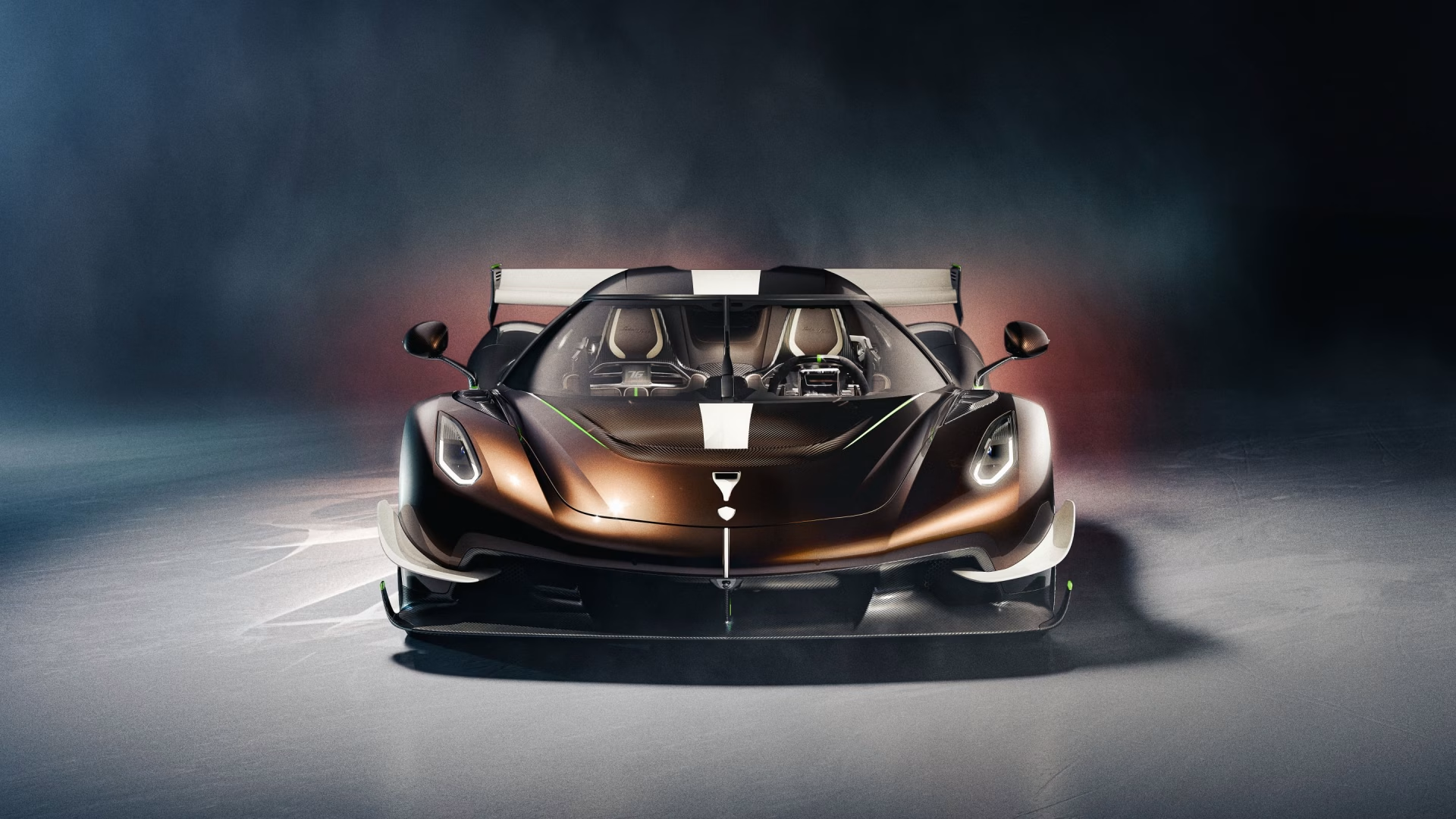
Koenigsegg Hero Vehicle

Model Lineup

Explore the current production vehicles.

Jesko

The masterpiece successor to the Agera RS. The Jesko is an exercise in ultimate performance, featuring a revolutionary 9-speed Light Speed Transmission. The Absolut version is engineered with one goal: to be the fastest production car in history, period.

Production 2021-Present

Gemera

The world's first 'Mega-GT.' The Gemera is a revolutionary four-seat hybrid that shatters the family car paradigm, offering seating for four adults and their luggage, combined with an insane 2300 horsepower from its V8 hybrid system. Utterly groundbreaking.

Production 2024-Present

Regera

The car that eliminated the gearbox. The Regera is a revolutionary luxury Megacar, a twin-turbo V8 hybrid with a groundbreaking single-gear Direct Drive system. It is a seamless, brutally fast, and incredibly sophisticated statement of the future of speed.

Production 2016-2022

Agera RS

The former king of speed. The Agera RS is the car that officially became the world's fastest production vehicle, averaging 277.9 mph. It is a masterful blend of the raw Agera R and the track-focused One:1, a true legend of the record books.

Production 2015-2018

One:1

The world's first 'Megacar.' The One:1 achieved the dream of a 1:1 power-to-weight ratio, with 1360 metric horsepower for its 1360 kg weight. It was a showcase of ultimate track performance and a landmark moment in automotive history.

Production 2014-2015

CCX

The first truly global Koenigsegg. The CCX was a raw, visceral, and formidable hypercar designed to meet worldwide safety and emissions standards. Famously difficult to tame, it was a pure, unapologetic beast with a thunderous twin-supercharged V8.

Production 2006-2010

CCXR

The eco-friendly hypercar that harnessed 'flower power.' The CCXR was an evolution of the CCX, ingeniously engineered to run on E85 biofuel, which boosted its output to over 1000 horsepower. A groundbreaking fusion of sustainability and extreme performance.

Production 2007-2009

CC8S

The car that started the ghost legend. The CC8S was the first-ever production Koenigsegg, a clean and minimalist machine that introduced the world to Christian von Koenigsegg's vision, including the revolutionary dihedral synchro-helix doors.

Production 2002-2003

CCR

The car that briefly stole the title of world's fastest production car from the McLaren F1. The CCR was a more powerful evolution of the CC8S, a statement of intent that proved a small Swedish manufacturer could take on the giants and win.

Production 2004-2006

Author

HugeGarage Editor

Published

Updated

6 Min Read

The 22-Year-Old vs. The World

In 1994, Christian von Koenigsegg was a 22-year-old with no engineering degree and an MS-DOS computer. He decided to build the world's fastest car. Everyone told him it was impossible. Volkswagen and Ferrari spend billions on R&D; he had a hangar in Sweden.

He proved them all wrong. Today, Koenigsegg is the benchmark for hypercar engineering. Unlike other boutique brands that buy engines from Mercedes or Ford, Christian invents his own.

The Doors: Dihedral Synchro-Helix

You cannot talk about Koenigsegg without talking about the doors. They don't open out, and they don't open up. They rotate forward and down in a single, fluid motion.
Officially, it is called the Dihedral Synchro-Helix Actuation System. It is wildly over-engineered, incredibly expensive, and utterly mesmerizing. It solves the problem of parking next to a high curb (the door clears it) while looking like a spaceship.

The "Ghost" Squadron

Every Koenigsegg built has a tiny Ghost symbol on the engine cover or rear window. This is a tribute.

In 2003, Koenigsegg's original factory burned to the ground. They moved into an abandoned airbase formerly used by the Swedish Air Force's Fighter Jet Squadron No. 1, known as the "Ghosts." The squadron's motto was "The Show Must Go On." Koenigsegg adopted the ghost symbol to honor the pilots and the facility that saved the company.

Engineering Witchcraft: The Regera & Gemera

Koenigsegg doesn't follow rules; they rewrite physics.

  • The Regera: It has 1,500 horsepower but no transmission. No gears. It uses a hydraulic coupling system called "Koenigsegg Direct Drive" to take the car from 0 to 250 mph in one seamless surge of power.
  • The Gemera: A 4-seater hypercar with a 3-cylinder engine. Sounds small? It produces 600 horsepower from 2.0 liters using "Freevalve" technology (no camshafts). It is arguably the most advanced internal combustion engine on earth.

The World Record

In 2017, the Agera RS shut down a highway in Nevada and averaged 277.8 mph (447 km/h), officially becoming the fastest production car in the world at the time, beating Bugatti. They did it with a fraction of the budget.

Buying Advice: The Application

You don't just buy a Koenigsegg. You apply, you wait 3-4 years, and you pay $3 million+. But unlike other hypercars that are just jewelry, a Koenigsegg is a piece of scientific history.

Frequently Asked Questions

What is the 2026 Koenigsegg Gemera and when are US deliveries?

The 2026 Koenigsegg Gemera is the world’s first "Mega-GT," a four-seater hypercar that redefines performance for the American market. While initial concept models were shown earlier, the production-spec units featuring the "Dark Matter" E-motor are slated for US customer deliveries throughout 2026.

The Gemera is available in two main configurations for US buyers: the "Tiny Friendly Giant" (TFG) 3-cylinder hybrid and the record-breaking HV8 (Hot V8) version. The HV8 combines a 5.0L twin-turbo V8 with electric propulsion to produce a staggering 2,300 horsepower and 2,028 lb-ft of torque, making it the most powerful production car available in the United States.

How does the Koenigsegg CC850 "Engage Shifter System" work?

The Koenigsegg CC850, arriving in US collections in 2026, features the revolutionary Engage Shifter System (ESS). This world-first technology allows the car to function as both a gated 6-speed manual with a physical clutch pedal and a 9-speed multi-clutch automatic.

For the purist driver in the USA, the ESS provides a mechanical feel identical to a traditional manual, but with the ability to switch to a seamless automatic mode for city driving in traffic-heavy areas like Los Angeles or Miami. This system is paired with a 1,385 hp V8, achieving a perfect 1:1 power-to-weight ratio (1,385 kg to 1,385 hp).

What is the top speed of the Koenigsegg Jesko Absolut in 2026?

The Koenigsegg Jesko Absolut is engineered to be the fastest production car ever made, with a theoretical top speed exceeding 330 mph. In 2026, it remains the ultimate "high-velocity" tool for American collectors, featuring an ultra-low drag coefficient of just 0.278 Cd.

Unlike the track-focused Jesko Attack, the Absolut removes the massive rear wing to minimize drag. In the US, it runs on E85 biofuel to achieve its maximum output of 1,600 horsepower. Every Jesko Absolut is equipped with the 9-speed Light Speed Transmission (LST), which can jump between any gear near-instantaneously to maximize acceleration.

Where can I service a Koenigsegg in the United States?

Koenigsegg has significantly expanded its authorized service network in the USA for 2026. Official service points are located in key hubs including Newport Beach, North Carolina (Charlotte), Florida (Davie/Miami), and Washington D.C.

These facilities employ factory-certified technicians who use specialized diagnostic tools linked directly to Ängelholm, Sweden. For 2026 models like the Gemera and Jesko, Koenigsegg also utilizes "Flying Rangers"—expert technicians who can travel directly to an owner's location to perform complex maintenance or software updates on-site.

What are the performance specs of the Koenigsegg "Dark Matter" motor?

The "Dark Matter" motor, featured in the 2026 Gemera, is a patent-pending Raxial Flux electric motor. It produces 800 horsepower and 922 lb-ft of torque while weighing only 86 lbs (39 kg). This power density is currently unmatched in the US automotive market.

By replacing three smaller motors with one "Dark Matter" unit, Koenigsegg has reduced the Gemera's complexity and weight while increasing performance. This allows the four-seater hypercar to achieve a 0-60 mph time of just 1.9 seconds, rivaling the quickest dedicated two-seater electric hypercars.

Can I buy a Koenigsegg with a "Show or Display" exemption in the US?

While many older Koenigseggs like the One:1 were originally imported under the "Show or Display" federal exemption (limiting them to 2,500 miles per year), the newer 2026 models like the Gemera and Jesko are engineered to be fully US-homologated.

This means they meet all FMVSS and EPA standards, allowing owners to register them for unlimited road use. For rare older models like the CCX or Agera reaching the 25-year rule (beginning in the 2030s), they will eventually be eligible for full import without restrictions.

What is the price of a Koenigsegg in the USA for 2026?

Koenigsegg prices in the US market for 2026 reflect their extreme exclusivity and "megacar" status. Estimated starting prices are:

  • Koenigsegg Gemera: Approximately $1.7 million to $2.1 million (HV8 variants higher).
  • Koenigsegg Jesko: Approximately $3.0 million to $3.4 million.
  • Koenigsegg CC850: Approximately $3.65 million.

Due to the bespoke nature of these vehicles, final "out-the-door" prices often increase significantly based on custom carbon-fiber finishes, interior materials, and "Ghost" performance packages.

How does Koenigsegg utilize "Freevalve" technology?

The 2026 Gemera features Freevalve technology in its 3-cylinder "Tiny Friendly Giant" engine. This system replaces traditional camshafts with independent electro-hydraulic-pneumatic actuators for each valve.

This allows for infinite control over valve timing and lift, enabling the engine to switch between different cycles (like Miller or Otto) on the fly. For US drivers, this results in a 2.0L engine that produces 600 hp while maintaining emissions compliance and fuel efficiency comparable to a standard modern sedan.

What is the "Ghost" package for the Koenigsegg Jesko?

The Ghost Package is a high-downforce aerodynamic upgrade for the Jesko. In 2026, US owners can specify this package to include a deeper front splitter, enlarged side winglets, and a massive active top-mounted rear wing.

While the Jesko Absolut is designed for top speed, a Jesko with the Ghost package (often called the "Attack" spec) is optimized for track performance, generating over 1,000 kg (2,205 lbs) of downforce at high speeds. This makes it a formidable weapon for American tracks like Circuit of the Americas or Road America.

Are Koenigsegg cars built with carbon fiber in-house?

Yes, Koenigsegg is one of the few manufacturers in the world that produces its own carbon fiber components entirely in-house. This includes the monocoque chassis, the body panels, and even the world’s first hollow-core carbon fiber wheels (Aircore™).

For the 2026 lineup, Koenigsegg uses a specialized weave that is both lighter and stronger than industry standards. US buyers can opt for "Koenigsegg Naked Carbon" (KNC), a finish where the epoxy layer is meticulously polished away, leaving the raw carbon fibers exposed to the touch and resistant to stone chips.