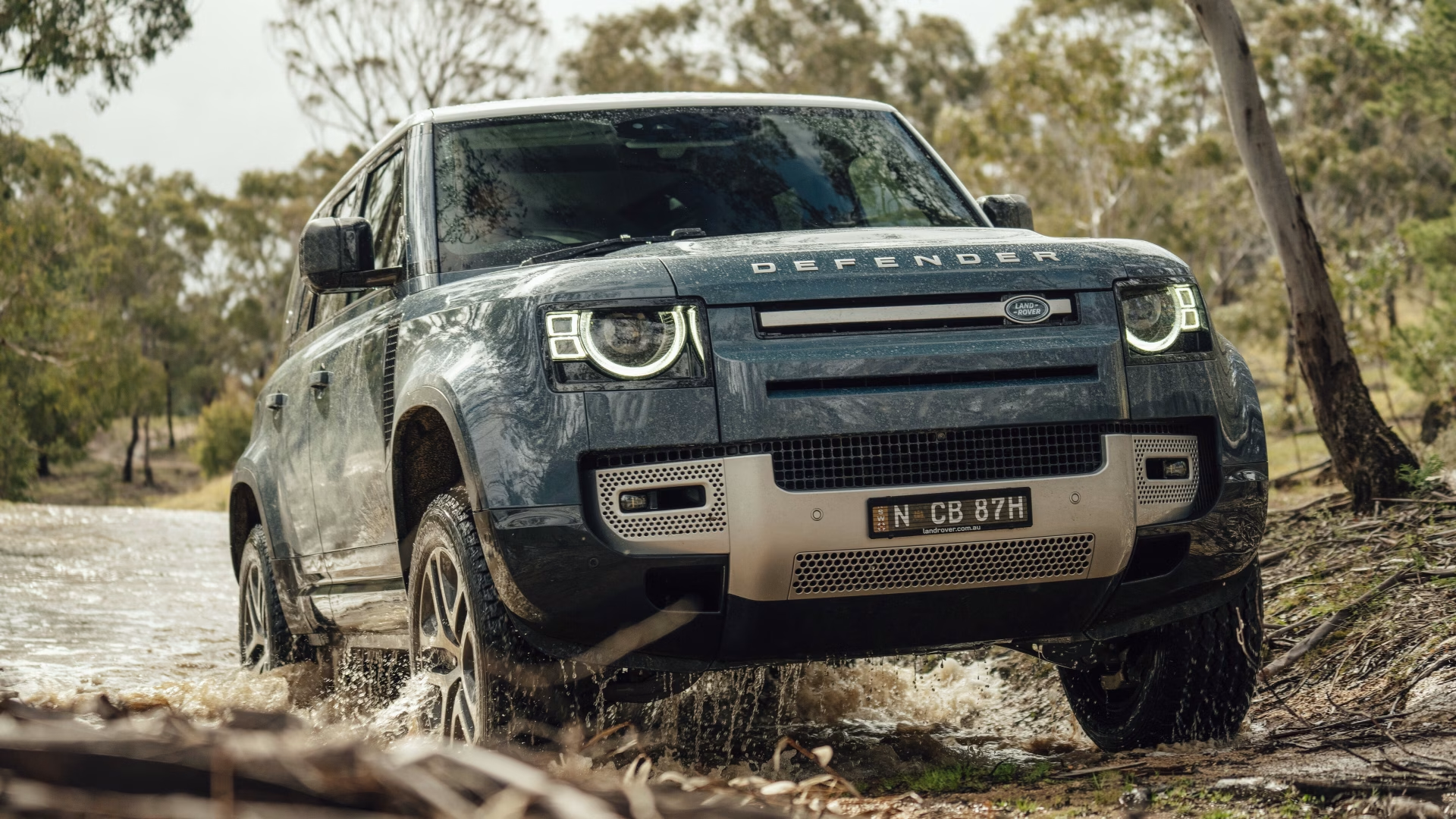
Land Rover: The Best 4x4 By Far

Land Rover was born out of necessity in post-war Britain, using surplus aircraft aluminum to build a farm vehicle that could go anywhere. It evolved into a dual-personality brand: the utilitarian Defender for the explorer, and the aristocratic Range Rover for the elite. It is the gold standard of off-road capability.

Land Rover Hero Vehicle

Model Lineup

Explore the current production vehicles.

Range Rover

The original luxury SUV and the undisputed pinnacle of its class. The Range Rover is the final word in peerless refinement, serene comfort, and formidable all-terrain capability. For over 50 years, it has been the conveyance of choice for royalty, connoisseurs, and adventurers alike.

Production 1970-Present

Range Rover Sport

The dynamic and driver-focused interpretation of the Range Rover legend. The Sport combines a muscular, athletic stance with an engaging, powerful driving experience, delivering a thrilling blend of performance and luxury that is unmistakably Land Rover.

Production 2005-Present

Range Rover Velar

The avant-garde expression of Land Rover design. The Velar is a masterpiece of reductive, minimalist modernism, with its stunning flush door handles and high-tech interior. It is a rolling sculpture that delivers dramatic style and quiet confidence.

Production 2017-Present

Range Rover Evoque

The original luxury compact SUV that started a global design trend. The Evoque distills the essence of Range Rover's sophisticated style and luxury into a chic, city-smart package. It is the definitive fashion-forward statement in its class.

Production 2012-Present

Defender

The icon, reimagined for the 21st century. The new Defender is an unstoppable force of nature, blending legendary, go-anywhere capability with a sophisticated, durable design. Available in 90, 110, and 130 forms, it's the ultimate modern adventure vehicle.

Production 2020-Present

Discovery

The supremely versatile 7-seat family adventure SUV. The Discovery is the Swiss Army knife of the Land Rover lineup, offering clever, stadium-style seating for seven, immense practicality, and the serious off-road capability to take your family anywhere.

Production 1989-Present

Discovery Sport

The smart and capable gateway to the Land Rover family. The Discovery Sport packs versatile 5+2 seating and a premium, adventure-ready spirit into a compact and efficient footprint. It's the perfect, do-it-all luxury SUV for active families.

Production 2015-Present

Classic Defender

The legendary, bare-bones, and utterly unstoppable off-road icon. The original Defender was a simple, rugged, and purely functional tool for exploration, agriculture, and adventure. It is the raw, authentic soul of the Land Rover brand.

Production 1983-2016

Series I, II, III

The vehicles that started it all. Born in the sands of a Welsh beach, the original Land Rover Series vehicles were marvels of simple, robust engineering. They were the unstoppable workhorses that carried the brand's name to the farthest corners of the globe.

Production 1948-1985

LR4 / LR3

The modern interpretation of the classic Discovery. Known as the LR3 and later the LR4 in the US, this generation was celebrated for its immense off-road capability, command driving position, and iconic stepped roof and asymmetrical tailgate.

Production 2005-2016

LR2 / Freelander

The capable and premium compact SUV. The LR2 (Freelander 2 globally) offered the brand's legendary Terrain Response system in a smaller, more fuel-efficient package, proving that a compact unibody SUV could still deliver authentic Land Rover capability.

Production 2007-2015

Author

HugeGarage Editor

Published

Updated

6 Min Read

Born on a Beach

The story of Land Rover is one of the most famous in automotive history. In 1947, Maurice Wilks (chief designer at Rover) sketched a shape in the sand at Red Wharf Bay in Anglesey, Wales. He wanted to build a British replacement for the American Willys Jeep he used on his farm.

The Aluminum Accident

Why are old Land Rovers made of aluminum? It wasn't a high-tech choice; it was desperation.
After WWII, steel was strictly rationed in Britain, but there was plenty of surplus aluminum alloy (known as Birmabright) left over from building fighter planes. This accident of history gave Land Rovers their signature traits: they were lightweight, resistant to rust, and easily dented.

The Defender: The Box on Wheels

For decades, it was just called the "Land Rover" (Series I, II, and III). In 1990, it became the Defender.

  • The Design: It looks like it was drawn with a ruler. The panels were bolted together, meaning you could disassemble the body with basic tools.
  • The Quirks: The driving position is cramped (your elbow hits the window), the heater is a suggestion, and it leaks water. But it is virtually unstoppable off-road.
  • NAS Defenders: In the US, the North American Specification (NAS) Defenders of the 90s are cult objects, selling for six figures.

The Range Rover: The First Luxury SUV

In 1970, Land Rover changed the world again. They realized people wanted off-road capability without the back-breaking ride of a tractor.
They launched the Range Rover. It used coil springs instead of leaf springs and a V8 engine. It was the first car to be exhibited at the Louvre Museum in Paris as an "exemplary work of industrial design." It invented the modern luxury SUV segment.

The Reliability Elephant

Land Rover ownership is a relationship of love and hate. While the mechanical components (axles, transfer cases) are robust, the brand is infamous for electrical gremlins and air suspension failures. There is an old joke: "Why do the British drink warm beer? Because Lucas (the electronics supplier) makes their refrigerators."

The Hugegarage Verdict

Land Rover is capability wrapped in prestige. It is the only vehicle that looks equally at home covered in mud on a sheep farm or valet parked at a Michelin-star restaurant. It projects an image of "Old Money" adventure—the idea that you could cross the Sahara, even if you are just crossing the suburbs.

Frequently Asked Questions

What is the difference between Land Rover and Range Rover?

Land Rover is the brand, while Range Rover is a specific model family within that brand. You can think of it as a hierarchy:

  • Range Rover Family: Focused on luxury and refinement (includes Vogue, Sport, Velar, and Evoque).
  • Discovery Family: Focused on versatility and family adventure.
  • Defender Family: Focused on extreme durability and off-road capability.
Are Land Rovers reliable for long-term ownership?

Land Rover vehicles are complex machines with advanced air suspension and terrain-response electronics. While modern models are much more reliable than those from the 1990s, they are "maintenance-heavy."

Reliability depends strictly on following the service intervals. Using OEM parts and specialized diagnostic tools is crucial, as the brand's sophisticated 4x4 systems require expert calibration to avoid electronic glitches.

What is Terrain Response in Land Rover vehicles?

Terrain Response is a proprietary system that optimizes the engine, transmission, differentials, and chassis to suit the driving surface. By turning a dial, the driver can choose modes like "Grass/Gravel/Snow," "Mud and Ruts," "Sand," or "Rock Crawl."

The system automatically adjusts the ride height and throttle sensitivity to ensure maximum traction without the driver needing to be an expert off-roader.

What does the name "Defender" signify?

The Defender name was introduced in 1990 to distinguish the original utilitarian Land Rover (previously just called the 90 or 110) from the newer Discovery.

It represents the brand's heritage in military and expedition use. The modern L663 Defender continues this legacy but uses an aluminum monocoque instead of the traditional body-on-frame, making it significantly more comfortable on paved roads.

What is a Land Rover Series I, II, or III?

These are the "Series" vehicles produced between 1948 and 1985 before the 90/110/Defender naming took over. They are the British equivalent of the Willys Jeep, featuring leaf springs and simple, robust mechanicals.

They are highly collectible today, especially the Series I, which was famously inspired by a sketch drawn in the sand on a Welsh beach by Maurice Wilks.

What engine is in the new Land Rovers?

Most modern Land Rovers are powered by the Ingenium engine family. This is a modular engine system designed in-house by Jaguar Land Rover (JLR).

It includes 2.0L four-cylinder and 3.0L six-cylinder options, often featuring MHEV (Mild Hybrid Electric Vehicle) technology to improve fuel efficiency and provide smoother stop-start transitions in city traffic.

Why do Land Rovers use aluminum bodies?

Land Rover has used aluminum since 1948, originally because steel was rationed after World War II. Today, it is used for weight reduction and corrosion resistance.

Using aluminum allows a large SUV like the Range Rover to be lighter, which improves handling and fuel economy while preventing the rust issues that plague steel-bodied off-roaders.

What is Land Rover "Wading Depth"?

Wading depth is the maximum depth of water a vehicle can safely drive through. Land Rovers are industry leaders in this area.

The new Defender and Range Rover have a wading depth of up to 900mm (approx. 35.4 inches). They often feature "Wade Sensing" technology, which uses ultrasonic sensors in the door mirrors to alert the driver if the water is getting too deep.

What is the difference between an L405 and L460 Range Rover?

These are internal chassis codes for the flagship Range Rover:

  • L405 (2012-2021): The first all-aluminum unibody Range Rover.
  • L460 (2022-Present): The newest generation, featuring a more minimalist design, improved rear-wheel steering, and a luxury-focused interior with larger curved screens.
Can I use a Land Rover for heavy towing?

Yes, Land Rovers are excellent towing vehicles. Most full-size models like the Discovery and Range Rover have a maximum towing capacity of 3,500kg (7,716 lbs).

They often include Advanced Tow Assist, which allows the driver to steer a trailer using the rotary controller on the center console while watching the path on the surround-view cameras.