Morgan: The Last of the True British Artisans

Morgan is the automotive world's greatest survivor. Building cars by hand in Malvern Link since 1909, they are famous for using ash wood in their construction. But don't be fooled by the retro looks; underneath lie modern BMW engines and bonded aluminum chassis. A Morgan is a blend of pre-war charm and modern performance.

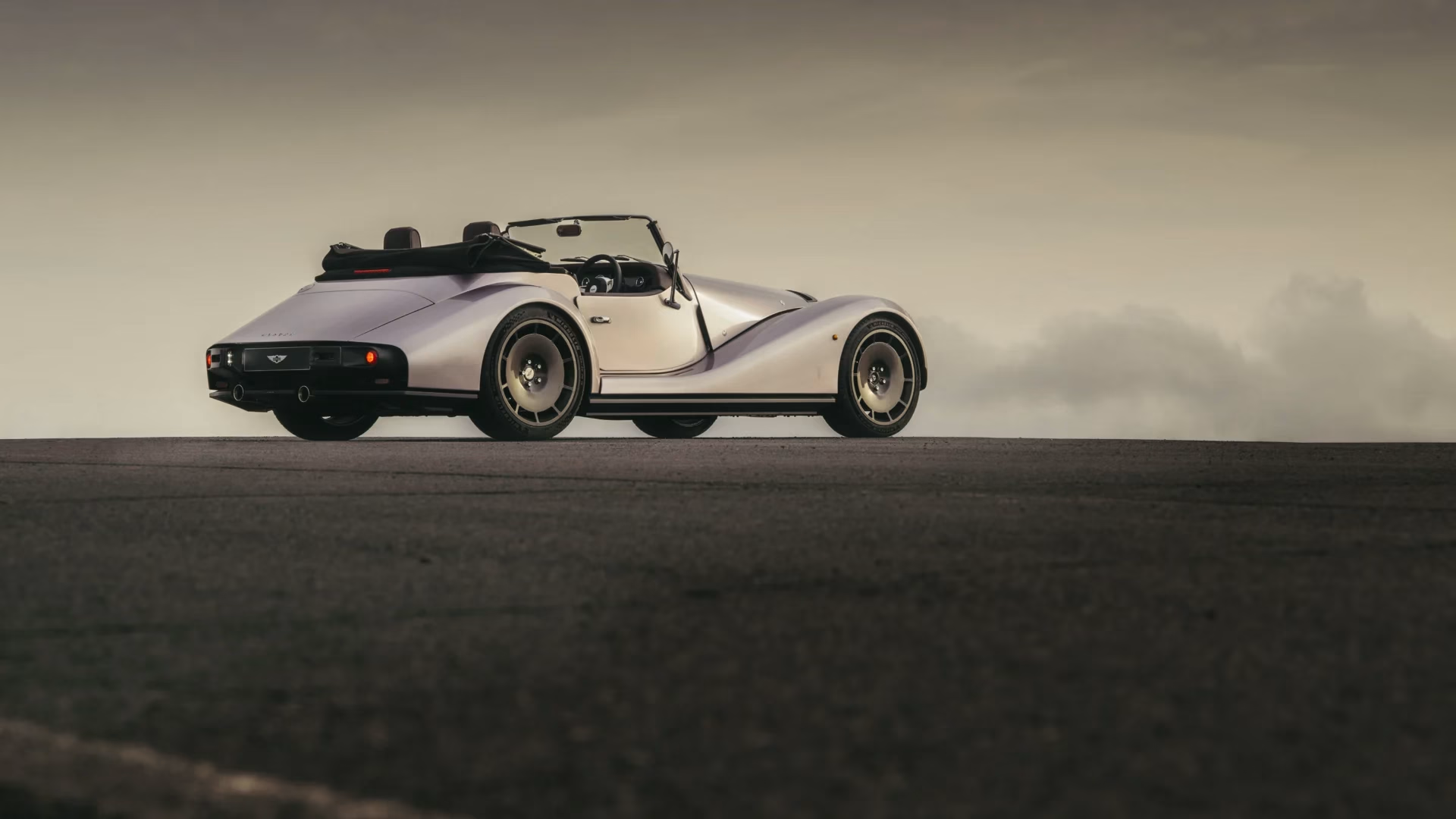
Morgan Hero Vehicle

Model Lineup

Explore the current production vehicles.

Plus Four / Plus Six

The quintessential British roadster, perfected. These cars blend the iconic, hand-formed aluminum-over-ash-wood body with a modern bonded aluminum platform and potent BMW power. It is the ultimate expression of analog driving pleasure in a digital age.

Production 2020-Present

Super 3

The next chapter in three-wheeled freedom. The Super 3 is a radical reimagining of the original, with a jet-age inspired monocoque chassis and a peppy Ford 3-cylinder engine. It’s a modern, more refined, but no less thrilling adventure machine.

Production 2022-Present

3 Wheeler

A glorious anachronism and the purest expression of automotive fun. With its throbbing V-twin engine mounted up front and two skinny front wheels, the 3 Wheeler delivers a visceral, wind-in-your-face, barnstorming experience like nothing else on the road.

Production 2012-2021

Aero 8

The car that rocketed Morgan into the 21st century. The Aero 8 was a radical departure, a lightweight aluminum supercar with a thunderous BMW V8 heart. Its polarizing design and incredible performance made it a true modern classic and a bold statement of intent.

Production 2000-2018

4/4, Plus 4, Plus 8 (Classic)

The legends. For over 80 years, these 'Traditional' models were the unbroken heart of Morgan. From the nimble 4/4 (the longest-running production car in history) to the brutish, V8-powered Plus 8, they are the very soul of British motoring heritage.

Production 1936-2020

Plus 8 GTR

A final, thunderous roar for the traditional V8. The Plus 8 GTR was a limited-edition, track-inspired special, a raw and aggressive tribute to the legendary 'Big Blue' race car of the 90s. The most powerful V8 Morgan ever built.

Production 2021

Author

HugeGarage Editor

Published

Updated

7 Min Read

Time Travel is Possible (And It Smells Like Leather)

If you visit the Morgan factory in Malvern Link, England, you won't see robots welding metal in a spark-filled frenzy. You will see men with chisels working on wood. You will smell sawdust, high-grade leather, and tea. Morgan is an anachronism, a company that refuses to let go of the past—not because they are stubborn, but because they believe they got it right the first time.

For the American driver accustomed to mass-produced appliances, a Morgan is a shock to the system. It is a car that vibrates, smells, and communicates. It has no lane-keep assist, no giant touchscreens, and definitely no "autopilot." It demands your attention. Driving a Morgan isn't just transportation; it is an act of defiance against the digital age.

The Wood Myth: Do They Really Use Trees?

Let’s clear up the biggest misconception about Morgan: They do not have a wooden chassis. If they did, you would die in a crash. The chassis (the part the wheels and engine bolt to) is a high-tech, bonded aluminum platform known as the CX-Generation. It is incredibly stiff and light.

However, the body frame—the structure that supports the aluminum body panels—is indeed made of English Ash wood. Why? Because wood is naturally dampening. It absorbs vibration better than metal, giving the car a unique, compliant ride. Plus, it is tradition. The skills required to shape these curves are passed down through generations. A Morgan is literally coach-built.

The Models: Three Wheels or Four?

Morgan’s lineup is small, eccentric, and brilliant.

The Super 3: The Tricycle of Joy

The Super 3 is the modern successor to the famous 3 Wheeler. It has two wheels in the front, one in the back, and no roof. It is powered by a 1.5L Ford 3-cylinder engine (the "Dragon" engine). It looks like a fuselage from a WWI fighter plane. You don't get in it; you lower yourself into it. Driving it is a visceral experience—wind in your face, bugs in your teeth, and the exhaust pipe right next to your elbow. It is arguably the most fun you can have on public roads at legal speeds.

The Plus Four: The Sweet Spot

The Plus Four looks like it drove out of a 1950s movie, but it is brand new. Under that long, louvred hood sits a 2.0L Turbocharged BMW engine (the B48). Because the car weighs next to nothing (around 2,200 lbs), 255 horsepower makes it fly. 0-60 happens in under 5 seconds. It is agile, quick, and usable enough to drive every day (if you are brave).

The Plus Six: The Hot Rod

If the Plus Four is a sports car, the Plus Six is a muscle car. It takes the same aluminum platform but stuffs a 3.0L Turbocharged BMW inline-six (the B58, same as the Toyota Supra) into the nose. With 335 horsepower, it is terrifyingly fast. It requires respect. It is a gentleman’s racer that can embarrass modern Porsches in a straight line.

The "Replica Car" Law and the USA

For years, getting a new Morgan in the US was impossible due to safety regulations (airbags, crash testing, etc.). However, thanks to the FAST Act (Fixing America's Surface Transportation), Morgan can now import a limited number of "replica" vehicles. This means you can actually buy a brand-new Plus Four in America. The waitlist is long, the deposit is hefty, but the exclusivity is guaranteed.

Buying Advice: You Are Buying a Relationship

Owning a Morgan is different from owning a BMW. You will get wet when it rains (the roof is "optimistic" at best). It will rattle. It will have quirks. But the community is incredible. Morgan owners wave to each other. They stop to talk at gas stations. They wear leather helmets without irony.

If you want a car that works perfectly every time, buy a Lexus. If you want a car that makes you feel like a pilot from the golden age of motoring every time you turn the key, there is only one choice. Discover Morgan.

Frequently Asked Questions

Are Morgan cars really made of wood?

Yes and no. A common misconception is that the chassis is wooden, but that is not true. Every Morgan features a hand-formed ash wood frame that sits on top of a metal chassis.

Morgan uses ash because it is lightweight, durable, and highly flexible, which helps absorb vibrations. This traditional coachbuilding technique has been used in Malvern for over a century, making every Plus Four and Plus Six a unique blend of nature and engineering.

What is the Morgan CX-Generation platform?

The CX-Generation is Morgan’s modern bonded aluminum platform introduced in 2019. It replaced the traditional steel ladder chassis used for decades.

This advanced architecture provides twice the torsional rigidity of previous models while remaining incredibly light (the chassis itself weighs just 97kg). This allows modern Morgans to handle with the precision of a contemporary sports car while maintaining their classic 1930s silhouette.

Which engines are used in modern Morgan cars?

Modern Morgan sports cars utilize high-performance powertrains from BMW and Ford:

  • Plus Four: Powered by a 2.0L BMW TwinPower Turbo inline-four engine.
  • Plus Six: Powered by the legendary 3.0L BMW B58 straight-six engine.
  • Super 3: Powered by a 1.5L naturally aspirated three-cylinder Ford engine.
What is the Morgan Super 3?

The Super 3 is Morgan’s modern three-wheeled vehicle, succeeding the famous 3 Wheeler. Unlike its predecessor which had an exposed V-twin engine, the Super 3 features an inboard Ford engine and a jet-age inspired design.

It uses an aluminum monocoque structure and is designed for pure, visceral driving fun. Its unique "sideblades" serve as both aerodynamic air ducts for cooling and mounting points for custom luggage bags.

Are Morgan cars still handmade in the UK?

Every single Morgan is hand-assembled at the historic factory on Pickersleigh Road in Malvern, England, where they have been built since 1914.

The production process involves master craftspeople working in three core departments: the Saw Shop (woodwork), the Tin Shop (aluminum body panels), and the Trim Shop (leather interiors). It takes several weeks of manual labor to complete a single vehicle.

Who owns the Morgan Motor Company today?

Since 2019, the majority shareholder of Morgan Motor Company is Investindustrial, a European private equity group (which also has history with Aston Martin and Ducati).

Crucially, the Morgan family continues to retain a minority shareholding and remains actively involved in the business, ensuring that the brand’s 110-year-old heritage and traditional values are preserved as they move toward electrification.

Do Morgan cars have modern safety features?

Despite their vintage appearance, current models are engineered with modern safety in mind. The Plus Four and Plus Six include ABS (Anti-lock Braking System), electronic stability control, and driver/passenger airbags.

The CX-Generation aluminum platform also features dedicated crash structures and crumple zones that meet modern European and US safety standards, a significant leap forward from the "traditional" steel-chassis Morgans.

How long is the waiting list for a new Morgan?

Historically, Morgan was famous for waiting lists that could stretch to 10 years. Today, thanks to modernized production techniques in the Malvern factory, the wait time is much shorter, typically ranging from 6 to 12 months.

However, because each car is built to order with over 40,000 potential paint colors and infinite leather combinations, the time depends heavily on the complexity of the customer’s bespoke specification.

What is the Morgan XP-1?

The XP-1 is Morgan’s experimental all-electric prototype based on the Super 3 platform. It serves as a laboratory for testing electric powertrains, battery packaging, and regenerative braking.

While Morgan has not yet released a production EV, the XP-1 signals the brand’s commitment to sustainable motoring while promising to maintain the lightweight "joy of driving" that defines their combustion cars.

Do Morgan cars hold their value?

Morgan cars are renowned for having some of the highest residual values in the automotive industry. Due to their limited production (roughly 800-900 cars per year) and timeless design, they rarely suffer from the steep depreciation seen in mass-produced luxury cars.

Vintage models, especially those with rare specifications or racing history, are considered blue-chip investments among British car collectors.