Oldsmobile: The Engineering Soul of General Motors

Oldsmobile was the bedrock of GM. Founded in 1897, it was the oldest American marque when it folded. From inventing the automatic transmission to birthing the muscle car era with the Rocket 88, Olds was the "Engineering Division." It was the perfect blend of speed and comfort until its heartbreaking end in 2004.

Oldsmobile Hero Vehicle

Model Lineup

Explore the current production vehicles.

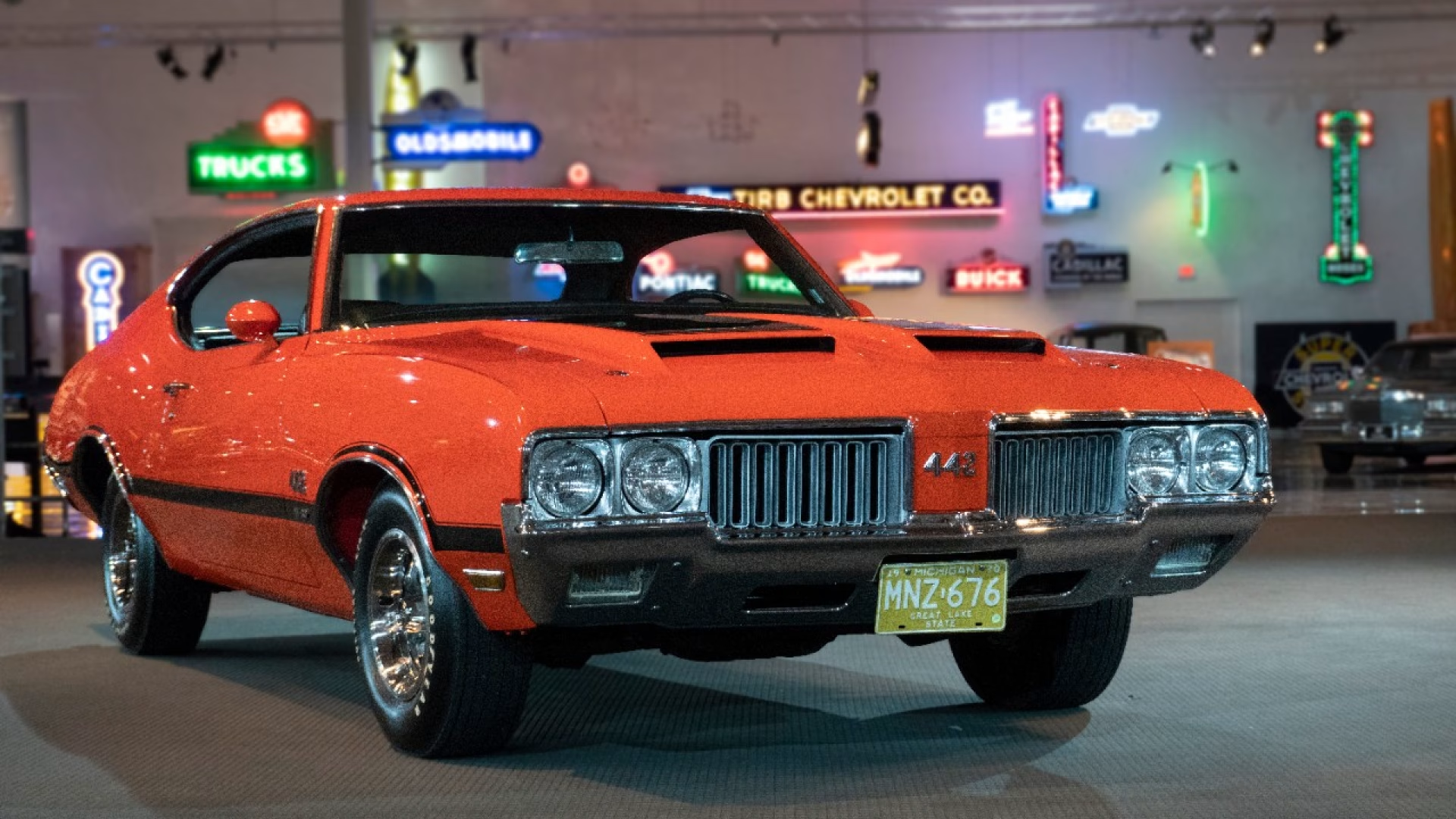
Cutlass / 442

The heart of the brand and an icon of the muscle car era. The Cutlass was America's best-selling car in the 70s, but its legendary 442 (4-barrel carb, 4-speed manual, dual exhaust) variant was a tire-shredding, gentleman's hot rod. A true legend.

Production 1961-1999

Hurst/Olds

The ultimate expression of Oldsmobile muscle. A special collaboration with Hurst Performance, these were limited-edition, big-block monsters in distinctive paint schemes. With features like the 'His/Hers' shifter, they were the pinnacle of gentlemanly brute force.

Production Various years, 1968-1984

Aurora

The car that was meant to reinvent Oldsmobile. The Aurora was a stunning, futuristic luxury sedan with a smooth, powerful V8 engine derived from a Cadillac. It was a bold and sophisticated statement that defined the brand's final chapter.

Production 1995-2003

Toronado

A revolutionary engineering masterpiece. The original Toronado was a massive personal luxury coupe that shocked the world with its groundbreaking front-wheel-drive system, proving FWD could handle big V8 power. An icon of 60s innovation.

Production 1966-1992

88 / Rocket 88

The car that arguably started the muscle car craze. The 1949 Rocket 88 put a powerful, high-compression overhead-valve V8 in a smaller body, creating a sensation on the streets and on the NASCAR track. The song 'Rocket 88' is often called the first rock-and-roll record.

Production 1949-1999

98 (Ninety-Eight)

The flagship of Oldsmobile luxury for over 50 years. The Ninety-Eight was the top-of-the-line model, a large and comfortable sedan that showcased the brand's latest technology and most opulent features. The definitive statement of traditional American luxury.

Production 1941-1996

Alero

The final compact from the Oldsmobile brand. The Alero was a stylish and sporty coupe and sedan that aimed to bring a more international flavor to the lineup, representing the brand's last effort to attract a younger generation of buyers.

Production 1999-2004

Intrigue

The critically acclaimed mid-size sedan that was a true import fighter. The Intrigue was a sharp-handling and sophisticated car that was praised for its European-inspired dynamics, representing the best of Oldsmobile's modern engineering.

Production 1998-2002

Bravada

The first-ever luxury SUV from an American manufacturer. The Bravada was a pioneer, offering a more luxurious and comfortable version of its GM siblings, featuring the innovative 'SmartTrak' automatic all-wheel-drive system.

Production 1991-2004

Silhouette

Dubbed the 'Cadillac of Minivans.' The Silhouette was a futuristic and luxurious take on the family hauler, known for its distinctive 'dustbuster' styling in the first generation and a host of innovative features in the second.

Production 1990-2004

Curved Dash

The first mass-produced automobile in history. Predating the Ford Model T, the Curved Dash was a revolutionary vehicle with its tiller steering and simple design, establishing Oldsmobile as one of the founding fathers of the entire automotive industry.

Production 1901-1907

F-85 Jetfire

A true pioneer of performance. The Jetfire was the world's first turbocharged production car, alongside the Corvair Monza Spyder. Its 'Turbo-Rocket' V8 used a wild methanol/water injection system, a glimpse into the future of automotive engineering.

Production 1962-1963

Starfire

A stunning personal luxury convertible and coupe. The Starfire was a top-of-the-line model that combined bucket seats, a center console, and a powerful V8, making it one of the earliest and most stylish predecessors to the muscle car era.

Production 1961-1966

Vista Cruiser

The iconic station wagon with the glass roof. The Vista Cruiser was the ultimate family road-trip machine, famous for its unique raised roof with tinted glass panels and a forward-facing third row of seating. A true symbol of 60s and 70s Americana.

Production 1964-1977

Author

HugeGarage Editor

Published

Updated

7 Min Read

The Rocket That Ran Out of Fuel

There is a tragedy in the story of Oldsmobile. Towards the end, it became the punchline of a joke—"This is not your father's Oldsmobile"—a desperate plea from a dying brand. But for the vast majority of its 107-year life, Oldsmobile was the technological powerhouse of General Motors. It was the brand for the man who wanted a Cadillac's technology but a Chevrolet's reliability.

Founded by Ransom E. Olds in 1897, this brand did more for the automotive industry than almost any other. They didn't just build cars; they advanced the species.

1940: The Death of the Clutch Pedal

If you hate traffic jams, you owe Oldsmobile a thank you card. In 1940, they introduced the Hydra-Matic, the world’s first mass-produced fully automatic transmission. Before this, driving was manual labor. Oldsmobile made it effortless. This cemented their reputation as the "Engineering Division" of GM, a title they held for decades.

1949: The First Muscle Car?

Historians argue about what the first "Muscle Car" was. The Pontiac GTO made the term famous in 1964, but the 1949 Oldsmobile Rocket 88 wrote the recipe. Oldsmobile engineers took their large, powerful "Rocket" V8 engine and dropped it into their smallest, lightest body shell. The result was a car that dominated NASCAR so thoroughly that it became the first "King of the Road." It inspired the first rock and roll song ("Rocket 88" by Jackie Brenston). It was fast, loud, and undeniably American.

The 4-4-2: The Doctor is In

In the 1960s, Oldsmobile unleashed the 442. The numbers originally stood for: 4-Barrel Carburetor, 4-Speed Transmission, and 2 Exhausts. While the GTO was raw and rowdy, the 442 was the "gentleman’s hot rod." It had balanced handling (thanks to sway bars others didn't have) and an interior that felt like a lounge.

But don't let the comfort fool you. The W-30 package 442s were street brawlers. And then there was the Hurst/Olds, with its iconic "Dual Gate" shifter (the "His and Hers" shifter), allowing the driver to slap through gears manually or leave it in drive. It proved that an automatic could be just as fun as a stick shift.

The Toronado: Engineering Audacity

In 1966, Oldsmobile did something crazy. They built a massive, personal luxury coupe with a 7.0-liter (425 cubic inch) V8 engine, but they made it Front-Wheel Drive. This was the Toronado. At the time, FWD was for tiny economy cars. Putting 385 horsepower to the front wheels of a 4,500-pound land yacht was considered impossible.

Oldsmobile did it anyway. The result was a design icon with hidden headlights and a flat floor (no transmission tunnel!). It drove through snow like a tank and looked like a spaceship. It remains one of the most daring designs GM ever produced.

The Cutlass Phenomenon

By the late 1970s and early 80s, the Oldsmobile Cutlass Supreme wasn't just a car; it was the car. For years, it was the best-selling vehicle in America. It was the uniform of the middle class—reliable, stylish, comfortable, and respectable. If you grew up in the 80s, your neighbor had a Cutlass. Your teacher had a Cutlass. You probably learned to drive in a Cutlass.

The Long Goodbye

So, what went wrong? As GM moved into the 90s, the lines between brands blurred. An Oldsmobile started to look and feel exactly like a Buick or a Pontiac. They lost their "Rocket" identity. They tried to save it with the Aurora in 1995—a fantastic, modern sedan that was genuinely world-class—but the damage was done. The younger generation had moved to imports, and the older generation had moved on.

In 2004, the last Oldsmobile (an Alero) rolled off the line, ending a 107-year run. But at Hugegarage, we remember the glory days. We remember the smell of unburned hydrocarbons from a 455 big block, the whine of a Hydra-Matic, and the sheer presence of a Toronado.

The Hugegarage Verdict

Oldsmobile represents a time when engineering led the way. They weren't afraid to try new things, even if they were risky. They democratized power and luxury. Today, an Oldsmobile 442 W-30 is blue-chip investment grade muscle, a reminder that the "gentleman" could also throw a knockout punch.

Frequently Asked Questions

When and why did Oldsmobile go out of business?

Oldsmobile ceased production on April 29, 2004. It was the oldest surviving American car brand at the time (founded in 1897).

General Motors shut it down due to an identity crisis and declining sales. Squeezed between Chevrolet (mass market) and Buick (premium luxury), Oldsmobile struggled to find a younger audience despite the famous "This is not your father's Oldsmobile" ad campaign, leading to the decision to phase out the brand.

What does "4-4-2" stand for on an Oldsmobile?

The meaning of 4-4-2 refers to the specific performance upgrades on the original 1964 model:

  • 4: Four-Barrel Carburetor.
  • 4: Four-Speed Manual Transmission.
  • 2: Dual Exhausts.

While the definition shifted slightly in later years (sometimes referring to 400 cubic inches), the "4-4-2" remains one of the most iconic badges in the golden era of muscle cars.

What is the Oldsmobile "Rocket" V8?

Introduced in 1949, the Rocket 88 engine is legendary for launching the American horsepower race. It was a high-compression, overhead valve (OHV) V8 engine.

Because it was powerful and placed in a relatively light body (the Olds 88), it dominated NASCAR in the early 1950s and became a cultural icon, even inspiring the first rock and roll song, "Rocket 88."

Why is the Oldsmobile Toronado historically significant?

The 1966 Oldsmobile Toronado was an engineering marvel. It was the first mass-produced American car with Front-Wheel Drive (FWD) since the Cord 810 of the 1930s.

Engineers developed the "Unitized Power Package" (UPP), placing the engine and transmission side-by-side. This system was so robust that it was later used to power the GMC Motorhome. It proved that FWD could handle the torque of a massive V8 engine.

Is a Cutlass Supreme a good collector car?

Yes, specifically the Cutlass Supreme models from the late 60s to the early 80s. For a time, the Cutlass was the best-selling car in America.

While millions were made, finding clean, rust-free examples is getting harder. The Hurst/Olds and 442 variants command high prices, but a standard V8 Cutlass coupe offers an affordable entry point into classic GM ownership with excellent parts availability.

What is the Hurst/Olds?

The Hurst/Olds was a special edition collaboration between Oldsmobile and Hurst Performance (famous for their shifters).

Oldsmobile would ship cars to a third-party facility where Hurst installed special "Dual Gate" shifters, gold striping, and unique spoilers. These cars were often used to bypass GM's corporate ban on engines larger than 400 cubic inches in mid-size cars, making them some of the fastest Oldsmobiles ever built.

What was the Oldsmobile Aurora?

The Aurora (launched in 1995) was Oldsmobile's last great attempt to reinvent itself as a high-tech import fighter.

It featured a futuristic unibody structure (so stiff it broke GM's testing equipment) and a sophisticated 4.0L DOHC V8 engine derived from the Cadillac Northstar. It was praised for its engineering but couldn't single-handedly reverse the brand's declining image.

Are Oldsmobile engines different from Chevy engines?

Historically, yes. Until the late 1970s, Oldsmobile designed and manufactured its own V8 engines (350, 403, 455).

Olds engines generally had a higher nickel content in the block (making them stronger) and were designed for low-end torque rather than high-RPM horsepower like a Chevy. However, in the late 70s, GM began putting Chevy engines in Oldsmobiles, leading to a famous consumer protection lawsuit.

What was the final car made by Oldsmobile?

The final vehicle to roll off the assembly line was an Oldsmobile Alero GLS in a special "Dark Cherry" metallic paint.

It was part of the "Final 500" collector series, which featured special badging and embroidery. That final car was signed by the factory workers in Lansing, Michigan, and was sent directly to the R.E. Olds Transportation Museum.

Did Oldsmobile invent the speedometer?

Oldsmobile was a pioneer of many technologies. While they didn't invent the concept, they were the first manufacturer to offer a speedometer as a standard feature on a mass-produced car (the 1901 Curved Dash Olds).

They were also the first to introduce chrome plating (1926) and the first to offer a fully automatic transmission (the Hydra-Matic) in 1940.