Pagani: When Da Vinci Builds a Hypercar

Pagani is not a car manufacturer; it is an art studio that happens to build vehicles. Founded by Horacio Pagani, who left Lamborghini to pursue his vision of carbon fiber perfection, the brand produces the Zonda, Huayra, and Utopia. Powered by custom Mercedes-AMG V12s, they represent the absolute intersection of art and science.

Origin: Italy
Est. 1992
Pagani Hero Vehicle

Model Lineup

Explore the current production vehicles.

Utopia

The third act in the Pagani saga, a masterpiece of analog engagement. The Utopia is a tribute to timeless design and pure driving, featuring a bespoke Mercedes-AMG twin-turbo V12 and, incredibly, a gated manual transmission option. The art of performance, perfected.

Production 2023-Present

Huayra

Named after the Andean god of wind, the Huayra is a masterpiece of active aerodynamics and obsessive detail. With its gullwing doors and twin-turbo V12, it's a technological tour de force. The final Huayra R is a screaming, track-only tribute to pure sound.

Production 2011-2022

Zonda

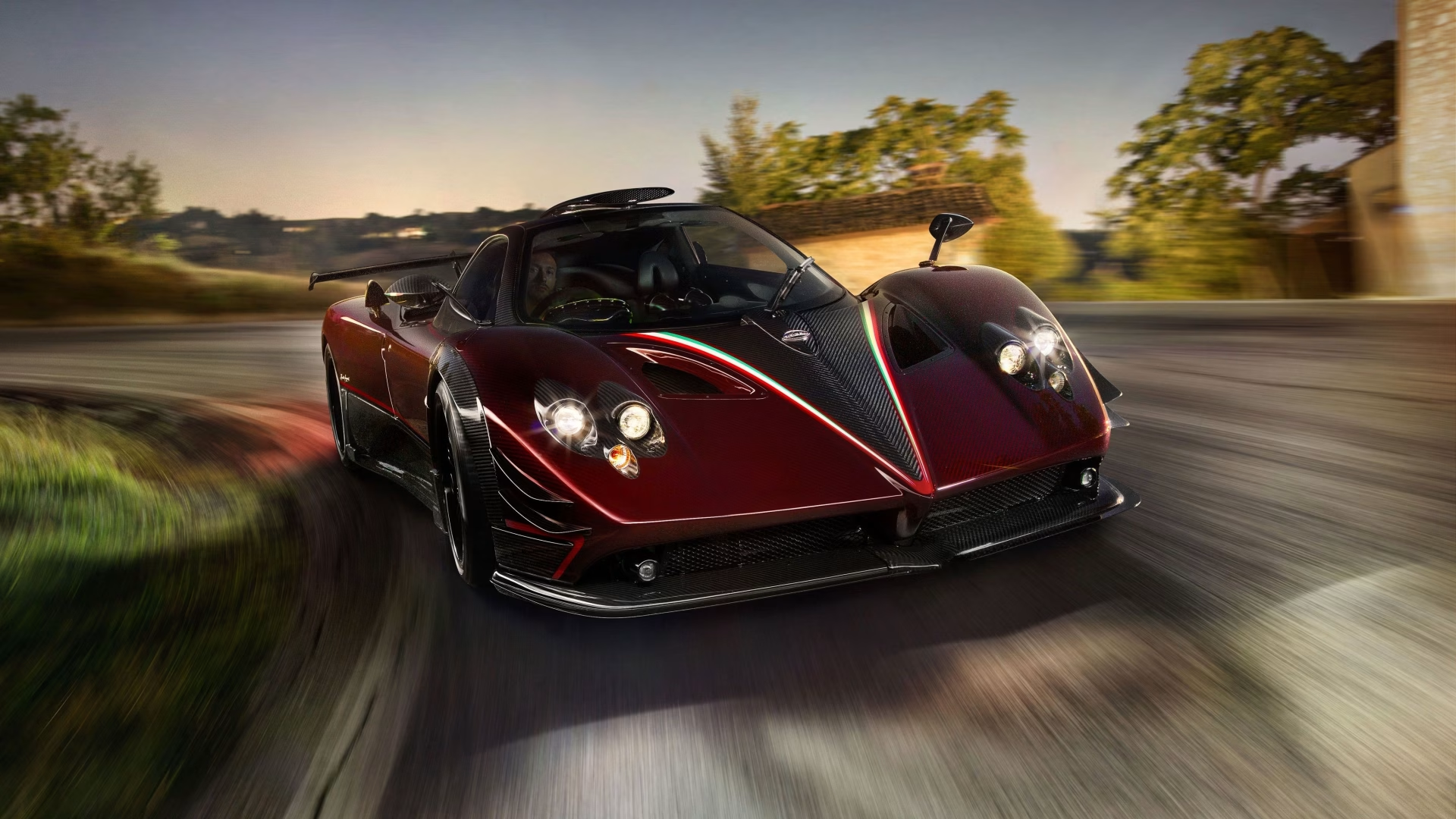
The car that started the legend. The Zonda was a shocking debut, a carbon-fiber work of art with a screaming, naturally aspirated Mercedes-AMG V12 and an alien-like design. It redefined the hypercar and remains one of the most beloved icons in history.

Production 1999-2019

Imola

A brutal, track-focused, and incredibly rare version of the Huayra. Limited to just five cars, the Imola is a showcase of Pagani's latest aerodynamic and performance technology, a true monster designed to conquer the legendary Italian racetrack.

Production 2020

Codalunga

A 'longtail' tribute to the legendary Le Mans racers of the 1960s. The Codalunga is a bespoke, exquisitely crafted version of the Huayra, an exercise in aerodynamic elegance and ultimate exclusivity. A rolling piece of automotive haute couture.

Production 2022

Zonda R

The ultimate, untamed expression of the Zonda. The Zonda R was a track-only, carbon-fiber beast that shared almost nothing with the road car, built with a screaming, F1-derived V12. It is pure, unfiltered sound and fury, a true work of performance art.

Production 2009-2011

Zonda Cinque

The 'street-legal Zonda R.' Limited to five coupes and five roadsters, the Zonda Cinque was the first Pagani to use the carbo-titanium tub, a breathtakingly rare and desirable model that brought the raw intensity of the track car to the road.

Production 2009

Author

HugeGarage Editor

Published

Updated

6 Min Read

The Man Who Left Lamborghini Over an Oven

The story of Pagani begins with a disagreement. Horacio Pagani was a chief engineer at Lamborghini in the 80s. He begged them to buy an autoclave (a giant oven) to manufacture carbon fiber parts. Lamborghini refused, saying, "Ferrari doesn't use autoclaves, so we don't need one."

Horacio famously borrowed money, bought his own autoclave, and then quit to start his own company. Today, Pagani is the undisputed master of carbon fiber (even inventing "Carbotanium," a weave of titanium and carbon), while Lamborghini plays catch-up.

The Zonda: The Forbidden Fruit

The Zonda (launched in 1999) is the car that put Pagani on the map. With a design inspired by Group C race cars and jet fighters, it looked like nothing else.

For US enthusiasts, the Zonda was a tragedy. It was never legally sold in the United States because Pagani couldn't afford the crash testing (he couldn't bear to destroy a $500,000 chassis). The only way to own one in the US is under the "Show and Display" exemption, which limits you to 2,500 miles a year. This scarcity has made it a mythical creature on American roads.

The Huayra: Steampunk Science

The Huayra (2011) was the first Pagani fully legalized for the US market. It is famous for two things:

  1. Active Aerodynamics: It has four flaps (two front, two rear) that move independently like airplane ailerons to keep the car flat in corners. It looks like the car is alive.
  2. The Interior: While Ferrari interiors look like race cockpits, the Huayra looks like a Swiss watch exploded. The gear linkage is exposed metal, the gauges look like steampunk jewelry, and every switch makes a satisfying mechanical "click."

The Heart of the Beast: AMG V12

Pagani does not build engines. Instead, they have a handshake deal with Mercedes-AMG. Every Pagani is powered by a twin-turbo V12 engine built by one man in Germany specifically for Horacio. It provides effortless, locomotive-like power.

The $100,000 Bolts

Why does a Pagani cost $3 million? Look at the bolts. Every single titanium bolt on the car is custom-made, laser-etched with the Pagani logo. The set of bolts alone costs roughly $80,000 to $100,000. Horacio Pagani believes that a car should be beautiful even where you can't see it.

Owning a Pagani isn't about speed (a Tesla Plaid is faster to 60 mph). It is about owning a sculpture that you can drive to dinner.

Frequently Asked Questions

What are the performance specs of the 2026 Pagani Utopia?

The Pagani Utopia is the successor to the Huayra and represents a return to "analog" driving. It is powered by a 6.0L twin-turbo V12 engine developed by Mercedes-AMG, producing 852 horsepower and 811 lb-ft of torque.

For US collectors, the most significant feature is the choice of a 7-speed manual transmission or an automated manual. With a dry weight of just 2,822 lbs, the Utopia emphasizes mechanical purity over hybrid complexity, achieving 0-60 mph in approximately 3 seconds while maintaining a top speed of 220 mph.

Is the Pagani Zonda C12 legally road-legal in the USA in 2026?

Yes, as of 2026, early examples of the Pagani Zonda C12 (manufactured in 1999 and 2000) have officially reached the 25-year import rule threshold. This means they are now exempt from DOT safety and EPA emissions standards.

While previously restricted under "Show or Display" permits to 2,500 miles per year, these vintage Zondas can now be imported, registered, and driven without mileage restrictions in most US states, making them highly desirable assets for American JDM and Euro-hypercar collectors.

What is the price of the Pagani Utopia Roadster in the United States?

The Pagani Utopia Roadster, making its major US debut in 2026, carries an MSRP of approximately $3.4 million. Production is strictly limited to 130 units worldwide, and most are sold to existing Pagani clients long before they reach American shores.

Despite the removable hardtop, the Roadster maintains the same weight as the Coupe and features the signature "butterfly" doors, a technical marvel achieved through the use of advanced Carbo-Titanium and Carbo-Triax composite materials.

What is the Pagani Huayra R Evo track hypercar?

The Huayra R Evo is Pagani’s most extreme track-only machine, debuting as an evolution of the Huayra R. It features a naturally aspirated V12-R Evo engine producing 900 horsepower and 568 lb-ft of torque.

Designed for the "Arte in Pista" program, it allows US owners to participate in exclusive track events at circuits like Laguna Seca or COTA. It features a "long-tail" aerodynamic design and a removable roof—a rarity for track cars—without sacrificing the 2,336 lb dry weight.

Does Pagani offer a factory maintenance program in the USA?

Yes, Pagani provides specialized support through Pagani North America and its authorized service centers in cities like Miami, Beverly Hills, and Greenwich. Every Pagani undergoes a rigorous annual service to maintain its warranty and resale value.

Service typically includes 12-month fluid changes, mechanical inspections, and software updates for the active aerodynamics. Due to the car’s complexity, many US owners utilize the "Flying Rangers" program—factory-trained technicians who travel directly to the owner's collection to perform maintenance.

How does Pagani’s "Grandi Complicazioni" program work?

The Grandi Complicazioni (Grand Complications) department is Pagani’s ultra-exclusive customization division. It allows American clients to co-design one-off or extremely limited-series cars, such as the Huayra Codalunga.

Clients work directly with Horacio Pagani and his team in Italy to select bespoke materials, unique paint finishes, and even structural modifications. This results in vehicles that are not just cars but individually commissioned artworks, often doubling or tripling in value on the secondary US market.

What is Carbo-Titanium and why does Pagani use it?

Carbo-Titanium is a patented composite material used in the monocoque of the Utopia and Huayra. It weaves carbon fiber strands with titanium wire, combining the lightness of carbon with the tensile strength of titanium.

For US owners, this means the car has an incredibly rigid safety cell that does not shatter upon high impact like traditional carbon fiber. This material is a key reason why Pagani can meet strict safety requirements while maintaining a dry weight significantly lower than most modern supercars.

What are the transmission options for the Pagani Utopia in the US?

Responding to enthusiast demand, Pagani offers two distinct gearbox options for the Utopia:

  • 7-Speed Manual: A traditional gated shifter for the ultimate analog connection.
  • 7-Speed Automated Manual: An Xtrac-developed unit that is lighter and faster than a dual-clutch transmission.

Most American orders for the Utopia have opted for the manual transmission, as it is increasingly rare in the hypercar segment and is expected to drive higher long-term collectability.

How does Pagani active aerodynamics work on the Huayra?

The Huayra features four independently controlled aero flaps (two on the hood, two on the rear). These flaps are managed by a dedicated ECU that monitors speed, yaw rate, lateral acceleration, and steering angle.

By adjusting these flaps in milliseconds, the car can increase downforce on the inner side during cornering to counteract body roll or act as an air brake during high-speed stops on long American highway stretches, providing unmatched stability at speeds over 200 mph.

What is the resale value of Pagani vehicles in the United States?

Pagani vehicles are among the highest-performing assets in the automotive world. Due to extremely low production volumes (typically 30–40 cars per year), most models sell for 2x to 3x their original MSRP on the secondary market.

In 2026, Zonda and Huayra models frequently fetch between $4 million and $10 million at US auctions like RM Sotheby’s or Gooding & Company, especially if they have documented service history from an authorized Pagani center.