
The Strategic Brilliance of Dual Production
Automakers rarely keep a previous-generation vehicle in active production once the successor hits the assembly line. Tooling costs remain high, and marketing two overlapping vehicles risks confusing the consumer base. Ram engineers aggressively rejected this conventional wisdom. When the all-new DT-generation truck launched in 2019, the brand made the highly unorthodox, massively successful decision to keep the outgoing DS-generation truck in production, rebranding it simply as the Ram 1500 Classic. This maneuver precisely targeted a specific demographic: fleet operators, budget-conscious contractors, and truck purists who demanded a proven, straightforward machine without the complex mild-hybrid systems and massive digital touchscreens dominating the modern market. The Classic served as an industrial bridge, preserving traditional muscular styling and raw mechanical simplicity.
The Anatomy of the DS Platform
The foundation of the Ram 1500 Classic is the revered DS platform, originally introduced to the market for the 2009 model year. This chassis fundamentally altered the trajectory of the American full-size pickup. Engineers abandoned the archaic, traditional stamped steel C-channel frame, opting instead for a fully hydroformed tubular architecture. High-pressure fluid forced heavy-gauge steel tubes into complex, geometrically optimized shapes. The resulting frame resisted torsional twisting under heavy payloads far better than its rigid contemporaries. A stiffer foundation allowed the suspension to focus purely on absorbing impacts rather than compensating for violent chassis flex over broken pavement.
The exterior styling retained the aggressive, semi-truck-inspired crosshair grille, a visual signature that cemented the brand's identity across the American highway system. Designers sculpted the massive steel hood with a distinct forward rake. This sweeping profile actively channels turbulent air smoothly over the windshield wipers, significantly reducing aerodynamic drag and minimizing acoustic wind noise inside the cabin. A subtle, integrated aerodynamic spoiler on the top lip of the steel tailgate extends the low-pressure wake zone behind the truck, smoothing out the airflow as it detaches from the vehicle. These adjustments dramatically improved efficiency, proving that a brick-shaped work vehicle can still cheat the wind.
Powertrain Engineering: The Proven Iron
Under the expansive hood, the Classic relied on the most battle-tested engines in the corporate arsenal. Buyers managing commercial fleets frequently selected the 3.6-liter Pentastar V6. This all-aluminum block utilizes dual overhead camshafts and variable valve timing to balance urban fuel efficiency with adequate pulling power. The true soul of the Classic rested entirely in the legendary 5.7-liter Hemi V8.
Displacing an impressive 5,654 cm3, this cast-iron block, aluminum-head OHV monster produced an explosive 395 horsepower and 410 lb-ft of torque. Engineers optimized the hemispherical combustion chambers to ensure a clean, rapid fuel burn. This specific geometry generates massive low-end grunt essential for pulling heavy double-axle trailers from a dead stop. To address highway efficiency without sacrificing displacement, the Hemi utilized a sophisticated Multi-Displacement System. Under light load conditions, such as steady-state interstate cruising, the engine control unit instantly deactivates fuel injection and spark to four of the eight cylinders. This effectively turns the massive V8 into a four-cylinder air pump, drastically reducing CO2 emissions and improving MPG. Pin the throttle to merge, and all eight cylinders instantaneously re-engage with a visceral, unapologetic roar.
Mastering the Drivetrain and Thermal Dynamics
The TorqueFlite 8-speed automatic transmission serves as the critical mechanical link between the high-output engine and the axles. This advanced gearbox features over 40 individual shift maps. The onboard transmission control module continuously monitors throttle position, ambient temperature, longitudinal acceleration, and trailer weight to select the absolute perfect gear. First gear utilizes an aggressive 4.71:1 ratio, multiplying torque massively to launch a heavy payload off the line without straining the torque converter. Overdrive gears drop engine speed drastically on the highway, reducing thermal buildup and maximizing fuel conservation.
Power routes through an available BorgWarner part-time transfer case. Drivers navigate hazardous conditions by shifting between two-wheel drive and four-wheel drive high on the fly at speeds up to 55 mph. This action mechanically locks the front and rear driveshafts together, providing the absolute traction required to conquer deep snowdrifts or slick, muddy job sites.
Revolutionizing the Ride: The Five-Link Coil Suspension
The defining engineering achievement of the Classic rests in its rear suspension geometry. For decades, the domestic truck market relied exclusively on rigid steel leaf springs. While they handled static weight adequately, they delivered a punishing, jittery ride when the bed was completely empty.
The decision to implement a class-exclusive five-link coil-spring rear suspension on the DS platform forced competing manufacturers in Detroit to completely reevaluate how a heavy-duty work vehicle should behave on public highways.
This sophisticated setup uses heavy-duty trailing arms to maintain strict longitudinal axle positioning and eliminate wheel hop during hard acceleration. A massive transverse steel Panhard rod handles lateral cornering forces, keeping the solid axle perfectly centered under the chassis through aggressive curves. Heavy-duty coil springs replace the archaic steel leaves, providing a ride quality that mirrors a large European sport utility vehicle rather than an agricultural implement. The truck tracks straight over highway expansion joints and absorbs high-speed washboard dirt road impacts with absolute, unshakeable composure.
The Warlock Revival: Aggressive Factory Customization
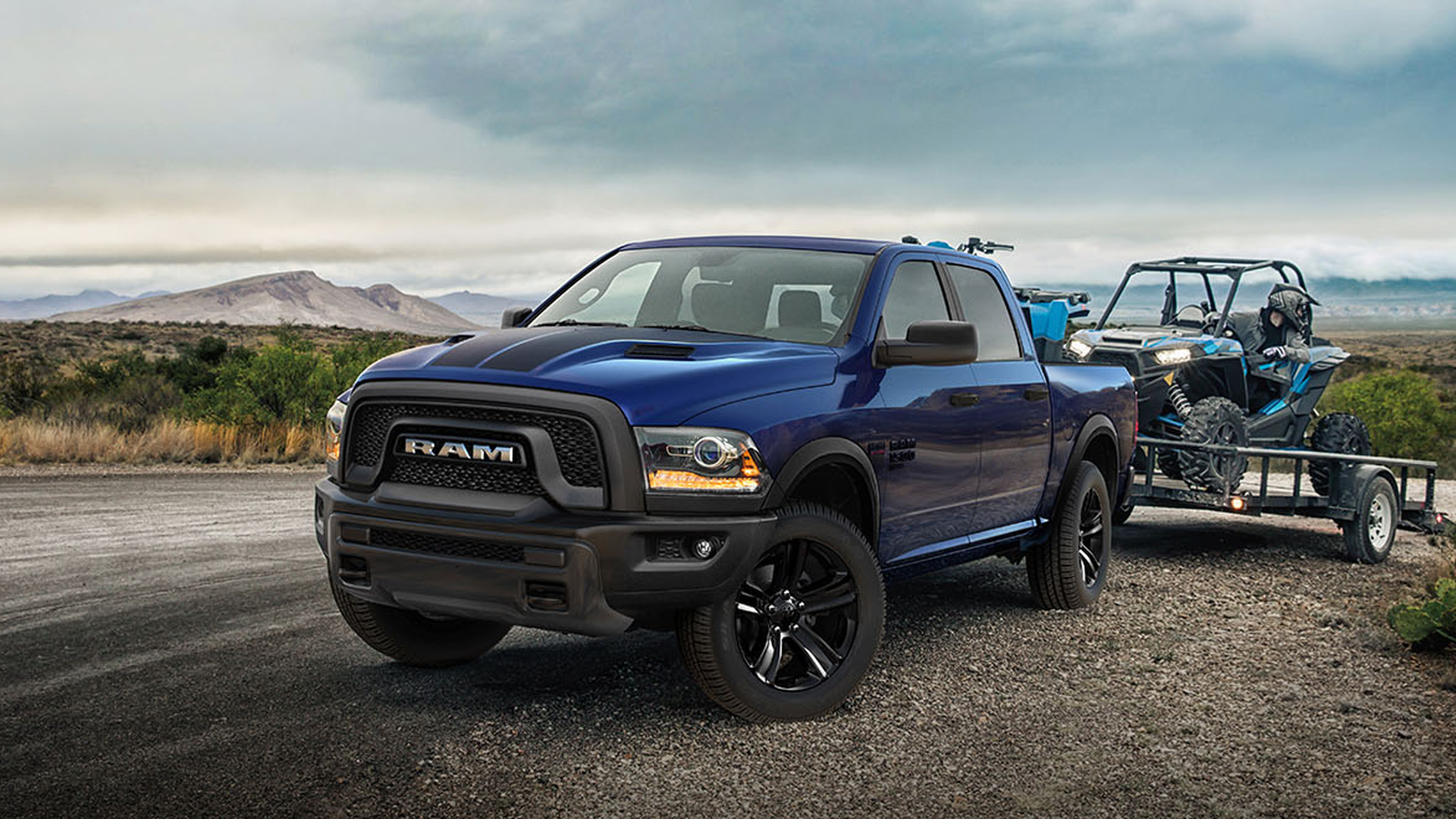
To keep the Classic highly relevant and visually distinct, Ram resurrected a legendary, menacing nameplate from the 1970s: the Warlock. The modern Ram 1500 Classic Warlock trim injected aggressive, custom-truck aesthetics directly from the factory floor. Designers aggressively swapped the traditional crosshair grille for the bold, block-letter grille borrowed from the off-road Rebel trim. Heavy-duty powder-coated front and rear bumpers replaced the standard bright chrome pieces, shrugging off rock chips and brush impacts on the trail.
The Warlock rides confidently on 20-inch semi-gloss black aluminum wheels. Engineers implemented a specific factory suspension lift, raising the ride height by one full inch. This modification comfortably accommodates larger all-terrain tires and vastly improves approach and departure angles for deep-woods excursions. Dark-bezeled projector headlamps, heavy-duty twin-tube shock absorbers, and aggressive hood decals completed the package, creating an imposing, murdered-out stance without requiring expensive aftermarket modifications.
Utilitarian Excellence: The Tradesman
While the Warlock captured retail buyers looking for aesthetic aggression, the Tradesman trim served as the undisputed, unkillable king of the commercial fleet. Ram designed the Tradesman specifically for daily industrial abuse. Unpainted, high-impact composite bumpers reduced expensive repair costs after minor job-site collisions or loading dock impacts. Inside the cabin, heavy-duty vinyl flooring allowed workers to simply hose out thick mud, drywall dust, and debris at the end of a grueling 12-hour shift.
Every single surface inside the Tradesman prioritized relentless durability over soft-touch opulence. The dashboard switchgear, climate controls, and rotary shifter were specifically engineered with heavy detents to be easily operated by a driver wearing thick leather work gloves. Despite its stripped-down nature, the Tradesman retained the heavy-duty engine cooling systems, massive 220-amp alternators, and the robust Torqueflite 8-speed automatic transmission required for relentless, daily maximum-capacity towing.
Cargo Management and Structural Safety
The cargo box of the Classic represents a masterclass in American utility. The bed floor features deeply ribbed, high-strength steel designed specifically to resist denting and puncturing from dropped payloads like cinderblocks, loose gravel, or heavy engine blocks. Buyers requiring maximum secure storage frequently opted for the innovative RamBox cargo management system. Engineers brilliantly utilized the empty, wasted void above the rear wheel wells, integrating illuminated, lockable storage bins directly into the outer bed rails. These secure bins feature massive drain plugs, allowing contractors to safely store muddy tow straps, chains, and wet tools, washing the entire bin out completely with a garden hose later.
Stopping a 5,000-pound truck carrying a maximum payload requires serious thermal capacity and structural integrity. The Classic utilizes massive 13.2-inch vented front brake rotors clamped securely by dual-piston calipers. The Electronic Stability Control system integrates directly with the advanced Trailer Sway Control software. If the onboard gyroscopes detect a heavy trailer beginning to violently oscillate at highway speeds due to crosswinds, the computer automatically reduces engine torque and applies asymmetric braking pressure to individual truck wheels. This complex action pulls the entire rig back into a straight, controllable line instantly, often without the driver ever needing to touch the brake pedal.
Technical Specifications & Capability
The sheer mechanical capability of the Ram 1500 Classic defined its success across thousands of American job sites. The core specifications highlight a machine built entirely for uncompromising utility.
- Standard Engine (Pentastar V6)
- A 3.6-liter naturally aspirated V6 producing 305 horsepower and 269 lb-ft of torque, prioritizing extreme long-term fleet reliability.
- High-Output Power (Hemi V8)
- A 5.7-liter V8 generating 395 horsepower and 410 lb-ft of torque, featuring cylinder deactivation to manage fuel consumption during highway transit.
- Maximum Towing Capacity
- Up to 10,610 pounds when properly equipped with the Hemi V8, a 3.92 axle ratio, and the factory Class IV hitch receiver.
- Maximum Payload Capacity
- Up to 1,930 pounds supported directly by the five-link coil rear suspension, ensuring the chassis remains stable under heavy structural loads.
The Final Chapter of an Icon
Stellantis officially announced that the 2024 model year would mark the final production run for the Ram 1500 Classic. As the automotive industry shifts aggressively toward smaller displacement forced-induction engines and fully electric architectures, the era of the straightforward, naturally aspirated iron-block V8 work truck is drawing to a close. The Classic survived far longer than any industry analyst predicted, largely because it delivered exactly what the American worker demanded: a reliable, comfortable, intensely capable machine devoid of unnecessary complexities. The DS platform will be remembered as the chassis that fundamentally changed how trucks ride, permanently cementing the Ram legacy in the history of American manufacturing.