
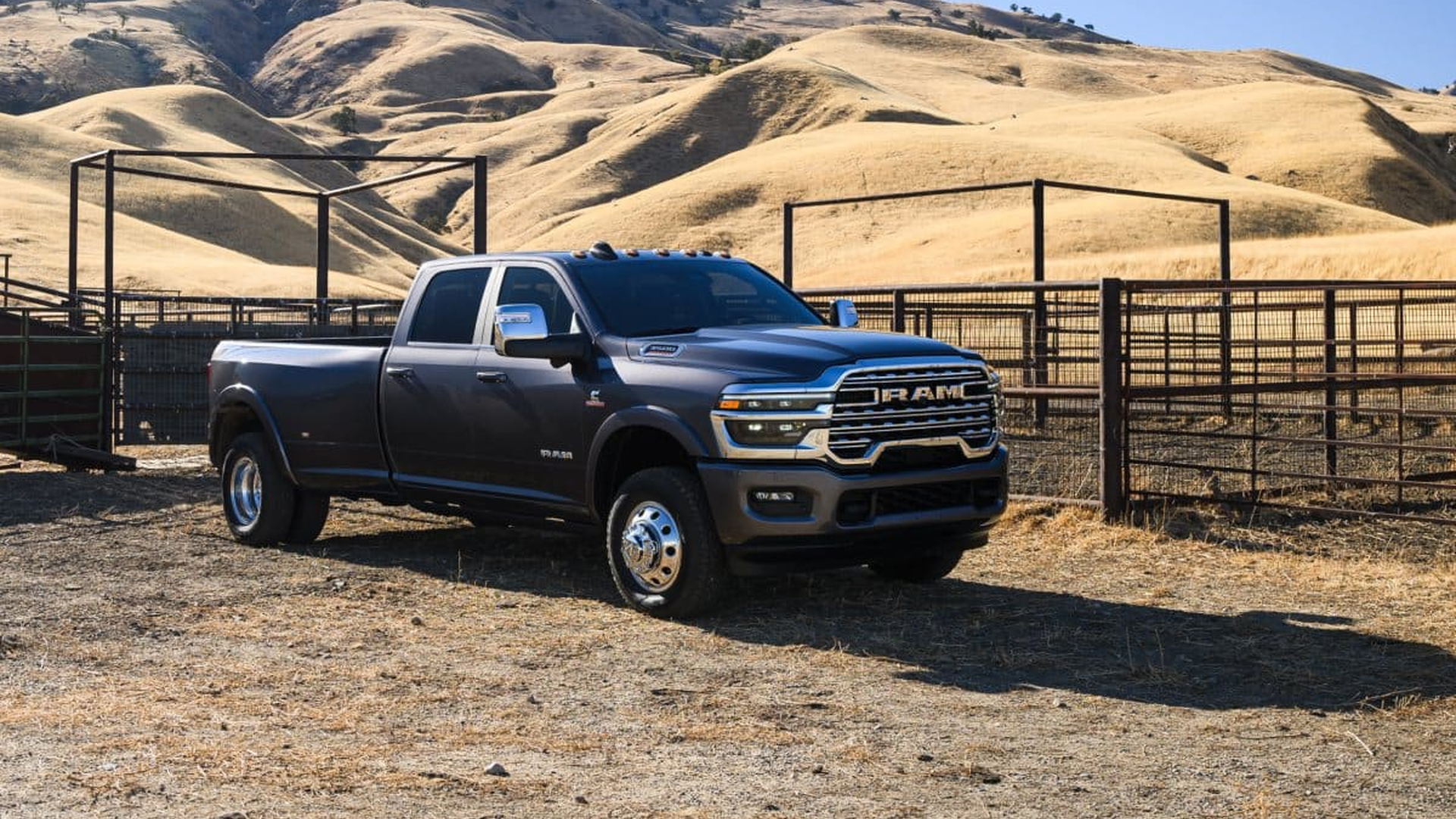
The Anatomy of a Commercial Titan
The one-ton heavy-duty pickup segment exists as an unforgiving battleground where marketing claims instantly evaporate under the crushing reality of actual industrial labor. A vehicle operating in this class must routinely haul massive fifth-wheel trailers, heavy construction equipment, and multi-horse gooseneck trailers across punishing topographical extremes. The Ram 3500 stands as the absolute apex predator of this environment. By prioritizing unyielding structural rigidity, massive dual-rear-wheel traction, and the sheer rotational violence of the Cummins turbodiesel, engineers crafted a machine that defines American commercial capability. It operates simultaneously as a cross-country locomotive and a highly refined mobile command center, absorbing staggering payloads without compromising high-speed highway stability.
The BR/BE Era (1994-2002): Reshaping the Industrial Landscape
Before 1994, Dodge struggled significantly to capture commercial fleet buyers, offering capable but visually uninspiring platforms. The launch of the BR/BE platform completely upended the traditional truck hierarchy. Chief designer Phillip E. Payne drafted a radical exterior profile heavily mimicking Class 8 semi-trucks. The design featured dropped fenders and a massive, prominent crosshair grille that demanded immediate respect on the highway. This aggressive exterior matched the brute force lurking underneath the hood.
Beneath this imposing sheet metal lived the legendary 5.9-liter Cummins 12-valve turbodiesel. This cast-iron inline-six powerplant featured a strictly mechanical Bosch P7100 injection pump, rendering it immune to complex electrical failures. It delivered relentless low-end torque, forging an immediate reputation for million-mile durability. Agricultural operators and hotshot truckers quickly realized this engine could pull immense loads at a mere 1,500 RPM all day without experiencing catastrophic thermal breakdown. The integration of this commercial-grade engine into a consumer chassis fundamentally altered how Americans viewed heavy-duty pickups.
The DR/DH Platform (2003-2009): Common-Rail Refinement
Entering the new millennium, the DR platform introduced vital modernizations to the underlying chassis. Ram engineers implemented fully hydroformed steel frame rails. This high-pressure fluid manufacturing technique eliminated the distinct weak points found in traditional stamped C-channel frames, massively increasing the overall torsional stiffness. A rigid frame prevented the bed from twisting into the back of the cab when navigating uneven job sites with an unbalanced, heavy payload.
In 2003, Cummins transitioned the 5.9-liter engine to a high-pressure common-rail fuel injection system. This significantly improved diesel fuel atomization, drastically reducing the harsh clattering noise associated with early diesels and lowering tailpipe emissions. Facing highly stringent environmental mandates in mid-2007, the engine displacement expanded to 6.7 liters. This larger block introduced a sophisticated variable geometry turbocharger (VGT). The VGT dynamically adjusted internal exhaust vanes to eliminate off-the-line turbo lag and function seamlessly as an integrated exhaust brake, saving the physical brake pads from vaporizing during steep, heavily loaded mountain descents.
The DJ/D2 Era (2010-2018): Escalating the Torque Wars
The DJ platform brought a sharpened aesthetic and the highly coveted Mega Cab configuration, but the true engineering war raged within the powertrain and the rear suspension geometry. While the lighter 2500 model adopted a coil-spring rear suspension to prioritize unladen ride quality, the 3500 rigidly maintained its traditional Hotchkiss leaf-spring setup.
Maintaining the heavy-duty rear leaf springs on the 3500 platform was an absolute necessity; extreme pin weights from massive gooseneck trailers required the progressive, unyielding load-bearing characteristics that only thick steel spring packs could reliably provide over decades of industrial abuse.
To refine the ride quality when the bed was empty, engineers offered an ingenious factory supplemental air suspension. This advanced system utilized heavy-duty pneumatic bladders positioned directly between the frame and the rear axle. When the sensors detected a heavy load dropping onto the fifth-wheel hitch, the onboard compressor automatically inflated the bladders. This action raised the ride height perfectly level to maintain optimal steering geometry and prevent the headlight beams from blinding oncoming traffic. During this era, torque figures began to climb violently as Ram engaged in an all-out arms race against Detroit rivals, pushing the Cummins output well past the 800 lb-ft threshold.
The Current Generation (2019-Present): Shattering the 1,000 lb-ft Barrier
The current iteration of the Ram 3500 fundamentally redefines maximum towing capacity. To break the mythical 1,000 lb-ft torque barrier without instantly destroying the engine block under massive cylinder pressures, Cummins engineers completely redesigned the 6.7-liter architecture. They discarded traditional heavy cast iron for the block, utilizing Compacted Graphite Iron (CGI) instead. This advanced metallurgical process creates a block that is significantly stronger, highly resistant to thermal fatigue, and structurally lighter, pulling critical weight off the front axle.
This High-Output (HO) variant pushes fuel into the combustion chambers at an astonishing 29,000 psi. Upgraded forged connecting rods, lighter aluminum pistons with low-friction rings, and higher-capacity water pumps handle the extreme thermal loads generated when pulling maximum capacity up steep grades. Generating an earth-shattering 1,075 lb-ft of torque, this engine transforms grueling topographical inclines into minor inconveniences. Experience the surreal sensation of pulling a 30,000-pound load up a seven percent grade while maintaining the posted highway speed limit with absolute, unshakeable confidence.
Mastering Rotational Violence: The Aisin Transmission
Standard heavy-duty transmissions instantly shatter when subjected to four-digit torque figures. To manage the rotational violence of the High-Output Cummins, Ram engineers partnered closely with Aisin to utilize the massive AS69RC six-speed automatic transmission. This true commercial-grade gearbox features an immense torque converter, heavily fortified planetary gear sets, and a highly sophisticated transmission control module. It delivers rapid, seamless shifts under extreme structural load, precisely managing kinetic energy to keep the turbodiesel perfectly within its narrow, highly efficient powerband. For the standard-output Cummins, Ram utilizes the proven, internally built 68RFE automatic.
The Dual Rear Wheel (DRW) Advantage and Structural Dynamics
To physically anchor massive fifth-wheel trailers, the Ram 3500 heavily relies on its available Dual Rear Wheel (DRW) configuration. A heavy-duty American Axle & Manufacturing (AAM) rear axle, featuring a massive 12-inch ring gear, routes power to four independent rear tires. This significantly widened footprint drastically increases the lateral stability of the entire rig. When crosswinds strike a massive slab-sided enclosed trailer on the interstate, the "dually" configuration fiercely resists the trailer's attempt to push the rear of the truck sideways. This geometric setup vastly increases the GVWR and provides a critical safety margin. If a rear tire suffers a high-speed blowout, the paired tire maintains the structural load, preventing a catastrophic rollover event.
Industrial Thermal Management and Braking Power
Cooling a rig pushing past a 40,000-pound GCWR requires industrial-scale thermal management. The Ram 3500 features a massive frontal grille opening specifically designed to funnel turbulent air directly into a heavy-duty cooling module. This stack includes an oversized primary radiator, a high-capacity charge-air cooler for the turbocharger, and a dedicated transmission fluid cooler. Dual heavy-duty alternators provide up to 440 amps of electrical current to run auxiliary trailer equipment, massive light bars, and powerful snowplow hydraulic pumps without draining the dual battery setup.
Stopping this immense kinetic mass requires equally serious hardware. The chassis utilizes massive 14.17-inch vented brake rotors at all four corners, clamped fiercely by twin-piston calipers. This massive swept area absorbs and dissipates extreme heat rapidly, eliminating deadly brake fade during repetitive heavy braking events.
The 6.4L Hemi V8: Maximizing Payload Capacity
While diesel dominates the heavy towing conversation, commercial fleet operators prioritizing pure payload capacity frequently spec the Ram 3500 with the 6.4-liter Hemi V8. Displacing 6,424 cm3, this naturally aspirated block avoids the massive weight penalty of the heavy diesel engine and its associated emissions equipment. This weight reduction directly increases the physical amount of weight the bed can legally carry. Generating 410 horsepower and 429 lb-ft of torque, the Hemi pairs exclusively with a ZF-sourced 8HP75 eight-speed automatic transmission. It utilizes variable valve timing and cylinder deactivation technology to optimize urban fuel efficiency, dropping seamlessly to four cylinders to reduce CO2 output under light throttle loads.
An Uncompromised Mobile Command Center
The interior of the modern 3500 aggressively blurs the line between commercial equipment and ultra-luxury sedans. High-tier trims like the Limited and Tungsten feature genuine leather seating with intricate, saddle-inspired stitching, real open-pore wood accents, and brushed aluminum trim. Active noise cancellation systems and acoustic laminated glass eradicate the aggressive clatter of the diesel engine, creating an isolated, serene environment. The massive 12-inch Uconnect display provides highly detailed navigation, seamless smartphone integration, and highly advanced trailer telemetry.
Engineers deeply integrated smart towing technology to reduce operator fatigue. The truck features a digital rearview mirror that displays an unobstructed camera feed from the back of the trailer, eliminating massive blind spots. An advanced Trailer Reverse Steering Control system allows the driver to back up a massive rig simply by turning a small dial on the dashboard, with the computer calculating the exact steering inputs required to place the trailer perfectly on the mark.
Technical Specifications & Heavy-Duty Capability
The engineering depth of the Ram 3500 is best understood through its raw, unyielding specifications. Buyers must carefully configure cab, bed, axle ratio, and engine choices to achieve these maximum metrics.
- Standard Powertrain (6.4L Hemi V8)
- A naturally aspirated heavy-duty V8 producing 410 horsepower and 429 lb-ft of torque. Prioritizes maximum payload capacity and lower initial purchase costs for commercial fleets.
- Standard-Output 6.7L Cummins Turbodiesel
- Generates 370 horsepower and 850 lb-ft of torque. Mated to the 68RFE six-speed automatic transmission, providing an optimal balance of intense pulling power and daily drivability.
- High-Output 6.7L Cummins Turbodiesel
- The undisputed king of the lineup, producing 420 horsepower and a staggering 1,075 lb-ft of torque. Paired exclusively with the Aisin AS69RC heavy-duty six-speed automatic transmission.
- Maximum Towing Capacity
- An astonishing 37,090 pounds when configured as a Regular Cab DRW with the High-Output Cummins, Max Tow Package, and a fifth-wheel hitch.
- Maximum Payload Capacity
- Up to 7,680 pounds when equipped with the lighter 6.4L Hemi V8 in a Regular Cab DRW configuration, supported directly by the massive rear leaf springs.
The Legacy of the One-Ton Ram
The Ram 3500 successfully bridged the massive gap between commercial-grade semi-trucks and consumer-friendly pickups. It forced an entire industry to elevate its engineering standards, proving that a truck capable of hauling 37,000 pounds can still offer an interior trimmed in premium leather and acoustic glass. Through decades of punishing industrial use, continuous metallurgical advancements, and the relentless evolution of the Cummins turbodiesel, the Ram 3500 cemented its legacy as the definitive American workhorse. It stands ready to conquer any task assigned, delivering raw power and sophisticated control in equal, massive measure.