Clio
The quintessential European supermini and a perennial best-seller. The Clio is the heart of the Renault brand, but its legendary, mid-engine, rear-wheel-drive V6 version is an insane 'hot hatch' unicorn. The R.S. models are true pocket rockets.
Renault is a giant of French industry with a complicated US history. Remembered for the quirky "Le Car" and the disastrous partnership with AMC, they are often misunderstood here. Globally, however, they are the pioneers of Formula 1 turbo technology and creators of the legendary R5 Turbo.
Explore the current production vehicles.
The quintessential European supermini and a perennial best-seller. The Clio is the heart of the Renault brand, but its legendary, mid-engine, rear-wheel-drive V6 version is an insane 'hot hatch' unicorn. The R.S. models are true pocket rockets.
A revolutionary supermini and a 70s design icon. The R5 was a brilliant piece of packaging, but its legendary R5 Turbo version, with its engine in the back seat and wild widebody, was a Group B rally monster for the road. An absolute legend.
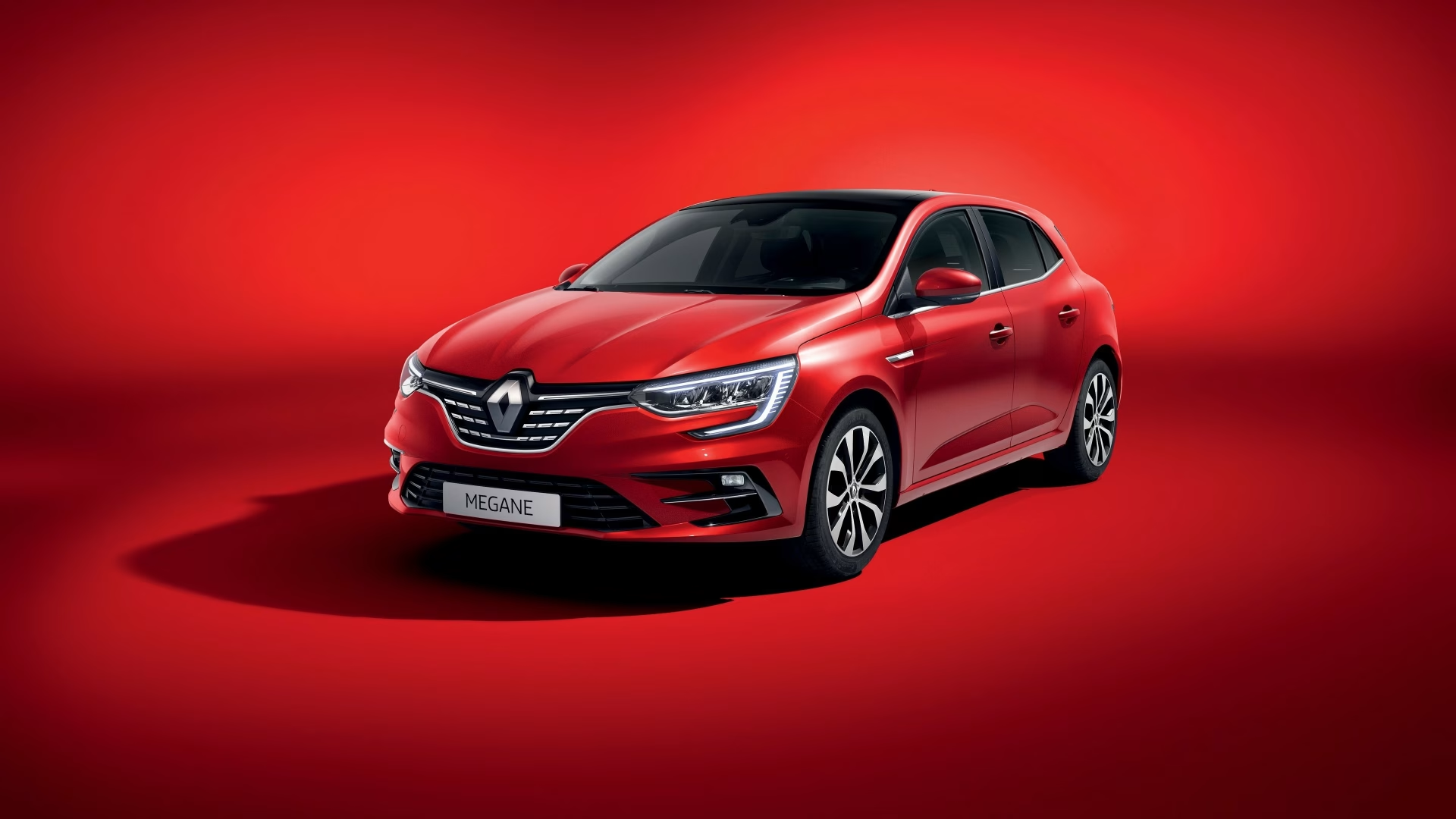
The backbone of the Renault family car lineup. The Mégane has always pushed design boundaries, but its Renault Sport (R.S.) versions are the stars. These are some of the finest-handling and most-revered hot hatches ever made, consistently setting Nürburgring records.
The vehicle that invented the European MPV (minivan) segment. The original Espace was a revolutionary 'one-box' design that prioritized interior space and versatility. The legendary, F1-V10-powered 'Espace F1' concept is a true automotive fantasy.
The cheerful, clever, and unmistakably French city car. The original Twingo was a masterpiece of minimalist design and packaging, with a friendly 'face' and a sliding rear seat that created incredible interior space. A true design icon.
The legendary rally-winning sports car, reborn. The original A110 was a giant-killing, rear-engine marvel. The modern version is a lightweight, mid-engine masterpiece that offers one of the purest and most agile driving experiences in the world.
The simple, utilitarian, and utterly indestructible 'blue jeans' car. The Renault 4 was a masterpiece of functional design, a go-anywhere, do-anything car for the people. It is one of the best-selling French cars in history, a true national icon.
The charming and stylish rear-engine sedan that was a massive global success for Renault in the post-war era. While not known for performance, its elegant design and affordability made it one of the most popular European imports in America during the 1950s.
A radical, no-compromise, open-top sports car built by Renault Sport. The Spider was a lightweight, aluminum-chassis machine with dramatic scissor doors, designed for pure, unfiltered driving pleasure. An incredibly rare and focused enthusiast's car.
A bizarre and brilliant failure; a three-door 'coupe-space.' The Avantime was a futuristic, pillarless luxury MPV-coupe, an audacious design experiment that was decades ahead of its time. A true cult classic for lovers of automotive oddities.
The futuristic, bubble-backed sport coupe of the 1980s. The Fuego was a bold design statement and one of the first cars to feature remote keyless entry. The Turbo model brought a dose of European performance to American shores in the early 80s.
Author
HugeGarage Editor
Published
Updated
To the average American over 50, Renault brings up memories of a tiny, boxy car with the word "Le Car" painted on the side. This was the US version of the Renault 5.
Sold through AMC dealerships, Le Car was initially a hit during the gas crisis because it sipped fuel and had a ride smoother than most American land yachts. But it was fragile. Rust and electrical gremlins turned the French dream into a mechanicâs nightmare, tarnishing the brandâs reputation in the States for decades.
While Americans were struggling to start their Le Cars, Renault was changing the world of racing. In 1977, they entered Formula 1 with the "Yellow Teapot." It was the first turbocharged F1 car. Everyone laughed when it blew up, but soon, everyone was copying them. Renault effectively invented the modern era of turbocharging.
The coolest thing Renault ever did was the R5 Turbo (1980). They took the boring front-wheel-drive Renault 5, threw the back seats in the trash, and put a turbocharged engine where the passengers used to sit.
It became a mid-engine, rear-wheel-drive monster with hips wider than a Kardashian. It was built to win rallies, and it remains one of the most coveted hot hatches in history.
In the 80s, Renault actually bought American Motors Corporation (AMC). This led to the Renault Alliance, a car built in Wisconsin. It famously won Motor Trend's Car of the Year in 1983, a decision that history has not been kind to. The Alliance was plagued by reliability issues.
Fun Fact: When Renault gave up on the US in 1987, they sold AMC to Chrysler. This sale included a little brand called Jeep. So, in a way, we have the French to thank for the modern Jeep Wrangler.
Technically, Renault beat Chrysler to the minivan punch in Europe with the Espace. It looked like a high-speed train (TGV) and proved that family haulers could be futuristic.
If you want to drive a Renault in the US today, you are looking at imports:
Renault is a brand of extreme highs and lows. They built some of the worst cars ever sold in America, but also some of the best race cars ever driven in Europe.
As of 2026, Renault does not officially sell new passenger cars in the USA. The brand withdrew from the American market in the late 1980s. However, through the Renault-Nissan-Mitsubishi Alliance, much of Renault's engineering and platform technology is available in the US under the Nissan and Mitsubishi badges.
For those seeking the authentic French experience, the 2026 Renault 5 E-Tech and Renault 4 E-Tech are available in neighboring international markets, and there are ongoing discussions regarding the Alpine brand's entry into the US market by 2027 using Renault-derived EV architectures.
The 25-year import rule makes 2026 a landmark year for Renault enthusiasts. Vehicles manufactured in 2001 are officially eligible for permanent import. Key models reaching eligibility include:
These cars can be imported without meeting modern FMVSS guidelines, provided they are over 25 years old at the time of entry.
The 2026 Renault 5 E-Tech is a retro-modern electric hatchback inspired by the classic R5. It features a 52 kWh battery providing a range of up to 250 miles (WLTP). Its electric motor produces 150 hp, enabling a 0-62 mph time of under 8 seconds.
Technical highlights include a multi-link rear suspension (rare for its segment) and V2G (Vehicle-to-Grid) technology, allowing the car to feed electricity back into the home gridâa feature highly relevant to the growing smart-home market in the USA.
The CMF (Common Module Family) platforms, developed primarily by Renault, underpin several popular US models. For example, the technology found in the Renault Austral and Espace is closely related to the platform used for the Nissan Rogue and Mitsubishi Outlander.
Additionally, Renaultâs expertise in small-capacity turbocharged engines and E-Tech hybrid systems often serves as the global blueprint for the Allianceâs fuel-efficient offerings across North America.
The Renaulution is a strategic plan to shift Renault from a volume-focused automaker to a tech-driven mobility company. In 2026, this focuses on Ampere, Renaultâs dedicated EV and software division. The goal is to reduce EV production costs by 40% while launching high-tech models like the Renault 4 E-Tech SUV.
This plan also emphasizes "Software Defined Vehicles" (SDV), which allows for over-the-air updates to performance, range management, and infotainment systems, similar to the technology seen in leading US electric brands.
Yes, the 2026 Renault 4 E-Tech is an all-electric compact crossover designed to pay homage to the original "4L." It features a rugged design, 18.1 cm of ground clearance, and up to 1,405 liters of cargo space. It utilizes a 150 hp motor and a 52 kWh battery, making it a functional rival to modern electric subcompacts.
US fans of the original R4 appreciate its practicality and retro-chic aesthetic, though it remains an "import-only" dream for the time being.
While Renault left the US decades ago, a dedicated community still supports classic models like the Le Car (R5) and the Renault Alliance. Parts can often be sourced through specialized retailers like Parts Geek or RockAuto, which still carry components for the 1.4L engines.
For more specific items, US owners often connect with the Renault Owners Club of North America or source parts from Renault Canada, where the brand had a more prolonged presence.
The Renault Clio V6 is considered a "Holy Grail" for American hot hatch collectors. Because it was never sold in the US, early 2001 Phase 1 models are now reaching the 25-year eligibility for import in 2026.
With its 3.0L V6 engine mounted where the rear seats should be, it produces 230 hp and features a widebody design that stands out at any American car meet. Pristine examples are currently seeing significant value appreciation at international auctions.
In 2026, Renaultâs racing heritage continues through the Alpine F1 Team. While the team is branded as Alpine, the power unit is developed by Renault Group at their specialized facility in Viry-Châtillon. The 2026 season introduces new regulations focusing on increased electrical power and sustainable fuels.
This F1 involvement serves as a high-speed laboratory for the E-Tech technology found in Renault's road-going hybrid and electric vehicles, emphasizing efficiency and energy recovery systems.
The Human First program is Renaultâs commitment to improving road safety through advanced technology. In 2026, this includes Safety Score and Safety Coach systems that analyze driving data to provide real-time feedback.
A standout feature is the Fireman Access, a special QR code on the windshield that allows first responders to immediately identify the battery location and structural points of an EV, a safety innovation that is being closely watched by US safety regulators.