Smart: The Watch That Became a Car

Smart is the result of a wild idea: What if the company that makes Swatch watches built a car? A joint venture between Swatch and Mercedes-Benz produced the Fortwo, a car small enough to park perpendicularly to the curb. Famous for its Tridion Safety Cell and interchangeable plastic body panels, it is the ultimate urban tool.

Smart Hero Vehicle

Model Lineup

Explore the current production vehicles.

Fortwo

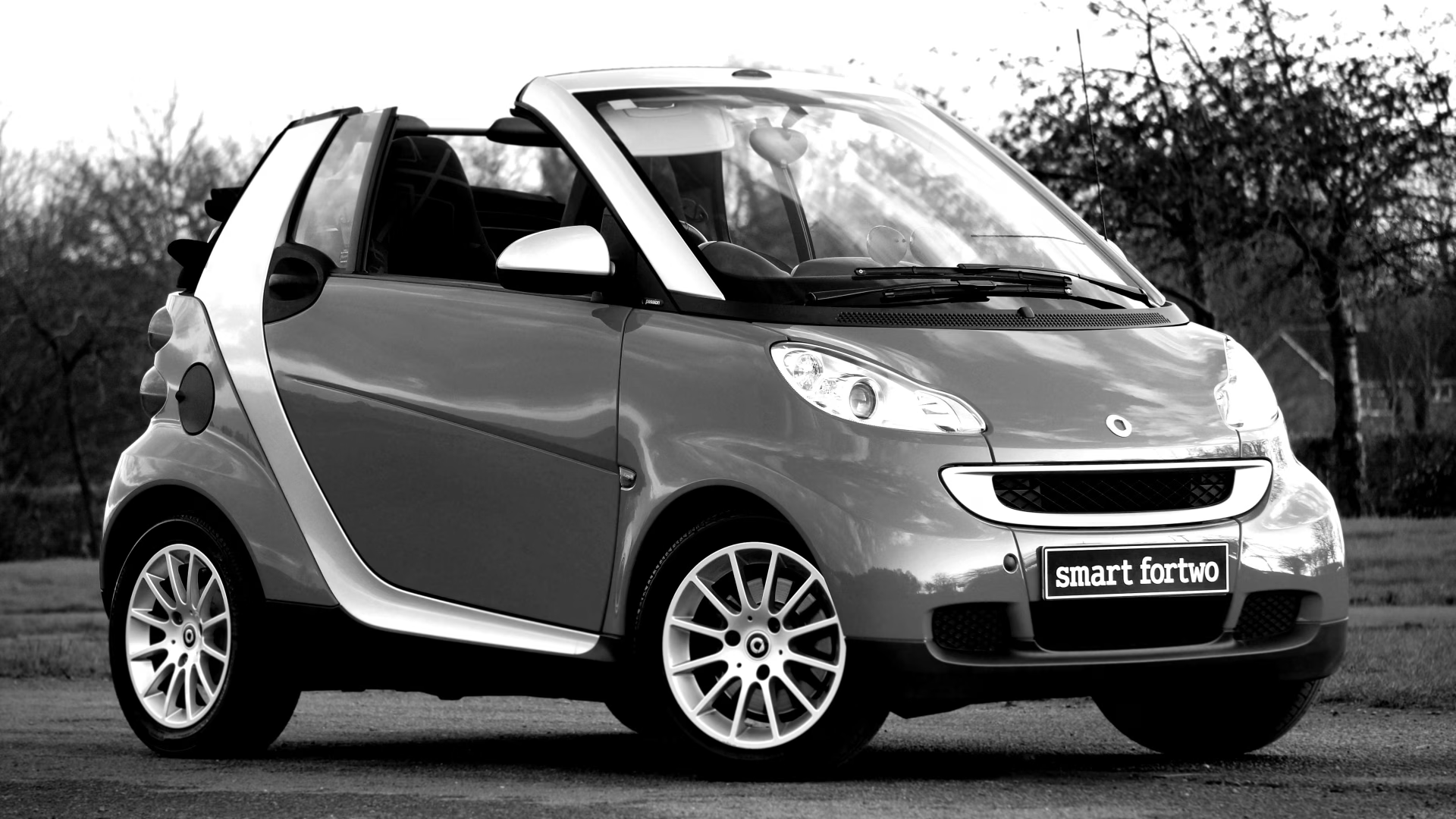
The icon. The original. The car that could park nose-to-curb. The Fortwo was a revolutionary two-seat city car, a masterpiece of packaging and safety engineering with its Tridion safety cell. It is the undisputed symbol of modern urban mobility.

Production 1998-2024

#1

The brand, reborn. The #1 is a stylish, all-electric compact SUV that represents the future of Smart under the new Mercedes-Benz and Geely joint venture. The Brabus version is a true, 422-horsepower electric 'hot hatch' in disguise.

Production 2023-Present

#3

The sleek and aerodynamic 'SUV Coupe' from the new Smart. The #3 takes the platform of the #1 and wraps it in a stunning, fastback-style body, offering a more emotional and design-focused take on the brand's electric future.

Production 2023-Present

Forfour

The 'Smart for four.' The Forfour translated the brand's clever design philosophy into a more practical four-seat package. The final generation was a unique and incredibly agile rear-engine city car, co-developed with the Renault Twingo.

Production 2004-2006, 2014-2019

Roadster / Roadster-Coupé

A brilliant and beloved cult classic. The Roadster was a tiny, featherweight, mid-engine sports car that delivered one of the purest, most fun-to-drive experiences of the 2000s. A true 'junior supercar' and a masterpiece of minimalist fun.

Production 2003-2005

Crossblade

The most extreme and radical Smart ever made. The Crossblade was a limited-edition speedster with no roof, no doors, and no windshield. A pure, unfiltered expression of automotive fun and a highly sought-after collector's item.

Production 2002-2003

Author

HugeGarage Editor

Published

Updated

5 Min Read

S-M-ART: Swatch Mercedes Art

The name tells the whole story. Swatch (the Swiss watchmaker) + Mercedes + Art = Smart.
In the 90s, Nicolas Hayek of Swatch wanted to build a "Swatchmobile"—a cheap, stylish, eco-friendly city car with interchangeable panels like watch straps. Volkswagen passed on the idea, but Mercedes-Benz said yes. The result was the Smart City-Coupe (later called the Fortwo), launched in 1998.

The Tridion Safety Cell: The Nutcracker

Americans were terrified of the Smart. "If I hit a truck, I'm dead," they said. Smart proved them wrong with the Tridion Safety Cell.

  • The Tech: The car is built around an incredibly rigid high-strength steel cage (usually painted silver or black on the exterior).
  • The Physics: It acts like a hard nut. In a crash, it doesn't crumple; it bounces. While this transfers more G-force to the passengers, it prevents the cabin from collapsing. Smart famously crashed a Fortwo into a Mercedes S-Class at 30 MPH, and the Smart's door still opened.

The Parking Superpower

The Smart Fortwo is only 8.8 feet (2.69 meters) long. For context, a Ford F-150 is about 20 feet long.
This allows for a unique superpower: Perpendicular Parking. In many European cities (and some daring US spots), a Smart can park nose-in to the curb in a parallel parking spot, taking up half the space of a normal car.

The Achilles' Heel: The Transmission

The early Smart cars (especially the 450 and 451 generations sold in the US) had one major flaw: the Automated Manual Transmission. It was a single-clutch system that shifted gears with a painful, slow lurch. It created the infamous "Smart Nod"—every time the car shifted, the passengers' heads would bob forward. It wasn't fixed until the 453 generation introduced a proper dual-clutch gearbox.

The Electric Future

Smart was always destined to be electric. The gas engines were just a placeholder. Today, the brand has ditched internal combustion entirely. Now a joint venture between Mercedes and Geely, Smart builds only EVs (like the Smart #1), finally fulfilling the original eco-friendly promise.

The Hugegarage Verdict

Smart is a specialized tool. Buying a Smart to drive on the freeway is like trying to cut a steak with a spoon. But in a congested city like New York or San Francisco, it is a cheat code. It fits in gaps that don't exist for other drivers. It is the most logical illogical car ever made.

Frequently Asked Questions

Are Smart cars safe despite their small size?

Yes, Smart cars are surprisingly safe due to the Tridion Safety Cell.

This hemispherical steel "cage" (often visible as the contrasting color on the car's exterior) acts like a hard nut shell, protecting the interior cabin from deformation during an impact. This rigid structure, combined with advanced energy-absorbing crash boxes, has allowed the Smart Fortwo to achieve high crash test ratings comparable to much larger sedans.

What does the name "Smart" stand for?

The name is actually an acronym derived from the brand's founders: Swatch Mercedes ART.

The project began as a collaboration between the Swiss watchmaker Swatch (Nicolas Hayek) and Mercedes-Benz, with the goal of creating an ultra-compact, stylish, and fuel-efficient city car "art" project.

Can you drive a Smart Fortwo on the highway?

Yes. Despite their city-car reputation, Smart cars are fully highway legal and capable.

The gasoline models have a top speed electronically limited to roughly 90-96 mph. While the short wheelbase makes them feel busier over bumps and more susceptible to strong crosswinds than a large SUV, they are perfectly stable at legal highway speeds.

Why did Smart leave the US market?

Smart ceased sales in the US and Canada after the 2019 model year.

The decision was driven by the high cost of homologating the new European models for US safety standards and declining sales. As American buyers shifted heavily toward large trucks and SUVs, the niche market for a two-seat electric microcar became too small to sustain a dealership network.

Is the Smart car electric?

The brand has fully transitioned to electric power. In 2018, Smart became the first traditional car manufacturer to announce a switch to 100% electric drive (EQ models).

The newer generation, developed under a joint venture between Mercedes-Benz and Geely (such as the Smart #1 and #3), are exclusively battery-electric SUVs and crossovers.

Where is the engine located in a Smart Fortwo?

The Smart Fortwo features a Rear-Engine, Rear-Wheel Drive layout.

The compact 3-cylinder engine sits directly under the trunk floor in the back. This design maximizes interior legroom by eliminating the front engine bay and improves traction, similar to the layout of a Porsche 911 (though with significantly less horsepower).

Can you tow a Smart car behind an RV?

Yes. The Smart Fortwo is one of the most popular "dinghy" or "toad" vehicles for RV owners.

Specifically, the gasoline models (2016 and newer with the dual-clutch transmission) generally require a battery disconnect switch to be flat-towed (all four wheels down). Older automated-manual models are also popular flat-tow choices, making them a common sight at campgrounds.

What is the Smart Crossblade?

The Smart Crossblade (2002) is a rare, limited-edition collector's car.

It has no roof, no doors, and no windshield (only a small wind deflector). It was designed as an open-air beach buggy. Only 2,000 were made, and the interior was designed to be completely waterproof so owners could hose it down after driving.

Why does the transmission shift slowly in older Smart cars?

Early Smart cars (2008-2015 in the US) used an Automated Manual Transmission (AMT).

It is a manual gearbox operated by a computer, not a traditional automatic with a torque converter. This resulted in a distinct "rocking" motion between gears. Owners often learn to lift off the gas pedal slightly during shifts to smooth out the ride, a technique not needed in the newer Dual-Clutch (DCT) models.

Who owns the Smart car brand now?

Smart is currently a 50/50 Joint Venture between Mercedes-Benz (Germany) and Geely (China).

Under this partnership, Mercedes-Benz handles the design and styling, while Geely handles the engineering and manufacturing in China. This collaboration produced the new, larger Smart #1 electric SUV.