In the rarefied air of the hypercar world, names like Bugatti, Koenigsegg, and Pagani reign supreme. They have heritage, massive budgets, and armies of engineers. Then, there is a guy named Jerod Shelby in Richland, Washington, working out of a glorified hangar, who looked at the speedometer of a Bugatti Veyron and said, "We can beat that." SSC North America (formerly Shelby SuperCars) is the David to the industry's Goliaths. They don't build luxury tourers; they build land-based missiles designed to alter the rotation of the earth.
The Name: No, Not That Shelby
Letâs get the disclaimer out of the way immediately: Jerod Shelby is not related to Carroll Shelby.
But the coincidence is almost poetic. Like Carroll, Jerod is an American obsessed with speed who took on the European establishment. SSC is a boutique operation. They don't have a test track in Germany or a wind tunnel in Maranello. They use closed highways in Nevada and runways at the Kennedy Space Center. This "garage builder" ethos makes their achievements even more terrifyingly impressive.
The First Strike: Ultimate Aero
In 2007, the automotive world was bowing down to the Bugatti Veyron. It seemed unbeatable.
Then, SSC rolled out the Ultimate Aero TT. It looked like a doorstop. It had no traction control. It had no ABS. It was powered by a Twin-Turbo Chevrolet V8 making 1,183 horsepower.
On a closed stretch of Highway 221 in Washington, it averaged 256.18 mph, officially stealing the Guinness World Record from Bugatti. It was a shock to the system. A car built in America, costing a fraction of the Veyron, had dethroned the king. It put SSC on the map forever.
The Masterpiece: Tuatara
After the Aero, SSC went quiet for a decade to develop its successor: the Tuatara (named after a New Zealand reptile with the fastest molecular evolution of any living animal).
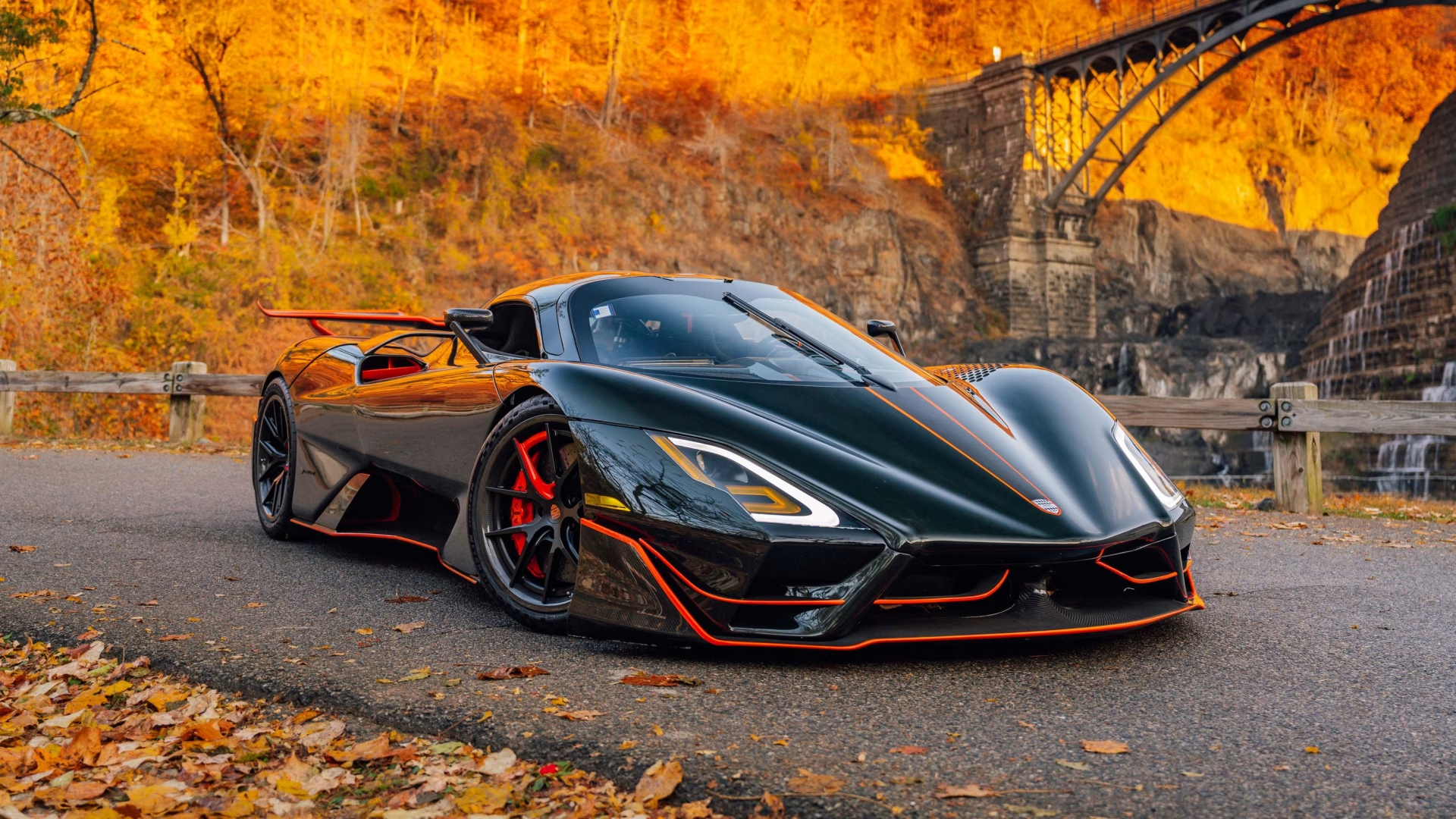
Designed by Jason Castriota (who penned the Ferrari 599), the Tuatara is an aerodynamic masterpiece with a drag coefficient of just 0.279. Unlike the brutalist Aero, the Tuatara is beautiful. It looks like a fighter jet wrapped in shrink wrap.
The Engine: Nelson Racing Sorcery
The heart of the Tuatara is a bespoke 5.9L Twin-Turbo V8 developed in collaboration with Tom Nelson of Nelson Racing Engines.
The Stats:
- 1,350 horsepower on 91 octane pump gas.
- 1,750 horsepower on E85 ethanol.
- 8,800 RPM redline.
This isn't a lazy truck engine. It is a flat-plane-crank-style screamer (though technically a cross-plane with unique firing order) that sounds like a chainsaw tearing through the fabric of reality. It sends all that power to the rear wheels via a CIMA 7-speed automated manual transmission that shifts in under 100 milliseconds.
The Controversy and The Redemption
SSCâs history includes a chapter of drama that would make a Netflix documentary.
In October 2020, SSC claimed the Tuatara hit 331 mph on a Nevada highway. The internetâspecifically YouTubers and math nerdsâanalyzed the footage and found discrepancies. The speed didn't match the GPS data.
Instead of hiding, Jerod Shelby did something rare: He apologized. He admitted the data was messy and the video was flawed. He promised to re-run the car.
The Redemption: In January 2021, at the Kennedy Space Center, with independent redundant GPS verification (Racelogic, Garmin, LifeRacing), the Tuatara hit a two-way average of 282.9 mph. later improving to 295 mph in 2022. While it wasn't 331, it was undeniably faster than the Koenigsegg Agera RS. It proved the car was real, erasing the doubt and cementing SSCâs integrity.
The Variants: Striker and Aggressor
Because 1,750 hp is apparently "not enough" for some people, SSC introduced two new trims.
The Striker: Focuses on downforce. It has a massive rear wing, dive planes, and a diffuser that generates 1,100 lbs of downforce at 160 mph. It is designed for track lap times, not just top speed.
The Aggressor: This is the track-only psychopath. It is not street legal. It has a stripped interior and an upgraded engine option that pushes power to 2,200 horsepower. It is essentially a rolling suicide note for the untrained driver.
The Experience: Analog Terror
Driving an SSC is not like driving a Bugatti Chiron. A Chiron is insulated, heavy, and stableâyou can do 200 mph with one hand on the wheel.
An SSC Tuatara is visceral. It weighs nearly 1,500 lbs less than a Chiron. It is rear-wheel drive. When the turbos spool, the acceleration is violent. It requires respect. It connects the driver to the road in a way that modern computerized hypercars have forgotten. It is the spiritual successor to the analog supercars of the 90s, just with double the horsepower.
Why SSC Matters to You
You respect SSC because they are the ultimate expression of American ambition. They don't have a parent company like VW or Rimac to bail them out. Every car they sell funds the next one.
Owning an SSC is a statement that you value raw potential over brand heritage. It is for the collector who wants the absolute peak of internal combustion performance before the world goes silent and electric.
The Hugegarage Verdict
SSC North America is a miracle of the automotive world. They survived the financial crisis, they survived a PR nightmare, and they emerged with the fastest production car on the planet. The Tuatara is a technological marvel that proves you don't need a billion dollars to break the laws of physics; you just need a hangar in Washington and the will to go faster than anyone else.